By Alan Brown
The second census to cover the whole of England and Wales took place on 30th March 1851. While it does not yet contain the same level of detail that would be achieved in later years, it provides a valuable picture of life in the parish of Llanstadwell in the period just before the coming of the railway. At that time the majority of the inhabitants lived in four communities that were geographically separate: (1) the original village of Neyland, which occupied the strip of land on the west bank of Westfield Pill, which is now the site of the Marina (the map below inaccurately places the name ‘Neyland’ on the east bank of the Pill); (2) the waterside settlement on the land that now runs from Church Lakes down to the Ferry House Inn. In the 1851 census, the term ‘Llanstadwell’ was used to refer to the whole of the parish, so instead it categorises these houses as Hazelbeach and Church Road; (3) the villages of Great and Little Honeyborough, which had existed since Norman times or earlier, and (4) the village of Waterston.
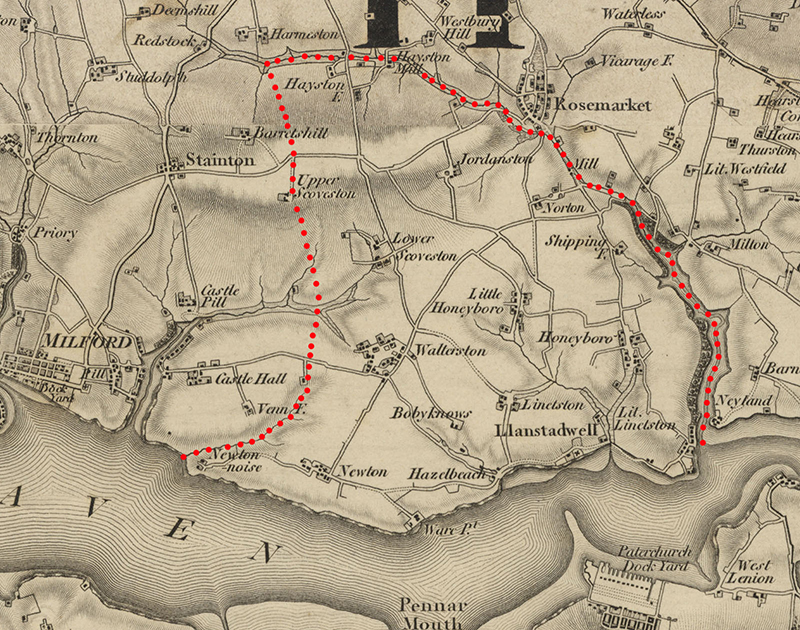
There were also smaller hamlets that centred on some of the principal farms in the parish: the names of several of these, ending in ‘ton’, suggest that they had been established in the early days following the Anglo-Norman-Flemish incursions in the 12th century, in many cases, the first element would have been the name of the Norman-era lord of the manor, hence Leonards-ton (Linetston on the above map), Jordans-ton and Walters-ton (now spelt Waterston).
The census gives the total population of Llanstadwell as 905, of whom 882 had been born in Wales: 873 being natives of Pembrokeshire. 428 were males, and 477 were females. Unsurprisingly, in the pre-railway days, most people lived their whole lives close to the place where they had been born. The main population clusters were:
Neyland 167; Hazelbeach & Church Road 148; Waterston 131; Great Honeyborough 96; Little Honeyborough 48.
Lesser communities:
Mastlebridge & Cants Hill (an old name for the houses on the lane north of the crossroads) 44; Wear (a now-vanished hamlet at Wear Point) 22; Jordanston 17; White Rock (former quarrymen’s cottages on the lane from Hazelbeach to Waterston, long demolished) 17; Newton (a medieval manor house & farm on land to the west of Hazelbeach, now demolished and occupied by Dragon LNG) 14; Limpin Hill (an old name for the land that slopes up from the present-day Trafalgar Terrace) 13.
The remainder of the population of Llanstadwell would have lived in isolated cottages sprinkled throughout the parish.
Many of the men of Llanstadwell parish worked either on the land or in sea-based occupations. The total number of men aged 14 or over was 256. Of these, 89 were described as farmers, farm bailiffs or farm labourers, while 44 either worked, or were retired from, various occupations in the shipbuilding trade; this census does not distinguish between the Royal Naval Dockyard in Pembroke Dock and the smaller private boatyards that were working on the northern shore of the Haven. One attraction to working in the government dockyard, as well as the army and navy, was the fact that a long period of service would be rewarded with a pension and therefore a degree of security in old age; the old age pension would not become a feature of British society until 1908. Another 22 men were classified as mariners, sailors, watermen, boatmen and ferrymen: either working or retired.
The remainder of the workforce was mostly employed in practical trades. There were three blacksmiths, plus one apprentice; this was a time before mass production, when many metal goods would have had to be made locally. 17 men worked in building and construction, with nine as joiners or carpenters, plus one cabinet maker; the other seven were described as masons or stonemasons: this was a broad grouping, and included what we would now class as bricklaying.
The requirements of the parish supported four butchers, three millers and one grocer; also a draper, two tailors and three shoemakers. Three men worked as gardeners, and one as a groom: this was a time when poor people walked, while the affluent members of society were conveyed by horses. There were three men described as ‘land proprietors’: Robert Child of Newton; William Rainbolt of Limpin Hill, and George Parry senior of Honeyborough House, who would later use some of his land for the construction of the houses in Charles Street and James Street, which are marked on late 19th century maps as ‘Parryville’. Two elderly gentlemen, William Hitchings and John Bowen, were ‘schoolmasters’, possibly at the Neyland Ferry School. George Parry junior, also of Honeyborough House, was a solicitor.

There were few age restrictions regarding employment at that time. Two 12 year old boys were recorded as working: one as a servant, and one as an apprentice carpenter. One 13 year old was a servant at Norton Farm. At the other extreme: the oldest inhabitant was 90 year old John Rogers of Neyland, who was described as a ‘publican’.
In 1851, employment for women outside of the home was practically unheard of. For married women, running the household was then a full-time occupation; alternatively, many unmarried women worked in domestic service, cleaning and cooking in somebody else’s home. A popular source of income for young women was dressmaking; nearly all clothing would have been locally made at that time, and ten local girls were providing this service. A mother and her two daughters in Mastlebridge were ‘straw milliners’, earning a living by making the straw hats which were then commonly worn outdoors by women.
Most women, therefore, were dependent on their husband’s income, and the loss of this would be the cause of immediate poverty. 27 of the adult women in the parish were widows: 12 of these were classed as ‘paupers’, meaning that they had no income apart from outdoor parish relief. The youngest of these was just 30 years old. Two were fortunate to be receiving pensions from their husbands’ employers: one from the Royal Navy, and one from the Dockyard.