By Carol Elliott
This article is drawn from the work of Desmond N. Davies, The End of the Line: A History of Neyland, Richard Parker, The Railways of Pembrokeshire, and Richard Parker, Neyland: A Great Western Outpost, whose combined research provides the foundation for understanding how and why the railway came to Neyland.
We probably do not think of the small hamlet of Neyland in the early 1800s as a place discussed in the Houses of Parliament: yet it was. In the passing of Railway Acts and the debates that surrounded them, this little settlement on the edge of Westfield Pill was brought into national consideration, and in doing so, Neyland’s future was changed forever.
The decision to bring the railway to Neyland was certainly not accidental, nor was it simply a matter of local convenience. It formed part of a wider national ambition, shaped by geography, economics, naval influence, and the practical judgement of Isambard Kingdom Brunel.
When Parliament authorised the extension of the South Wales Railway to Milford Haven under the South Wales Railway Act of 1852 (15 & 16 Vict. c.198), it did so within the context of a much larger vision, namely, the creation of a direct rail and sea route between London and Ireland.[1]
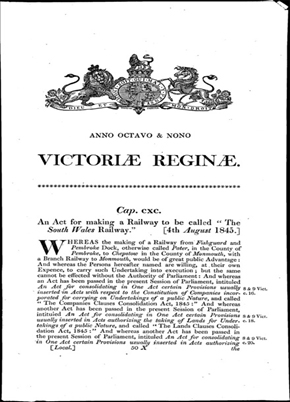
Called "The South Wales Railway"
Earlier, the South Wales Railway Act of 1845 (8 & 9 Vict. c.156) authorised the construction of the main line from Gloucester towards South Wales, establishing the broad-gauge trunk route engineered by Brunel.[2] This was followed by the South Wales Railway Amendment Act of 1846 (9 & 10 Vict. c.369), which refined the route and powers of the company as construction progressed westwards.[3] Together, these Acts set in motion a railway intended not simply to serve South Wales, but to reach the coast and connect with Ireland.
From the outset, the South Wales Railway had been conceived not as a regional line, but as a strategic corridor linking the industrial Midlands and the capital to a western seaport. Ireland was central to this plan. Key to this was the movement of passengers, mail, and livestock across the Irish Sea, which promised substantial commercial return. The railway was therefore designed to deliver this traffic efficiently to a suitable port on the Pembrokeshire coast.[4] In the years that followed, Neyland would prove how effectively it fulfilled this role.
However, the difficulty lay in choosing that port. Pembrokeshire presented a complex geography. The Milford Haven Waterway and the rivers Cleddau divided the county, and no single location could satisfy all interests. Several competing claims emerged. Fishguard, on the north coast, offered a shorter sea crossing to Ireland, but it lacked harbour facilities and would require costly construction in an exposed position. Milford promoted itself strongly, emphasising its existing settlement and aspirations for transatlantic trade. Pembroke Dock, supported by the Admiralty, offered naval importance but was not initially connected by rail.[5]
So far as is known, there were initially no plans to build the line to Neyland. The original intention had been to reach Fishguard and establish a harbour there, with alternative consideration later given to Abermawr. However, the impact of the Irish potato famine, together with the wider financial difficulties of the late 1840s, forced a rethink, and a more practical and economical solution was sought.[4]
Brunel’s early preference for Fishguard reflected the attraction of the shorter crossing, but this choice proved impractical. The cost of creating a harbour there, involving extensive blasting and construction, was considerable, and the wider financial crisis of the late 1840s, combined with the economic consequences of the Irish famine, forced a reassessment of priorities. The collapse of railway investment meant that a more economical and immediately workable solution had to be found.[6]
It was in this context that Brunel turned his attention to the Milford Haven Waterway. In 1851 he undertook a detailed survey of the estuary, examining a number of possible landing places before identifying Neyland Point, at Westfield Pill in the parish of Llanstadwell, as the most practical site. The reasons were clear. Neyland offered deep water at all states of the tide, a sheltered anchorage within the Haven, and a site that could be developed at a fraction of the cost required elsewhere. It lay directly opposite Pembroke Dockyard, one of the most important naval installations in Britain, and could be linked to it by a short water crossing until a railway connection was provided.[7]
The influence of the Admiralty was significant. While it later opposed Brunel’s plans to develop both sides of Westfield Pill, it had a clear interest in the choice of terminus. A port at Neyland offered proximity to the dockyard without interfering directly with naval operations. This alignment of engineering practicality and naval preference strengthened the case for Neyland during Parliamentary consideration.[8]
Cost was decisive – it always is. Contemporary estimates suggested that development at Neyland could be achieved at a fraction of the cost required at Fishguard. In a period when railway capital was constrained and investor confidence weakened, Parliament was not approving an ideal scheme in abstract terms, but a workable and financially viable one.[7]
The Act of 1852 therefore authorised the extension of the railway from Haverfordwest to 'Milford Haven', not as a reference to a specific town, but as a geographical designation for a port on the Haven suitable for Irish packet traffic.[1] In practice, Brunel’s surveys determined that this meant it had to be Neyland.
Newspaper reports of the time make it clear that the existing village of Neyland would have to be cleared. The railway was driven through what had been a small shoreline settlement, and the dwellings on the proposed site demolished, displacing their inhabitants. In their place rose the infrastructure of the terminus, while a new town of Neyland developed on the hillside above to house both former residents and incoming railway workers.[9]
Brunel had envisaged a more extensive development, including the use of both sides of Westfield Pill and the separation of goods and passenger traffic. Parliamentary opposition, led by local landowners and reinforced by Admiralty concerns, prevented this expansion. The railway was confined to the west bank, resulting in a more restricted layout than originally intended.[8]
Despite these compromises, the Parliamentary decision achieved its primary aim. It brought the railway to a location where it could function immediately as a port linked to Ireland, while avoiding the prohibitive costs and engineering challenges of alternative sites. When the line opened in April 1856, Neyland, previously a small and little-known village, became the western terminus of a railway stretching from London.
The choice of Neyland therefore reflects a balance between ambition and practicality. It was not the most direct route to Ireland, nor the grandest vision originally proposed, but it was the one that could be realised within the financial, political, and geographical constraints of the time. In that sense, the decision was characteristic of Brunel’s approach, combining bold planning with a willingness to adapt when circumstances required.
In the years that followed, Neyland would grow rapidly as a railway town, its identity shaped by the very decision that brought the line to its shores. As Parker later observed, it became “a Great Western outpost,” a remote but strategically important terminus at the western edge of Brunel’s system.[10]
Footnotes
[1] South Wales Railway Act, 1852 (15 & 16 Vict. c.198)
[2] South Wales Railway Act, 1845 (8 & 9 Vict. c.156)
[3] South Wales Railway Amendment Act, 1846 (9 & 10 Vict. c.369)
[4] Desmond N. Davies, The End of the Line: A History of Neyland, pp.7–8
[5] Davies, pp.9–11
[6] Davies, p.10
[7] Davies, pp.10–11
[8] Davies, p.15; Richard Parker, The Railways of Pembrokeshire, p.13
[9] Richard Parker, Neyland: A Great Western Outpost, pp.1–2
[10] Parker, Neyland: A Great Western Outpost, title and introductory section
Citations
Davies, Desmond N. The End of the Line: A History of Neyland. Neyland: privately published, c.1990s.
Parker, Richard. The Railways of Pembrokeshire. Tiverton: Halsgrove, 2000.
Parker, Richard. Neyland: A Great Western Outpost. [Privately published / local history publication, date unknown].
South Wales Railway Act, 1845 (8 & 9 Vict. c.156). London: HMSO.
South Wales Railway Amendment Act, 1846 (9 & 10 Vict. c.369). London: HMSO.
South Wales Railway Act, 1852 (15 & 16 Vict. c.198). London: HMSO.