By Carol Elliott
Article based on the memories of Picton Davies as reported in the West Wales Guardian, 16 August 1985
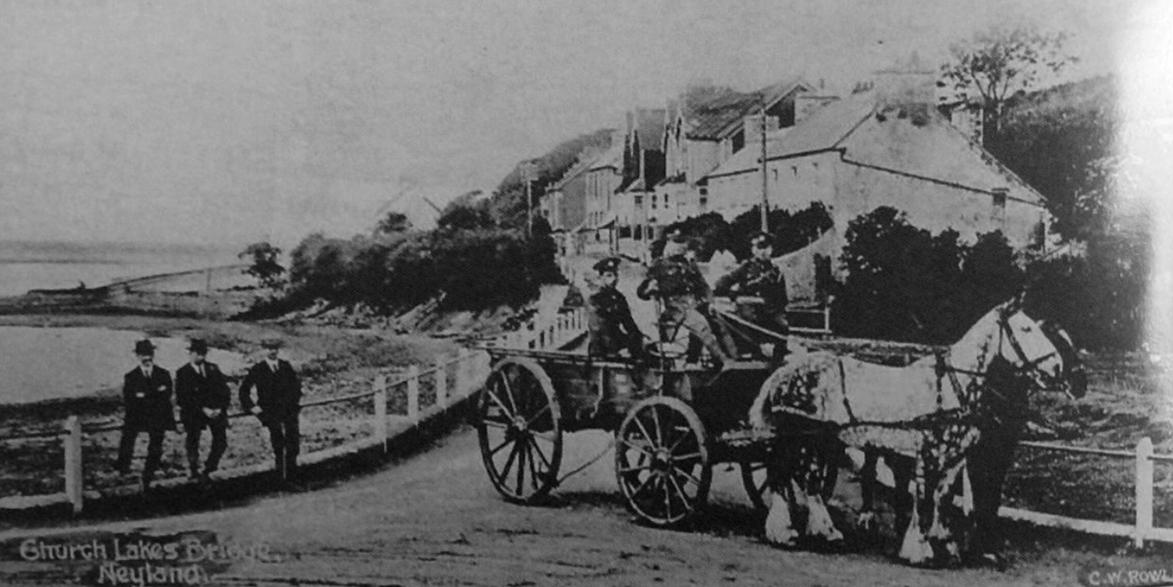
The Military Road linking Scoveston Fort to Hazelbeach and Neyland was the product of two distinct phases of military activity: the construction of Scoveston Fort in the 1860s and the mobilisation for the First World War in 1914. Its history reflects how national defence policy was carried into practice through the labour of local farmers, quarrymen, contractors, and schoolboys.
Strategic Context
Milford Haven has long been recognised as one of the best natural harbours in Britain. During the French Revolutionary and Napoleonic Wars, fears of invasion from across the Channel were real, and the French landing at Fishguard in 1797 confirmed Pembrokeshire’s vulnerability. [1]
Renewed concern came in the 1850s with Napoleon III’s modernised French Navy. The government appointed the Royal Commission on the Defence of the United Kingdom (1859), chaired by General Sir John Fox Burgoyne, to recommend permanent fortifications. [2] Its report identified Milford Haven as a priority: if left undefended, it could be seized and used as a base against Britain.
Parliament passed the Defence Loans Acts of 1860–61, allowing the Treasury to borrow funds for the works. [3] These Acts provided the War Office with powers to acquire land and construct new forts. Among the Milford Haven defences authorised were Hubberston, Stack Rock, South Hook, and Scoveston.
Building Scoveston Fort in the 1860s
Scoveston was the only inland fort built north of the Haven. Polygonal in design, with a wet moat and casemated barracks, it was intended to block an enemy landing advancing inland. [4]
Construction demanded huge quantities of stone. Local memory records that a temporary pier was built at Church Lake (Chuck Lake), where ships unloaded the material. From there, rail tracks were laid from the shore inland, and horses hauled stone wagons up to the fort site. This tramway provided the first engineered line of approach to the fort.
Although completed, Scoveston was never called into active service in the nineteenth century. Like many Palmerston forts, it was soon considered out of date. The tramway alignment remained as a poor cart-track, however, and would later be upgraded as the Military Road.
The Road in 1914
At the outbreak of the First World War, the cart-track still existed but was in bad condition. Milford Haven resident Picton Davies, who worked on it as a boy, remembered it as “a mere cart-track … deeply rutted in the summer and a quagmire in the winter.” [5]
With the arrival of the 4th Battalion, Welch Regiment in August 1914, Scoveston Fort was reactivated as part of Milford Haven’s land defences. A secure supply route to Neyland harbour and railway was urgently required, and the War Office ordered the road to be rebuilt.
Local Effort and Labour
The work was carried out with local resources. Farmers and contractors provided horses and carts, and schools released pupils as young as thirteen and fourteen to make up the shortage of labour.
Picton Davies, then aged 13 and a pupil at Hakin Council School, recalled how his headmaster, Albert Stafford, granted him permission to leave:
“Mr. Stafford granted permission, since I was in Standard VII, which was the top class. I could handle horses as well as any man.” [6]
He worked with his uncle, Abel Codd of Goosepill Farm, a haulage contractor. Along with his relative William Codd of Beaconing, Steynton, Abel’s horses and wagons became essential to the work. Their carts impressed the military authorities, who awarded them contracts.
Davies described the daily routine:
“We had to leave the farm at 7 o’clock to get to Johnston by 8. We would load up with coal, drive it out to Hearson, unload, and return to Johnston. The horses required an hour’s rest. So, on would go the nose-bags. After eating our own meal, we would repeat the morning’s work in the afternoon. It meant that we delivered two loads of coal to the camp each day.” [7]
Other locals recalled on the gangs included Robert Mathias, George Hodges, and John Donnelly of Steynton. The contractor W. J. Rees & Sons of Neyland supplied equipment. Oversight came from Mr. Evans of Neyland, the town surveyor and father of the rugby player “Tommy Pete” Evans.
Methods and Materials
Stone for the new surface came from Johnston and Mastle Bridge quarries. Boys and men broke it down:
“We boys, with hammers, would break the stones into sizes varying from cricket ball down to golf ball.” [8]
The layers were laid by surfacemen, with earth and clay—“the mud”—brushed into the joints, settled with water, and compacted by a steamroller. By September 1914 the new Military Road was finished.
Importance in the First World War
Once completed, the Military Road was immediately used to move coal, supplies, and weapons to Scoveston Fort and Hearson Camp. Soldiers marched along it to Neyland station for embarkation to France.
Davies remembered the activity at the camp:
“At the camp, the soldiers were detailed off into squads of about 30 to 40 men. They used to march back and fore and I can remember there was a lot of dust around. It used to cover their uniforms.” [9]
Weapons were stored and displayed at Hearson, and men were detailed to cleaning duties. The road became a vital link in Milford Haven’s defensive system.
Legacy
The Military Road was not simply a wartime construction of 1914. Its origins lay in the 1860s tramway built from Church Lake to supply Scoveston Fort. It was then remade by the combined effort of the Neyland and Llanstadwell community during the First World War. Farmers, contractors, quarrymen, schoolboys, and soldiers all contributed.
Scoveston itself illustrates the changing face of defence: built in the 1860s under powers granted by the Defence Loans Acts and the recommendations of the Royal Commission on the Defence of the United Kingdom, it lay dormant for decades, then was reactivated in 1914 with the Military Road as its essential lifeline.
Today, “Military Road” remains as a street name in Llanstadwell, a reminder of both the fort’s history and the collective labour that sustained it. [10]
Notes
1.1. J. R. Guy, The French Invasion of Fishguard, 1797 (Cardiff: University of Wales Press, 1987).
2.2. Report of the Commissioners Appointed to Consider the Defences of the United Kingdom (London: HMSO, 1860).
3.3. Defence Loans Act, 1860 (23 & 24 Vict. c.112); Defence Loans Act, 1861 (24 & 25 Vict. c.67).
4.4. “Scoveston Fort,” British Listed Buildings entry no. 14337.
5.5–9. West Wales Guardian, 16 August 1985, “They Called It the Military Road,” with testimony of Mr. Picton Davies.
6.10. Ordnance Survey Gazetteer, entry for “Military Road, Llanstadwell.”