By Carol Elliott
The story that follows is drawn from the research contained in the books listed in the citations below, especially the work of Desmond N. Davies and Richard Parker, whose detailed studies allow us to trace how Neyland grew, and why it was once known to the wider world as ‘New Milford.’
Why Neyland Was Called ‘New Milford’
The renaming of Neyland to ‘New Milford’ was not a casual or accidental change, but a deliberate decision taken by the South Wales Railway Company and recorded both in contemporary newspapers and later historical works. When these sources are read together, they reveal clearly that the name was imposed from above, for practical and commercial reasons, and not accepted locally.
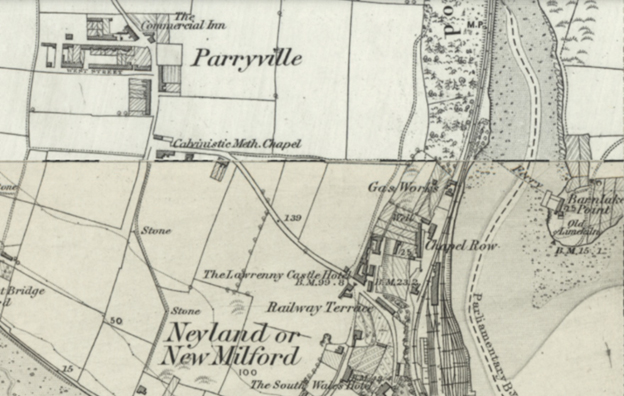
When the railway reached the Haven on 15 April 1856, the terminus was established at Neyland, a small and little-known village at Westfield Pill. From the outset, however, the railway company chose to describe the destination as ‘Milford Haven’, reflecting the wording used in the Parliamentary Act and the wider recognition of Milford Haven as a harbour of national importance.[1]
This created immediate confusion. Neyland was not Milford town, but a separate place some four miles distant. For the first three years after opening, the company struggled with how to name the terminus. As Desmond N. Davies records, there was “indecision and confusion” over the name, with 'Milford Haven' initially adopted despite Neyland itself being largely unknown to railway directors and the wider public.[2]
By 1859, this confusion had become a practical problem. Passengers travelling from London and elsewhere were misled by the use of the name Milford, often assuming they would arrive at the town itself. In response, the South Wales Railway Company formally announced a change of name.
A notice published in The Welshman, 28 October 1859, made this explicit:
“On and after the 1st November next, the Terminus of this Railway on Milford Haven, hitherto called Neyland Terminus, will be called New Milford.” [3]
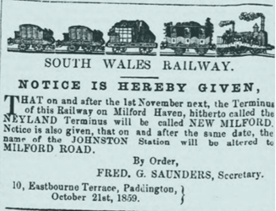
This was not simply a proposal, but an official directive issued by the company’s secretary. The intention was to provide a clearer and more commercially meaningful name for passengers travelling long distances.
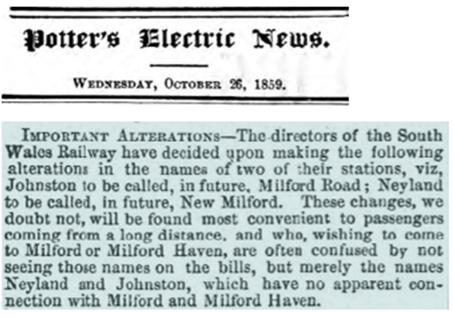
The reasoning behind this change was also explained in the press at the time. Reports in Potter's Electric News in October 1859, noted that names such as Neyland and Johnston had “no apparent connection with Milford and Milford Haven,” and that the new name would be more convenient for travellers unfamiliar with the area.[4] In other words, 'New Milford' was chosen because it aligned the terminus with a name already recognised across Britain.
Both Davies and Parker confirm that this decision was implemented in practice. Timetables began to adopt the new name, and the terminus was thereafter officially known as New Milford, particularly in railway and shipping contexts.[2][5]
However, the change did not resolve confusion. Instead, it created a new problem.
When the railway was extended westward and reached Milford town in 1863, the company attempted to distinguish between the two locations by renaming Milford itself as 'Old Milford', while Neyland remained 'New Milford'.[2] This distinction, while logical on paper, proved highly problematic in practice. Booking clerks and passengers frequently confused the two, and journeys were misdirected as a result.
At the same time, local opposition to the name 'New Milford' was strong. As Davies records, there was “much resentment” among local people, and complaints appeared in the press. One letter published in the Milford Haven and Haverfordwest Telegraph in December 1859 criticised the change, arguing that the name Neyland was already well established and that the adoption of 'Milford' would only lead to further confusion.[2]
Despite this resistance, the railway companies continued to use the name 'New Milford' for several decades. It appeared in official timetables, company correspondence, and transport records, reflecting the railway’s wider commercial identity rather than local usage.[5]
Locally, however, the name never took hold.
The people who lived there continued to call their town Neyland, and the two names existed side by side. As Parker notes, it was not uncommon for newspapers and reports to refer to the place as both Neyland and New Milford within the same account.[5] The official name belonged to the railway. The real name remained with the community.
The situation continued until the early twentieth century. In 1906, following the transfer of the Irish ferry services to Fishguard, Neyland’s role as the principal western terminus declined. With this change, the need for the name 'New Milford' disappeared.
In that year, the railway company finally abandoned the title.
'New Milford' was dropped in 1906; the station reverted officially to 'Neyland'
This brought an end to nearly fifty years of dual naming.
The story of 'New Milford' therefore reflects a wider tension between national systems and local identity. It shows how railway companies attempted to impose clarity and commercial logic on a landscape that already had its own names and meanings. It also shows that, in the end, those local names endured.
Neyland may have been presented to the world as 'New Milford', but it never ceased to be Neyland to the people who lived there.
Footnotes
[1] South Wales Railway Act, 1852; see also Davies, The End of the Line, pp.7–9
[2] Desmond N. Davies, The End of the Line: A History of Neyland, pp.11–13
[3] The Welshman, 28 October 1859, South Wales Railway notice
[4] Potter’s Electric News, 26 October 1859
[5] Richard Parker, The Railways of Pembrokeshire, p.13; Richard Parker, Neyland: A Great Western Outpost, pp.1–3
Full Citations
Davies, Desmond N. The End of the Line: A History of Neyland. Neyland: privately published, 1997
Parker, Richard. The Railways of Pembrokeshire. Tiverton: Halsgrove, 2000.
Parker, Richard. Neyland: A Great Western Outpost. Tiverton: Halsgrove, 2002.
The Welshman. 28 October 1859.
Potter’s Electric News. 26 October 1859.