By Carol Elliott
The arrival of the railway on 15th April 1856 transformed Neyland almost overnight. In describing the event, ‘The Illustrated London News’ turned to Shakespeare, calling Neyland, “this blessed Milford”. But the railway had not reached Milford town, it had actually reached Neyland.
Reading this newspaper cutting describing the arrival of the railway, it becomes clear that there was some geographic confusion about where the South Wales Railway actually ended. This article looks at how that confusion came about, and why the name Milford was used for what local people always knew as Neyland.
OPENING OF THE SOUTH WALES RAILWAY TO MILFORD HAVEN
This newspaper was dated 26th April, some weeks after the actual date of the railway's arrival at Neyland. The heading used in the newspaper report announces the arrival of the railway at 'Milford Haven'. Yet as we read the account more closely, it becomes clear that the terminus was in fact at Neyland. The railway did not actually reach the town of Milford Haven until some seven years after reaching to Neyland – not till 1863.
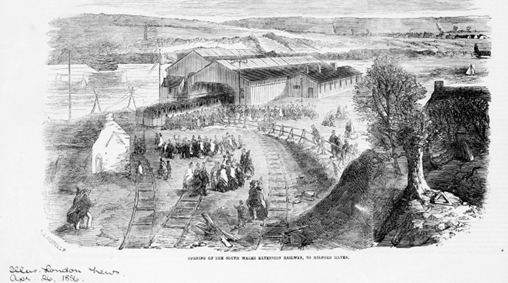
The engraving that accompanied the newspaper article, is looking across the Cleddau towards Pembroke Dock. That image, drawn within days of the event, shows the temporary station buildings at Neyland, the train shed and goods facilities, and groups of spectators gathered along the newly laid track overlooking the Haven. The structures depicted closely reflect the 'temporary station' arrangements agreed between the South Wales Railway and its contractor, William Lewis, confirming that what we see is not an idealised scene but a reasonably accurate representation of Neyland at the moment the railway arrived.
Here is the newspaper cutting:
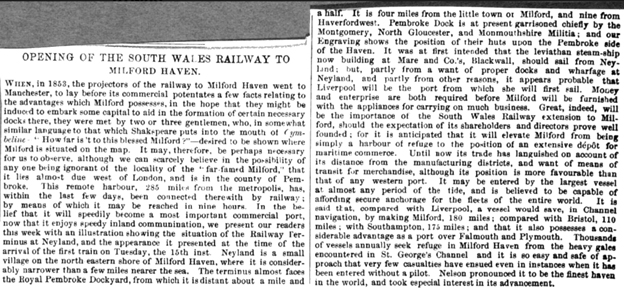
As the original newspaper print can be difficult to read, a transcription of the cutting is set out below:
OPENING OF THE SOUTH WALES RAILWAY TO MILFORD HAVEN.
When, in 1853, the projectors of the railway to Milford Haven went to Manchester to lay before its commercial potentates a few facts relating to the advantages which Milford possesses, in the hope that they might be induced to embark some capital to aid in the formation of certain necessary docks there, they were met by two or three gentlemen who, in somewhat similar language to that which Shakespeare puts into the mouth of Cymbeline, “How far is’t to this blessed Milford?”, desired to be shown where Milford is situated on the map.
It may, therefore, be perhaps necessary for us to observe, although we can scarcely believe in the possibility of any one being ignorant of the locality of the “far-famed Milford”, that it lies almost due west of London, and is in the county of Pembroke. This remote harbour, 285 miles from the metropolis, has, within the last few days, been connected therewith by railway, by means of which it may be reached in nine hours.
In the belief that it will speedily become a most important commercial port, now that it enjoys speedy inland communication, we present our readers this week with an illustration showing the situation of the Railway Terminus at Neyland, and the appearance it presented at the time of the arrival of the first train on Tuesday, the 15th inst.
Neyland is a small village on the north-eastern shore of Milford Haven, where it is considerably narrower than a few miles nearer the sea. The terminus almost faces the Royal Pembroke Dockyard, from which it is distant about a mile and a half. It is four miles from the little town of Milford, and nine from Haverfordwest. Pembroke Dock is at present garrisoned chiefly by the Montgomery, North Gloucester, and Monmouthshire Militia; and our engraving shows the position of their huts upon the Pembroke side of the Haven.
It was at first intended that the leviathan steam-ship now building at Mare and Co.’s, Blackwall, should sail from Neyland; but, partly from a want of proper docks and wharfage at Neyland, and partly from other reasons, it appears probable that Liverpool will be the port from which she will first sail. Money and enterprise are both required before Milford will be furnished with the appliances for carrying on much business.
Great, indeed, will be the importance of the South Wales Railway extension to Milford, should the expectation of its shareholders and directors prove well founded; for it is anticipated that it will elevate Milford from being simply a harbour of refuge to the position of an extensive dépôt for maritime commerce. Until now its trade has languished on account of its distance from the manufacturing districts, and want of means of transit for merchandise, although its position is more favourable than that of any western port.
It may be entered by the largest vessel at almost any period of the tide, and is believed to be capable of affording secure anchorage for the fleets of the entire world. It is said that, compared with Liverpool, a vessel would save, in Channel navigation, by making Milford, 180 miles; compared with Bristol, 110 miles; with Southampton, 175 miles; and that it also possesses a considerable advantage as a port over Falmouth and Plymouth.
Thousands of vessels annually seek refuge in Milford Haven from the heavy gales encountered in St. George’s Channel, and it is so easy and safe of approach that very few casualties have ensued even in instances when it has been entered without a pilot. Nelson pronounced it to be the finest haven in the world, and took especial interest in its advancement.
As Shakespear said in Cymbeline: “How far is’t to this blessed Milford?” A Name London Understood - A Place Called Neyland
This line in the newspaper, was borrowed from Shakespeare, it was used to describe a simple truth at the time. Many people outside Pembrokeshire had little idea where Milford, or indeed Neyland, actually was.
When the railway reached the Haven on 15 April 1856, it came to Neyland, a small village at Westfield Pill. Yet the national press described the destination as 'Milford Haven'. This was not a mistake. It was a deliberate choice of language that people in London and the industrial towns would recognise. No-one knew where Neyland was!
Milford Haven was already known as a great natural harbour, spoken of in naval and commercial circles and praised for its shelter and depth. Neyland, by contrast, was hardly known beyond the local area. To announce that the railway had reached Neyland would have meant little to most readers. To say it had reached Milford Haven immediately gave the place meaning and importance.
The newspaper itself makes this clear. Having used Milford Haven in its headline, it then explains that Neyland is a small village on the shore of the Haven. In other words, the railway had reached Neyland, but it was being described through the better-known name of the harbour.
This moment marks the beginning of a long-standing confusion. In the years that followed, the station was called Milford Haven, then New Milford, while local people continued to call it Neyland. The official name shifted, but the local one endured.
The phrase “this blessed Milford” therefore captures more than just a line of Shakespeare. It reflects how the place was introduced to the wider world. London understood Milford. The people who lived there knew it as Neyland.
In addition, the newspaper makes reference to the 'leviathan steam-ship' which makes it clear just how ambitious the plans for Neyland once were. Brunel had envisaged that his great ship, the SS Great Eastern, might one day sail from the Haven, using Neyland as part of a direct Atlantic route.
At the time, however, Neyland lacked the necessary deep-water facilities and developed docks to handle a vessel of such size. For that reason, the ship’s maiden voyage was to sail from Liverpool instead. Even so, the idea that she might eventually depart from Neyland remained part of Brunel’s wider vision for the port, showing how seriously the Haven was considered as a future centre of international trade.
So, what the newspaper account reveals is a place at the very beginning of its story. Neyland was still a small village yet already being described to the wider world as Milford Haven. That confusion did not disappear with time. For nearly fifty years the railway station in Neyland continued to be called New Milford by the South Wales Railway and later the Great Western Railway, even though local people continued to call it Neyland. The railway created the town in 1856, but its true name and identity remained firmly in the hands of those who lived there.