By Alan Brown
Early Years
The Romney Marshes are a remote and isolated area of wetland on the southeast coast of England; in the 19th century malaria was still a common illness there. The undefended location, just across the Channel from France, made them a potential route for invasion during the Napoleonic era; consequently, when the threat was at its height, several small fortifications, known as Martello Towers, were built along the coast. Following Napoleon’s final defeat at Waterloo, the likelihood of attack receded and the towers eventually became used instead as dwellings for coastguards and their families. In 1845, William George Aswell was born in one of these towers; his father, Richard Aswell, was a Londoner who worked as a coastguard’s boatsman.
Richard Aswell’s employment next took him to Hengistbury, on the Hampshire coast near to Christchurch. The 1851 census informs us that the family’s home there was a retired coastguard cutter, a small ship that had been drawn up onto the beach and converted into housing for the staff.
By 1861 the Aswells had again moved westwards, this time into slightly more conventional accommodation: they were then living at the coastguard station near the village of Langton Herring, a few miles from Weymouth. The neighbouring village was Chickerell, where a young lady named Jessie Matilda Dyne lived with her family. She was the same age as William Aswell; her father was John Dyne, a local builder. In accordance with the system of the time, William’s personality and academic aptitude had earned him the role of ‘pupil teacher’, taking on the task of teaching the youngest children and thus demonstrating his suitability for eventual transfer to a full-time role following a period of professional training; this would entail a move to the nation’s capital.
The 19th century was a period of progressive social improvement in England and Wales. The Industrial Revolution had been the catalyst for economic growth, which went along with the development of philanthropic movements that sought to promote both the physical and spiritual well-being of the lower classes. Few working people could even write their own names on the marriage certificates when these first came into use in 1837; following the gradual introduction of state education, which did not become compulsory until 1880, most young people were literate by the end of the century. For the first time, schoolteachers were also expected to undergo formal training. The earliest institution that could be described as a teachers’ training college was established in 1798 on Borough Road in Southwark, just south of the River Thames in London. By the time William Aswell went there in the early 1860s, it would have taken him two years’ attendance in order to gain his certificate.
To Neyland
In 1865, a locally run school was opened on Charles Street in Neyland; previous to this, any education that was available would have been by weekly payment in small, private establishments. The Charles Street school was established by the British and Foreign School Society, and was consequently known as the ‘British School’. At just twenty years of age, and fresh from college, William Aswell became its pioneering headteacher.
At the start of the Easter holidays of the following year, William journeyed back to Chickerell in Dorset where, on Easter Sunday, he married Jessie Dyne. The marriage certificate notes that they were then both ‘of full age’, i.e. twenty-one. William gave his profession as 'schoolmaster' and his home address as ‘New Milford’: this was during the time when the town’s naming was still causing controversy. In the 1871 census they were living in a house on Neyland High Street with two children: two year old Jessie Alberta and baby Constance, who was then just three weeks old although, sadly, she died not long afterwards. Infant mortality was still very high at that time.
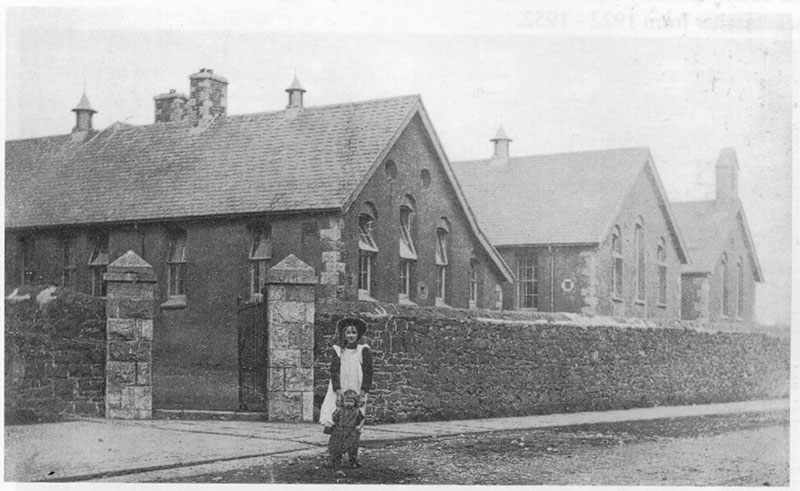
The next advance in state schooling came with the obligation on local authorities to set up school boards, made up of respectable local individuals who then became responsible for the planning and control of education in their area. Neyland’s board convened for the first time on 14th April 1871, setting in motion the train of events that led to the construction of a large school on what is now John Street; it opened in 1874, and for many years afterwards was known simply as the ‘Board School’. William Aswell’s reputation was now well-established in his adopted home town and, once again, he was the new school’s first headmaster. The evidence of family baptisms indicates that William’s parents were Methodists, which may have been a factor in his favour, since the Board school came to be favoured by non-conformists, whereas the smaller ‘National School' in Neyland was strongly associated with the Anglican church. In addition to his teaching duties, he was active in the recently-formed National Union of Elementary Teachers, acting at various times as both treasurer and president of the local branch. This organisation was the forerunner of the National Union of Teachers.
Four more children had been born by the time of the following census in 1881: Beatrice in 1872 and Percy in 1874. When another girl came along in 1876, the Aswells named her ‘Constance Mabel’; in Victorian times, it was a very common practice to reuse the Christian name of a child who had died in infancy. A second boy, Harold, was born In 1879. William, Jessie and their five children were living at 3, Lawrenny Terrace. Two further children, Elsie and Douglas, were born in the following decade, bringing the couple's total births to eight; five girls and three boys, with seven surviving to adulthood. This was not an exceptionally large family by the standards of the time.
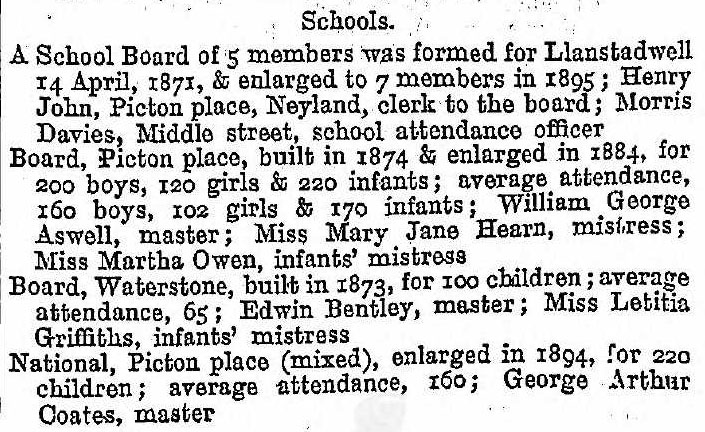
The 1895 directory entry gives the school’s address as ‘Picton Place’. This was the original name given to the houses at the lower end of what is now Kensington Road. Housing in John Street was still under construction at that time.
William Aswell’s final census entry was in 1911, where he described himself as ‘County Council Head Schoolmaster’. He was then nearly 66 years old and had been the mainstay of state education in Neyland for over 45 years, with 37 of these at the school in John Street, and he would retire soon after the census was taken. The boys and girls whom he taught in his later years might have been the grandchildren of the ones who were in his first classes. William died in Neyland in 1918, aged 73, with his wife, Jessie, passing away in the following year. Of his eight children: one, Constance, had died in infancy, while tragically the lives of both Percy and Harold came to a premature end in their twenties; both were unmarried. Douglas also never married, and spent his working life as a telegraph clerk for the GWR. William’s eldest daughter, Jessie, and his eldest son, Percy, both entered the teaching profession. Jessie spent her entire career working at a girls’ school in the town of Barking, to the east of London. In 1897, at the age of 22, Percy became schoolmaster at the village school in Waterston; he was just 27 when he died in 1902. Following their mother’s death, none of the other four surviving children remained in Neyland; within the space of a few years Beatrice, Constance Mabel, Elsie and Douglas had all moved to Gloucestershire, settling either in Gloucester or in the nearby town of Lydney, on the banks of the River Severn.
Their departure meant that no physical trace remained of William Aswell’s long career in educating the children of Neyland; he had devoted the whole of his adult life to this end, but it wasn’t long before his name was forgotten and he became just a footnote in history. Any legacy that he left behind was of a more intangible, but equally long-lasting, kind. He may have taught my great-grandmother, and would almost certainly have taught my grandfather, along with his brothers and sisters, plus three generations of Neyland’s children.
Bibliography
Davies, D N. (1997) The End of the Line – A History of Neyland. Pembrokeshire: Pembrokeshire County Council Cultural Services
Hancock, S. (2000) A Proud Centenary – Neyland in 1900. Pembrokeshire: Llanstadwell & Neyland Historical Society