By Carol Elliott
“A tradition preserved in stone and memory”
This story comes from the written work of Roy Mason, a member of my family, whose handwritten notes, compiled over more than forty years, preserve a remarkable body of local knowledge relating to Llanstadwell and its lost landscapes.[1]
It is one of a number of small mysteries connected with the long-lost manor of Newton.
Was there really a gravestone in Llanstadwell churchyard that condemned a man so brutally that his memory lingered for generations? And if so, what had he done to deserve it?
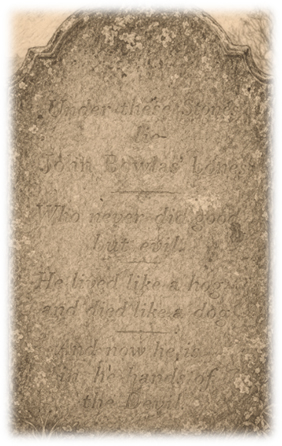
(AI recreation)
Among Roy Mason’s notes is a record of information given in 1965 by Rev. Barnard Jones of Llanstadwell. He stated that the following inscription could be found on a headstone in Llanstadwell churchyard, near the Childs family grave:[2]
“Under these stones lie John Bowlas’ bones,
Who never did good, but evil.
He lived like a hog and died like a dog,
And now he is in the hands of the devil.”[2]
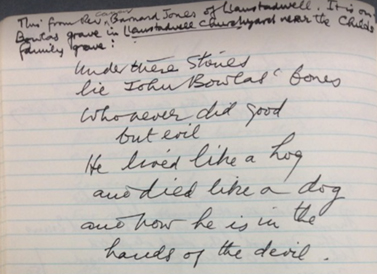
This is not the only version. A slightly different rendering was given earlier, in 1950, by Lizzie Jane Heatherly, née Edwards, who was licensee of the Ferry House from about 1916 to 1963:[3]
“Under these stones lies John Bowlas bones
He never did anything but evil
He lived like a hog
And died like a dog
And now is a companion for the devil.”[3]
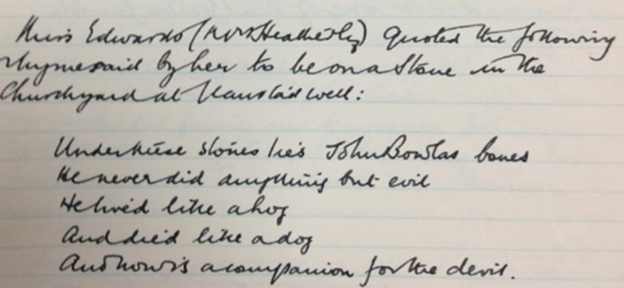
Two versions, recorded independently, both carrying the same message. This is not a casual invention. It is something that was remembered.
So who was John Bowlas, and why was he spoken of in this way?
Roy Mason’s notes preserve one explanation. According to the account recorded from Lizzie Jane Heatherly, Bowlas owned Newton and tried to prevent people from using the footpath across his land between Newton and Venn Farm. To do so, he kept a prize bull loose in his fields.[3]
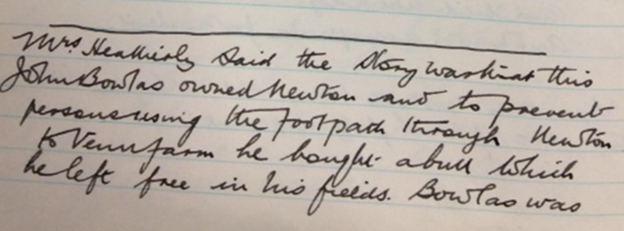
The story continues that he met his end at the horns of that same animal. He was actually gored to death. Lizzie Jane Heatherly tells us the while attending to his herd, he was attacked and killed by the bull and she says he was, “hoisted by his own petard”. In that light, the phrase that he “died like a dog” begins to sound less like an insult and more like a remembered event.[3]
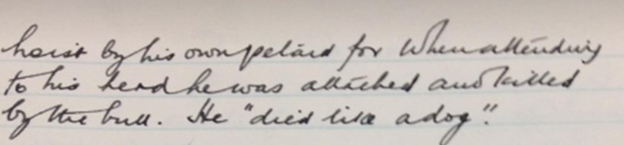
But is that the whole story, or simply the part that survived in local telling?
A further note, recorded within the family in 1986, suggests another possibility. Gwen, verbally in 1986 proposes that the verse may have been composed by Lewis Childs, who believed himself wronged over the inheritance of Newton. According to this account, John Bowlas had been left Newton “for life” by his brother Samuel, but the estate itself had already been settled on Samuel’s nephew, Lewis Childs. Bowlas, when making his own will, appears to have been dissatisfied with this arrangement.[4]
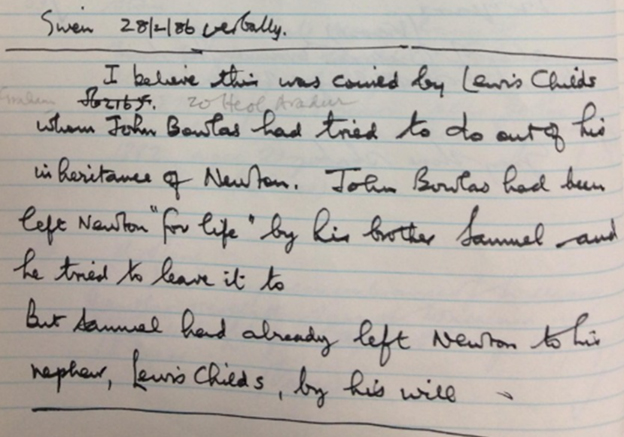
At this point, the story moves from memory into record.
The will of Samuel Bowlas, dated 1794 and proved in the Diocese of St David’s, confirms that Newton was left to John Bowlas only “for and during the term of his natural life”. The same document then assigns the estate, after John’s death, “for ever” to his kinsman Lewis Childs and his heirs.[5]
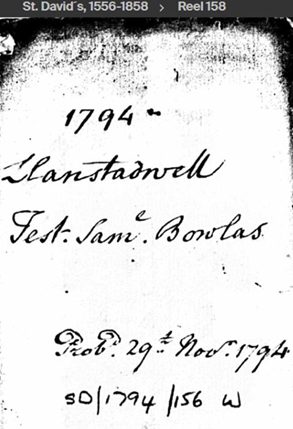
This is a crucial detail. John Bowlas lived at Newton, but he did not own it outright. He held it for life, while knowing that it would pass to someone else.
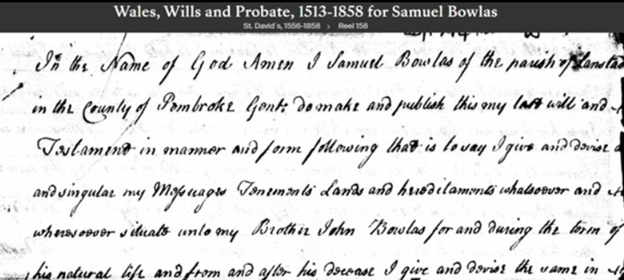
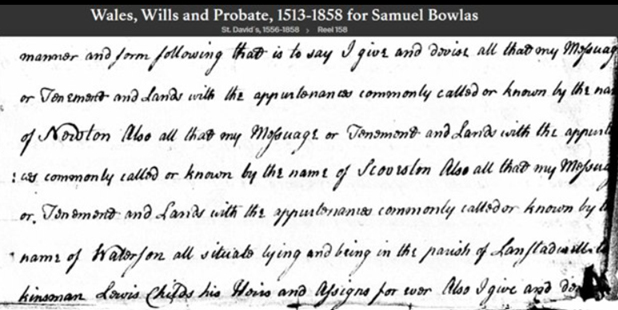
When this is considered alongside correspondence in the Newton Estate papers, which suggests that John Bowlas attempted to interfere with or alter the intended inheritance, a clearer picture begins to emerge.[6] If there was tension between Bowlas and Childs, then the hostile tone of the epitaph may reflect more than general reputation. It may reflect a specific dispute.
And then there is the stone itself.
One member of the parish has identified what is believed to be the grave in Llanstadwell churchyard. Though now heavily worn and almost lost to time, the surface still bears faint traces of lettering, just visible in certain light. The words can no longer be fully recovered, but the survival of even a fragment suggests that this was once a real inscription, not simply a story repeated.[7]
So what are we left with?
A remembered epitaph.
A story of a violent death.
A documented dispute over inheritance.
And a gravestone that has not entirely vanished.
Whether the verse was carved exactly as remembered, or whether it was sharpened in the telling, cannot now be proved. But the evidence suggests that something happened at Newton that left a mark strong enough to be preserved in both record and memory.
The question remains. Was this simply a man with a bad reputation, or was this a quarrel that followed him beyond the grave? It’s a mystery!
Citations
[1] Roy Mason, History of Llanstadwell, unpublished handwritten notes compiled over approximately forty years, in family possession.
[2] Canon Barnard Jones, verbal testimony recorded in Roy Mason’s notes, 1965.
[3] Lizzie Jane Heatherly (née Edwards), oral testimony recorded in Roy Mason’s notes, 1950; licensee of the Ferry House, Llanstadwell, c.1916–1963.
[4] Family notes (unattributed, possibly Gwen), 1986, preserved within the Roy Mason collection.
[5] Wales, Wills and Probate, 1513–1858, Diocese of St David’s, will of Samuel Bowlas of Llanstadwell, proved 29 November 1794 (Reel 158).
[6] Newton Estate Papers, Haverfordwest Record Office, correspondence relating to the Bowlas and Childs families and the disposition of Newton estate.
[7] Local observation, Llanstadwell churchyard, reported by a present member of the parish; partially legible gravestone identified, inscription largely eroded.