By Carol Elliott
Perched high above the water’s high tide mark lies St Tudwal’s Church in Llanstadwell: it has stood at the heart of this community for over a thousand years. What we see today is not just a parish church, but the continuation of an early Christian site, shaped by Norman rebuilding, medieval patronage, Tudor reform, and centuries of local life. From the worn tombstone effigy lying in the church, to the Elizabethan chalice still used at special services, and the Restoration bells that have rung across the water since 1684, this church holds within it the layered history of Llanstadwell itself.
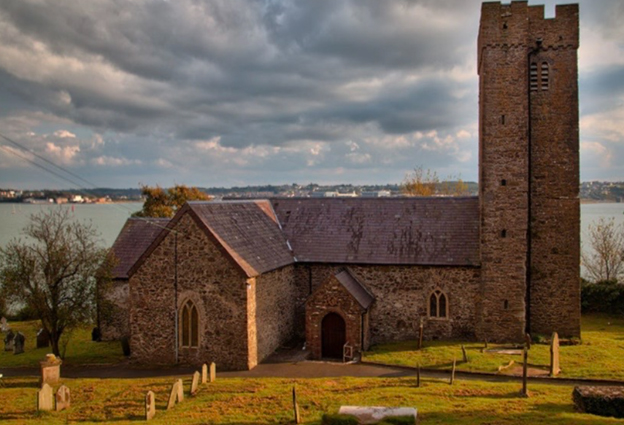
St Tudwal’s - An Historical Account
Pre-Norman Period
The parish church of St Tudwal at Llanstadwell occupies a site of early origin within the Hundred of Roose in south Pembrokeshire. The dedication derives from Llan-sant-Tudwal, indicating an early ecclesiastical enclosure. Rice Rees in 1836 identified the dedication with Tudwal Befr, one of the early medieval saints active in the 5th and 6th centuries.[1]
Such sites formed part of an early network of Christian foundations combining religious, territorial, and social functions. Llanstadwell’s position on the Milford Haven waterway accords with the coastal distribution of early ecclesiastical sites in west Wales.[2] By the late eleventh century, prior to the Norman advance of 1093, the area formed part of the kingdom of Deheubarth and supported an established ecclesiastical structure.
Norman and Medieval Period
A key reference to Llanstadwell is provided by Giraldus Cambrensis, who records that the manors of Llanstadwell had formerly belonged to St Davids before passing into lay control prior to the episcopate of Bernard in 1115.[3] This confirms that Llanstadwell was an organised ecclesiastical and manorial centre before Norman consolidation.
The Norman occupation did not involve a change of dedication, indicating that an existing religious site was adopted. The nave and chancel are generally attributed to the twelfth and early thirteenth centuries, representing rebuilding in stone during this period.[4]
The wider region was shaped by Flemish settlement under Henry I of England and Henry II of England, contributing to the later cultural distinction of south Pembrokeshire.[5]
The Visit of Richard II (1394)
In 1394, Richard II of England passed through Llanstadwell on his expedition to Ireland.[6] The campaign required the mobilisation of a substantial fleet from the Milford Haven waterway, one of the principal embarkation points of the period. A payment recorded in the royal Exchequer accounts to the parish vicar confirms that the king was accommodated locally and compensated the parish for the costs incurred.
The anchorage later known as King’s Road, situated off the Llanstadwell shoreline, functioned as a secure harbour within the Haven and is plausibly associated with such royal maritime activity, although this association cannot be conclusively demonstrated.
The Medieval Effigy (c.1350)
Within the church there survives a medieval tomb slab, now considerably worn, with the effigy almost entirely effaced. Its presence was recorded by Richard Fenton, who described a “much defaced effigy” within the church.[4]
Modern assessment has suggested a date of circa 1350, placing the monument within the later medieval period.[7] The slab represents the remains of a carved effigy, most likely commemorating an individual of local standing. Its worn condition reflects prolonged use within the church floor and the effects of post Reformation changes in the interior. The survival of the stone confirms the use of the church for privileged burial within the medieval parish.
The Priory and Late Medieval Church
During the later medieval period, Llanstadwell came under the control of the Augustinian Priory at Haverfordwest. The priory appropriated the rectory and received the greater tithes, while a vicar served the parish and received the lesser tithes. This arrangement reflects a common system of monastic control over parish churches in medieval Wales.[8]
The dissolution of the priory under Henry VIII resulted in the transfer of these rights into secular hands, altering the structure of ecclesiastical patronage and administration.[9]
Tudor Period
The Tudor period saw the reorganisation of parish worship following the Elizabethan settlement. Under Elizabeth I, uniform Protestant practice was established, and parishes were required to replace medieval chalices with communion cups suitable for administration to the laity.[10]
At Llanstadwell, a silver communion chalice survives from this period, hallmarked 1599. The vessel bears the Latin inscription “Poculum Ecclesie de Lan Set Wal”, identifying it as the church cup of Llanstadwell. Its date places it within the wider programme of post Reformation replacement of church plate across the Diocese of St Davids.[11]
The chalice remains in use for special services, providing a direct material link between the Tudor religious settlement and the present life of the parish.
Stuart Period
The seventeenth century brought significant religious disruption. The Act of Uniformity of 1662 required clergy to conform to the rites of the Church of England. At Llanstadwell, the vicar John Luntley was ejected for nonconformity after refusing to comply with the Book of Common Prayer.[12]
Following his removal, Luntley returned to secular employment and later became associated with nonconformist religious activity in the region. His ejection reflects the wider pattern of dissent in Wales.
The Church Bells (1684)
The tower contains two bells cast in 1684, in the period following the Restoration of Charles II of England. One bell bears the inscription “VIVAT REX”, meaning “Long live the King”.
This inscription reflects the re-establishment of royal authority after the Interregnum. The installation of bells in this period corresponds with the revival of parish life and worship following the Restoration. While specific commissioning records do not survive, their date and inscription strongly associate them with this period of religious and political settlement.[13]
Georgian Period
During the eighteenth century, the parish reflects broader developments in ecclesiastical life. Clerical education improved, and parish administration stabilised under lay patronage. The tithe system continued to shape the economic structure of the parish.[14]
Victorian Period
The nineteenth century saw significant demographic expansion associated with maritime and industrial development in the Milford Haven waterway, particularly following the establishment of Pembroke Dock in 1814.[14]
A major restoration of the church took place in 1867. This involved structural alteration, including rebuilding and extension of parts of the church, the addition of a porch, and reordering of the interior. These works reflect the broader nineteenth century programme of church restoration across Wales, combining repair with contemporary liturgical requirements.[15]
Conclusion
St Tudwal’s Church at Llanstadwell represents a site of long continuity from the early medieval period to the present. Its origins lie in an early ecclesiastical enclosure, its structure reflects successive phases of rebuilding, and its history illustrates the interaction between monastic control, Crown authority, and local religious practice. The survival of the medieval effigy, the Elizabethan chalice, and the Restoration bells provides tangible evidence of key stages in that development.
Incumbents (Vicars) of Llanstadwell
Thomas Balymore (fl. 1393–1394)
Hugh Baker (1535)
John Pobling (1546)
Thomas Stevins (1554–1565)
Abraham Rede (1565)
John Vaughan (1620)
John Pritchard (1623)
Marc Carre (1634)
John Luntley (ejected 1662)
Thomas Price (1665)
John Williams (1709)
Thomas Davies (1714)
John Phillips (1745)
John Jordan (1776)
John Phillips (1778)
Benjamin Gibbon (1802)
Thomas Owen (1813–1851)
Joseph Tombs (1851)
Peter Phelps (1858)
Henry Sheppard Green (1866)
Henry Philip William Hughes (1870)
John Echlin Armstrong (1871)
George Valentine Wheeler (1873)
Lacy Henry Rumsey
David Lewis Davies (1911)
Footnotes
[1] Rice Rees, An Essay on the Welsh Saints (1836), p.13.
[2] T. M. Charles-Edwards, Wales and the Britons 350–1064 (Oxford, 2013).
[3] Giraldus Cambrensis, Historical Works (1863).
[4] R. Fenton, A Historical Tour through Pembrokeshire (London, 1811), s.v. Llanstadwell.
[5] William of Malmesbury, Gesta Regum Anglorum.
[6] Issues of the Exchequer, reign of Richard II.
[7] Jerry Sampson, archaeological assessment of the effigial slab at St Tudwal’s, Llanstadwell (unpublished), assigning a date of c.1350.
[8] J. Burton and K. Stöber, Monastic Wales (2013).
[9] G. W. Bernard, The King’s Reformation (2005).
[10] C. Haigh, English Reformations (1993).
[11] J. T. Evans, “Elizabethan Communion Cups in Wales,” Archaeologia Cambrensis; RCAHMW Inventory.
[12] J. Spurr, The Restoration Church of England 1646–1689 (1991); R. Tudur Jones, Protestant Nonconformity in Wales (1999).
[13] C. Duffy, The Stripping of the Altars (1992).
[14] S. Lewis, A Topographical Dictionary of Wales (1833).
[15] M. Yates, Religion and Society in Nineteenth-Century Wales (2007).