By Carol Elliott
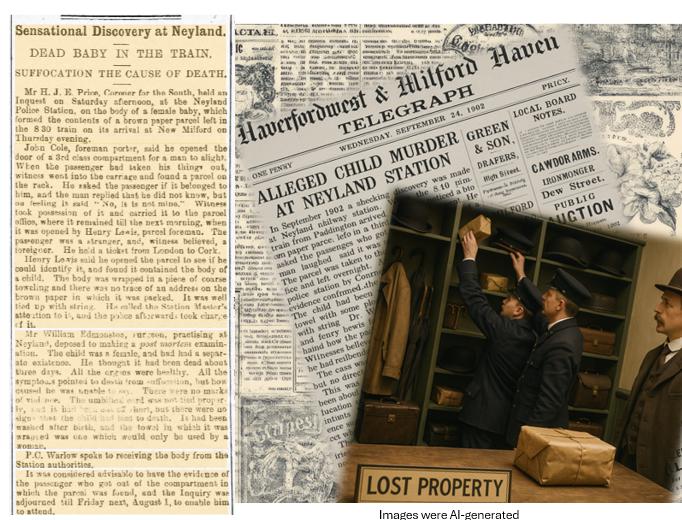
It is only about a year since a live baby was left on the hands of the authorities at Neyland railway station, and, although the strictest inquiries were instituted, no clue has yet been discovered as to the parties who abandoned the poor little creature. On Thursday evening last, an incident of a graver kind occurred there, the baby in this instance being dead, and the body bearing signs which would go to show that a murder had been committed. As in the other case there is a complete absence of all means of identification, and, unless something unforeseen arises, there is little probability that the guilty party or parties will be discovered.
The circumstances are simple. When the 8.40 p.m. train reached Neyland on Thursday, a passenger alighted from a third class compartment, and, picking up some small parcels which lay alongside him on the seat proceeded to make his way out of the station. A porter standing at the door of the carriage noticed a brown paper parcel on the rack at the other end, and asked the passenger if it was his. The passenger laughingly disclaimed the ownership and went his way. The porter then took possession of the parcel, and, having carried it into the office, deposited in the place usually assigned to lost property, and went away for the night.
In the case of unclaimed parcels, it is customary for the railway officials to open them in order to ascertain if the contents will lead to the discovery of the owner, and, in accordance with that practical, the parcel was opened the following morning. To the shocked astonishment of the porter it was found to contain the dead body of a child. Information was at once given to the police and, for the present, there the matter rests. No suspicion attaches to the passenger who left the carriage, but inquiries are being made after him in the hope that he may be able to throw some light on the manner in which the parcel found its way into the carriage. It seems he travelled down all the way from Paddington, and he may have noticed someone go in and out of the carriage who may have deposited the parcel. The parcel was very tightly corded, and the body of the child was wrapped around with a coarse towel on which there were some blood stains. There were no other marks of any kind, but the body bore all the signs of death by suffocation. It is considered that the living child was tied up in the parcel, and so smothered.
THE INQUEST
The coroner (Mr H. J. E. Price) held an inquest on the body at the Neyland police station on Saturday afternoon.
A jury was sworn with Mr G. M. Voyle as foreman, and the body was carried into the room to be viewed.
The Coroner said it was scarcely probable that they could conclude the inquest that day. The police were making inquiries, but up to the present they had not been able to obtain any clue, and it might be advisable to adjourn the inquest for a week or a fortnight.
John Cole, foreman porter at New Milford, said that, on the night of the 17th, a train arrived about 8.40. As usual he went along the platform to open the doors for the passengers, and opened the door of a third class carriage for a passenger to get out. Witness saw a parcel on the rack and asked the passenger if it belonged to him. He said he did not know and felt the parcel. Then he remarked that it did not belong to him and witness took it into the parcel office. The parcel was packed in brown paper. Next day witness saw Henry Lewis open the parcel in the office, but did not see the contents. The man did not seem to hesitate when witness asked him if the parcel belonged to him, but he made some remarks, laughed and went away. Witness believed the man came from London and went over by the Cork boat. He judged that the man was not an Englishman, and he was told that the ticket was from London to Cork.
Henry Lewis, foreman in the parcels office, said he remembered the last witness bringing a parcel into the office about 8.45 p.m. on the 17th. Witness left it in the office in the place in which lost property is usually kept, and, on the next day about 9.30 a.m., opened it to see if the contents were such as would lead to the discovery of the owner. He found that it contained the body of a child. It was wrapped in brown paper outside and there was a piece of coarse towel round the body. Witness called the attention of the stationmaster to it and then handed it over to the police. The parcel was well tied up with string and bore no address or mark. It was customary for the officials to open lost parcels, and they had to send a daily report of what was found in the trains.
Dr W. Edmondson deposed that he examined the body. It was that of a female child, who had been born alive and had had a separate existence. It seemed to have been about three days dead. The organs were apparently healthy and the cause of death was suffocation. He could not say definitely how the child had been smothered but it might have been done by the act of wrapping it in a parcel. The umbilical cord had not been properly tied but was cut clean away short. The child, however, had not bled to death that way. There were general symptoms of suffocation such as frothing, the clenching of the hands, and the usual signs about the eyes. The body had been washed after birth. There was some blood on the towel which had been round the body.
The witness gave other particulars regarding the nature of the towel, and added that there was no sign that the child had suffered from haemorrhage. The extent of the bleeding caused by the cutting of the cord would depend upon how soon after the child was smothered.
The Coroner said that was all the evidence, and it would be more satisfactory if the inquiry was adjourned for a week so that the police could prosecute their investigations. It might be more satisfactory if they could discover the passenger who was in the carriage, although perhaps he knew nothing about it, but he might be able to give them an idea of where the parcel was put in.
P.C. Warlow proved that the parcel produced and that found in the carriage were the same.
It was mentioned by the witness Lewis that the passenger in the carriage was supposed to have gone to Ireland in charge of a motor car.