By Tony Organ
The club was established in 1899 with its very first game being played on the 11th October that year against Pembroke Dock Reserves. From an administrative perspective, it was constituted subsequent to the first recorded AGM in September 1901.
The club became one of the founder members of the Pembrokeshire League and on the 10th September 1910 was chosen to host the league ‘play-off’ for cup and medals from the previous season. Many of the supporters for the two finalists would have travelled to Neyland by train and then walked up the High Street to the pitch in Honeyborough.
There was a cessation in activities during the war years of 1914-1918 and later from 1939-1945.
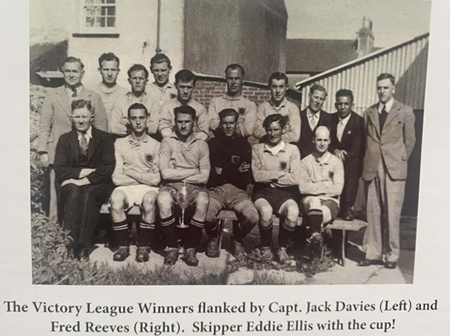
Immediately after the Second World War Neyland re-connected with league football, playing in the First Division of the Pembrokeshire League. In the season 1946/47 the club won the ‘Victory League’ – a special post-war mid-week league. It was a remarkably successful era for both senior and youth football. The youth team won the Wiltshire Cup in the 1946/47 season beating Pembroke Borough in the final. The following season the men’s XI finished a respectable 6th from 15 teams and the youth XI ‘did it again’ winning the Wiltshire Cub beating a very strong Marble Hall Villa in the final. The following season saw them win the first youth league and topping off three seasons undefeated!
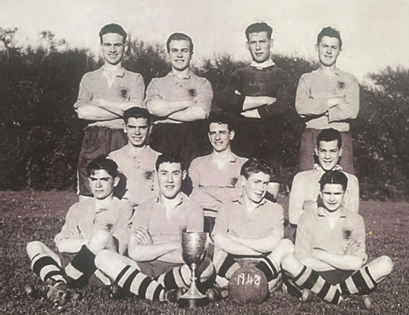
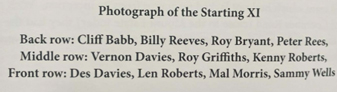
There was a particularly strong committee behind the club and the most influential members all pursued business at the Milford Haven Docks, two of them owning their own fishery companies. It was also evident that they were members of the Masonic Lodge. The secretary of the club, Fred Reeves, became Chairman of the Pembrokeshire League in 1948, a post he held until 1853.
Sadly, immediately after this ‘purple patch’ in the club’s history, it was suddenly bereft of young players, who would have been transitioning to senior football. Within a two-year period all the 18 year olds were ‘called up’ for National Service. When they returned to their beloved home town some 2/3 years later, the provision for the sport had ceased.
And so it was that the returning players signed for other clubs which had not been devastated from a mass exodus. Three of the players – Mal Morris, Len Roberts and Colin Davies – signed for Pembroke Borough and became part of its successful Welsh League & Cup winning side. Mal was the first Neyland player to become a professional player when he was sold by the Borough to Swansea Town in October 1956, making his debut one month later with the Swans’ 4-1 win over Notts County. He joined Gloucester City in July 1958 for a fee of £3,000 and became its leading scorer in 58/59 netting 26 goals in 51 appearances.
The next most significant era came in 1966 when the club applied to re-affiliate with the league. The committee at that time had everything in place …… bank account, sufficient funds, constitution, a viable number of players, kit etc. They met all the prerequisites except for one thing …… they didn’t have a pitch! However it was agreed at the League AGM that the club could ‘share’ the home pitch of Johnston AFC (for a fee of 10 shillings per game). It was at this point that one of the players exclaimed “we shall never play at home in Neyland, we shall be nomads”. That is the true history of how the nickname ‘The Nomads’ was adopted by the club and the community. Infact when the club re-entered the league in the 1966 season, it was recorded as ‘Neyland Nomads’.
From this date the club lived up to its nickname, playing on a pitch behind the youth club in Charles Street; then to the Neyland CP School field, courtesy of the Headteacher; a move up to Honeyborough was next on the cards, playing where the garden centre is today. When this was required for development, there was a forced move down to a field opposite the old ‘Commercial Inn’. In 1982 the club moved to its now permanent home in a field adjacent to the Athletic Club grounds, further to a compulsory purchased facilitated by the Neyland Town Council.
In 1976, having been promoted from the 3rd division to the 2nd division, the team beat reigning Division One champions/Senior Cup & West Wales Cup holders, Fishguard Sports on the 10th January on the Honeyborough pitch. There was a massive crowd for this much anticipated fixture and, having gone down 0-1 to the Sports, Neyland went on to win 4-1. The following season it was promotion to the First Division, finishing 11th from 17th teams.
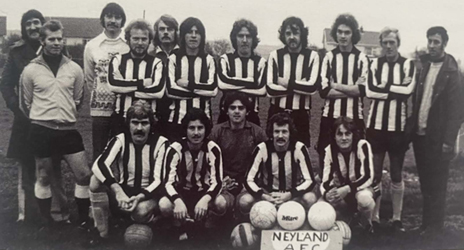

By now the club was running two senior teams, and in 1984 the 2nd X1 achieved a league and cup double with some talented players, many of whom had First Division experience. In October 1999 the club celebrated its centenary with many past and present players and committee members having an evening of nostalgia at the Athletic Club (including many of the great youth players from the 1940s).
The new millennium witnessed another upturn in fortunes. From 2002-2004 the First XI was promoted from Division Three to Division One in consecutive seasons, winning the 2nd Division Cup en route at the Bridge Meadow Stadium.
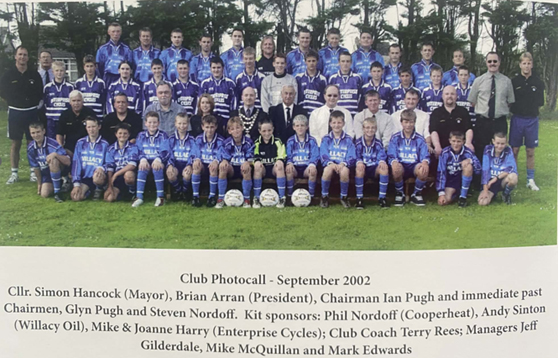
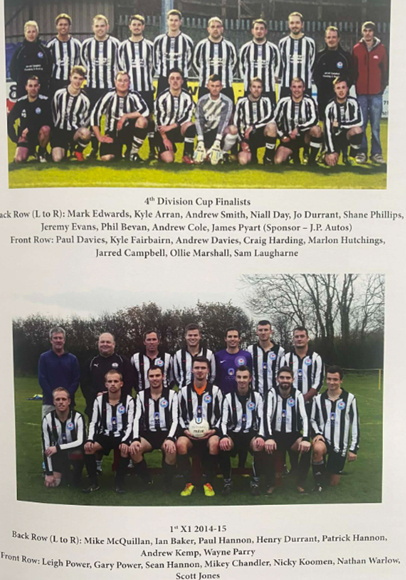
There followed a 20 year span of ‘life in the First Division’, culminating in a Senior Cup Final appearance on the 2nd May 2015 again at the Bridge Meadow Stadium, Haverfordwest.
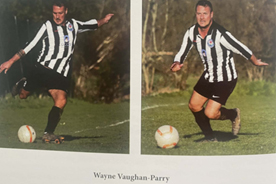
The club has been fortunate in both nurturing and attracting good players – and faithful, loyal clubmen. It may appear invidious to single out individual players, but in terms of the modern era there would not be one player who would disagree with acknowledging a certain Wayne Vaughan Parry who devoted 20 to his beloved Neyland when he could have played at a higher level.
Today the club sponsors mini, junior and youth teams and has established strong girls’ teams with individuals progressing to Swansea City u. 19’s and senior women’s squads.
Llanstadwell Football Club (1914-1938).
Although we are reflecting on the history of Neyland AFC it would be amiss not to mention Llanstadwell Football Club (1914-1938). Initially known as ‘Llanstadwell Church Lads’ and initiated by curate Rev. H. Evans, it quickly developed into possibly the strongest and most successful village team in the county at that time. Having started life in the Milford and District Junior League, the club was soon integral to the Pembrokeshire League. In the 1925/26 season Llanstadwell was referred to in the press as “last season’s champions”. In the same season they reached the final of the Cottrill Cup where they lost 1-0 to the Royal Welsh Fusiliers, a team of extremely fit servicemen from all over the country. Admission at the Welsh League Pill Lane ground was “1 shilling; Ladies 6d; Schoolboys 3d”. Llanstadwell had former Welsh League player B. Batten in goal and they were successful in signing several players with Welsh League experience.
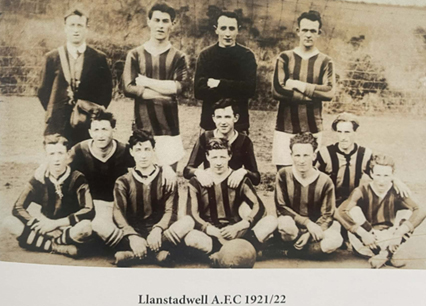
Stalwarts behind the club for many seasons were the Bowen brothers – George, Jack, Gilbert and Wilfred! They all lived in the village and Wilfred went on to be the club’s secretary for some years. The club had three pitches during its lifespan. Firstly in Leonardston Fields (up from the Church); secondly mid-way up Waterston Road on the left hand side; and finally in Waterston itself on the site where Alban Crescent is located today. On that ground they built a pitch pine changing room. As with ‘all good things’ it ceased to provide sport from 1938 but left so many memories.