By Carol Elliott
Shipbuilding along the shores of Neyland and Llanstadwell developed through the work of several local families whose small private yards produced trading vessels for the coastal and international maritime trade. From the early nineteenth century through to the late Victorian period, shipbuilders in Neyland and Llanstadwell constructed dozens of sailing ships and steam vessels that served ports around Britain and across the wider world.
The Scurlock Shipbuilding Family
Westfield Pill Yard
One of the earliest recorded shipbuilding families in Neyland were the Scurlocks, whose yard operated at Westfield Pill during the early nineteenth century. We believe the shipyard was located somewhere near the current Marina. From this small yard the family produced a series of wooden sailing vessels, most of them modest coastal traders that worked the busy commercial routes of the Bristol Channel and Irish Sea.
Among the first ships launched from the yard was the sloop Maria, a 15-ton vessel built in 1820. She was followed by another small sloop, Betsy of 29 tons, launched in 1828. By the end of the decade the Scurlocks had begun constructing slightly larger vessels, including the 99-ton schooner Alfred launched in 1829.
During the 1830s the yard produced a steady stream of working vessels. These included the 49-ton smack Earl of Kingston launched in 1830, and the 60-ton vessel Edwin built in 1833. In the same year the Scurlocks launched the 103-ton schooner Alert.
Further vessels followed throughout the decade. The smack Reform of 34 tons was launched in 1834, followed in 1835 by a larger 165-ton schooner also named Betsy. The 107-ton schooner Superb was launched in 1836.
By the late 1830s the Scurlock yard was producing some of the larger coastal traders working the Haven. These included the 150-ton schooner Victoria launched in 1838 and the 131-ton schooner British Queen built the following year. One of the last known vessels from the yard was the 140-ton schooner Lady of the Lake launched in 1840.
When Isambard Kingdom Brunel brought the railway to Neyland in 1856, the route of the new line unfortunately cut directly across the site of the Scurlock family’s shipyard at Westfield Pill. As a result, the yard had to be relocated. The Scurlocks moved their shipbuilding operations to Church Lakes, an area where the family owned much of the surrounding land, allowing them to continue their work along the shoreline for several more years.
The Scurlock ships formed part of the busy coastal trading fleet that supplied ports around the Irish Sea. Their cargoes typically included coal, grain, timber and limestone, transported between Wales, Ireland and western England.
The Warlow Brothers of Hazelbeach
Shipbuilding activity also developed further west along the coast at Hazelbeach. During the later nineteenth century the Warlow brothers established a shipyard at Hazelbeach, just beyond Llanstadwell Church.
The Warlows built the two big houses beside their yard and operated a small but productive shipbuilding enterprise along the shoreline. Although their yard appears to have produced only a limited number of vessels, some of their ships became well known locally.
Schooner Margaret Hobley (1868)
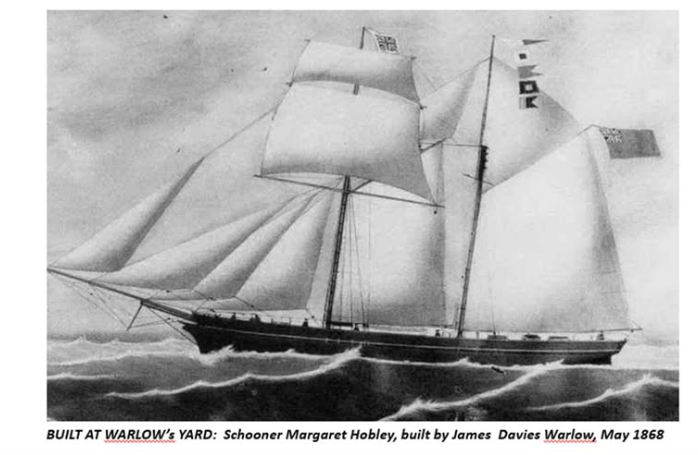
The Margaret Hobley was a two-masted schooner built in May 1868 at Warlow’s shipyard at Hazelbeach, near Llanstadwell on the Milford Haven waterway. The vessel was constructed by James Davies Warlow, a member of the Warlow shipbuilding family who operated a small private yard on the shoreline west of Llanstadwell Church.
The Ship
The image shows a typical Welsh coastal schooner of the mid-nineteenth century. Ships of this type were designed primarily for the Bristol Channel and Irish Sea trade, where speed, manoeuvrability, and a relatively shallow draft were important.
In 1876 the Warlow yard launched the vessel Princess of Wales, which traded on Bristol Channel routes. Although relatively little is recorded about her later career, the ship remains one of the better-known vessels associated with the Hazelbeach yard.
The Gaddarn Shipyard at Limpin Hill
The most significant figure in Neyland’s shipbuilding history was James Gaddarn (1822–1890). His yard at Limpin Hill, near the present Promenade, became one of the largest private shipyards on the Milford Haven waterway.
Gaddarn trained as a shipwright at the Royal Dockyard at Pembroke Dock, and by the early 1850s he had established his own yard at Neyland. The enterprise expanded rapidly and at its height employed around two hundred men, including shipwrights, apprentices and labourers.
Early vessels from the yard
The earliest recorded vessel built at Limpin Hill was the 39-ton schooner Elizabeth, launched in 1853. She was followed in 1858 by the 90-ton schooner Martha and Mary, which was later lost in St George’s Channel.
In April 1859 the yard launched the 122-ton brigantine Sylph. After many years of trading she was eventually lost on 14 November 1875 in Goultrop Roads in St Bride’s Bay while carrying coal from Ayr to Cork.
The yard also experimented with steamship construction. In May 1860 the steamship Pembrokeshire was launched for the firm of Ford and Jackson. Another vessel, Dispatch, followed in 1861.
The clipper ship era
During the mid-1860s Gaddarn began constructing larger, faster sailing ships. These were clipper vessels, famous for their speed and widely used in global trade.
Among the most impressive was the 650-ton clipper Cardiganshire, launched in September 1864 for Jenkins & Co. of Lime Street in London. She was followed in April 1865 by the 260-ton clipper Neyland. In March 1866 another vessel, Caernarvonshire, was launched and christened by Gaddarn’s wife Elizabeth.
Later sailing ships
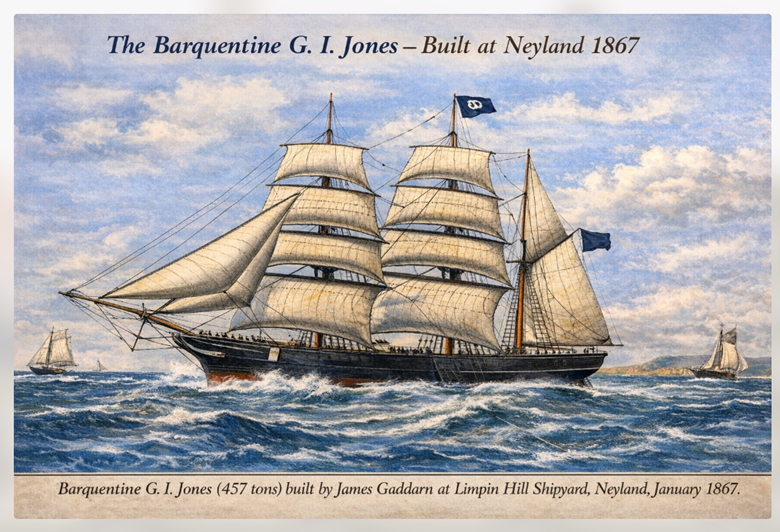
One of the best-known ships from the yard was the 457-ton barquentine G. I. Jones launched in January 1867. The vessel traded widely before being wrecked on 1 September 1883 at Perranuthnoe in Cornwall, where eleven members of her crew lost their lives.
Steamship construction
By the early 1870s Gaddarn’s yard was increasingly turning to steamship construction. Among the vessels built during this period were the steamer Plover, built for a Liverpool merchant, and another vessel known as No. 17 for William Grantham of Newport.
Further ships included Glamorganshire and Denbighshire, both steam vessels employed in commercial service.
The final ships associated with the Limpin Hill yard were the steamers Bessemer and St Ethelolf. Both were reportedly launched on 8 April 1875, marking the end of large-scale shipbuilding at the site.
The Joshua Mills Shipyard
Following the decline of Gaddarn’s enterprise, shipbuilding in Neyland continued under Joshua Mills (1843–1920), who became the last major private shipbuilder in the town.
Mills had grown up locally and learned the trade of ship’s carpenter from his father. After working with Gaddarn and at the Pembroke Dock Co-operative Shipbuilding Company, he eventually took over the Limpin Hill yard and continued building vessels into the late nineteenth century.
Many of Mills’ ships were named after members of his own family.
The first of these was the 135-ton schooner Percy, launched in 1879 and named after his eldest son. Another vessel, the 54-ton schooner Howard, was also constructed at the yard.
Among the most notable ships built by Mills was the 163-ton schooner Alice May. She traded widely but was eventually lost in a storm in 1890 while returning from the West Indies.
Another vessel, the 127-ton schooner Edith Maud, was registered at Milford Haven in 1888. She was wrecked on 13 May 1893 near the Rio Grande, although her crew survived.
Further ships included the 149-ton schooner Bertie Mills and the 194-ton schooner Mary Mills, the largest vessel constructed by Joshua Mills.
The Marriage of the Gaddarns and the Mills Families
A significant family connection was established in 1875 when Joshua Mills married Mary Gaddarn, a niece of James Gaddarn. This marriage created a direct link between the two shipbuilding families and effectively tied the future of the Neyland shipyard to the next generation.
The End of the Neyland Shipyards
By the late nineteenth century shipbuilding on the Milford Haven waterway was changing rapidly. The rise of large industrial shipyards and iron-hulled steamships meant that the small private yards of Neyland and Llanstadwell could no longer compete.
Ship construction increasingly shifted across the Haven to the Royal Dockyard at Pembroke Dock, where larger facilities and industrial methods dominated.
Although shipbuilding in Neyland gradually declined, the vessels built there carried the town’s name to ports across Britain and around the world. Today their legacy survives in local records, maritime archives and the continuing history of the Milford Haven waterway.