By Carol Elliott
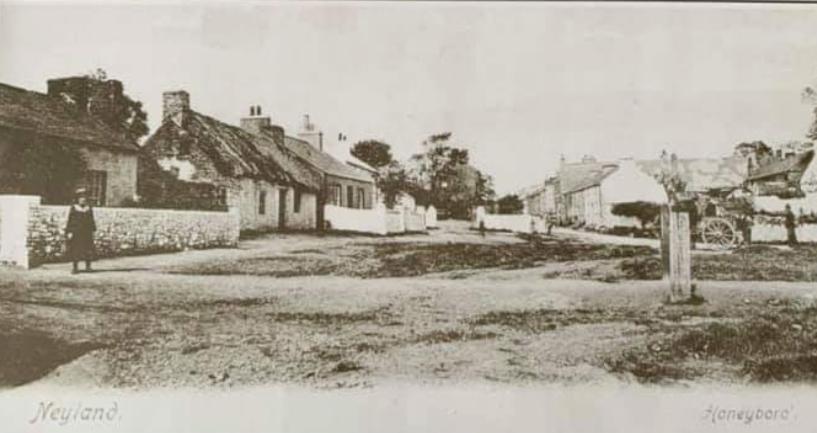
Introduction
The Medieval village of Great Honeyborough was here long before Neyland became a railway town in 1856. Great Honeyborough had already been in existence for over 500 years. Medieval manuscripts called it Hunteborch or Honiborth, and by the 1200s it ranked among the largest village estates in south Pembrokeshire. Its complex strip fields system was measured not just in acres but in knight’s fees, the currency of feudal power, and its tenants owed service to some of the most powerful marcher lords in Wales. Families such as the Hunteborchs, Melyns, Robelyns, and de la Portes lived here, their names preserved in charters, inquisitions, and court rolls. During the 1600s the manor was shared between the Perrot, Bowen and Scourfield dynasties; these were succeeded by the Batemans and the Taskers. By the fifteenth century the Batemans of Rosemarket had taken possession, linking Great Honeyborough into the networks of the county gentry. After 1810 it was held by farming tenants.
Great Honeyborough History
Honeyborough is recorded in medieval documents under several spellings, Hunteborch, Honiborth, and Honyburgh. The settlement almost certainly existed before the Norman conquest of south-west Wales, when this area formed part of the Welsh kingdom of Dyfed. After the late eleventh century, Norman knights and Flemish settlers established control of south Pembrokeshire. The land was reorganised into marcher baronies, each owing service directly to the Crown.
Honeyborough fell within the barony of Walwyn’s Castle, controlled by the de Brian family (Edwards 1956, p. 332). The marcher system measured holdings in knight’s fees, each representing the obligation to provide one mounted knight or the equivalent payment (Round 1901, p. 57). Honeyborough’s obligation amounted to about one and a half knight’s fees, along with two and a half carucates of land (around 260 acres). This was a substantial portion of the barony, which contained around twelve knight’s fees in total, compared with about seven in the neighbouring barony of Roch (Green 1912, p. 269). Roy Mason, in his unpublished notes, underlined that Honeyborough was “one of the largest villages among the knight’s fees of the Lordship of Haverfordwest.”
Note: Honeyborough was one of the largest holdings in the Lordship of Haverfordwest
Most village estates owed a fraction of a knight’s fee. Honeyborough’s obligation of 1½ knight’s fees plus 2½ carucates (around 260 acres) placed it among the largest village holdings in the Lordship of Haverfordwest.
Knight’s Fee
A unit of feudal landholding. In theory, it was the amount of land needed to support one mounted knight. Instead of always providing military service, tenants often paid a cash sum (scutage) or performed duties in the lord’s court.
Carucate
A measure of land used in medieval surveys, based on the area that could be ploughed in a year by a team of eight oxen. Roughly 120 acres.
Thirteenth Century
In 1219 William de Brian, Lord of Walwyn’s Castle, holding land in Hunteborch, was recorded as a witness to charters (Cal. Charter Rolls, Hen. III, p. 178). At this time the earldom of Pembroke was held by the Marshal family, one of the most powerful Anglo-Norman lineages in the British Isles (Painter 1933, pp. 215–18). After the Marshals died without male heirs in 1245, the earldom passed in 1247 to William de Valence, half-brother of Henry III (Prestwich 1988, p. 73). Honeyborough was already recognised as a defined estate within this framework.
Fourteenth Century
The inquisition post mortem of Guy de Brian, taken in 1307, listed “2½ carucates in Hunteborch” held by homage, an annual rent of 5s. 4d., and the obligation of fortnightly attendance at the baronial court of Walwyn’s Castle (CIPM, Edward I, vol. 5, no. 347). The tenant was Robert de Hunteborch, the first known to adopt the surname from the place.
Inquisition Post Mortem (IPM)
An official enquiry made after the death of a landholder who held land directly from the Crown or a marcher lord. Local juries reported what land was held, what obligations were owed, and who the heir was. IPMs are key sources for medieval historians because they record ownership, rents, and services in precise detail.
By the 1330s, the estate was associated with the Augustinian Priory of St Thomas at Haverfordwest. Canon John de Honyburgh was appointed prior in December 1331 by Bishop Henry Gower of St David’s (Barrow 1973, p. 241). Although the priory was based in Haverfordwest, its canons styled themselves “of Honeyborough” owing to their tenure of its lands (Edwards 1956, p. 332).
In 1324 an inquisition recorded John de la Porte, John Melyn, and Alexander Robelyn as holding one and a half knight’s fees at “Honiborth” (CIPM, Edward II, vol. 6, no. 212). By 1344 John Melyn was witnessing deeds with William Robelyn (NLW Picton Castle Deeds, no. 113). In 1351 John Melyn and his wife Joanna appeared in court at Haverfordwest (CPR, Edward III, 1351, p. 276). In 1358 John de la Porte held a manorial court at Honeyborough (Cardiff MSS, Deeds, LP 106). The de la Porte family continued into the 1360s, when both John “senior” and “junior” are distinguished in documents (CIPM, Edward III, vol. 12, no. 178).
Later Fourteenth Century
By the 1380s Honeyborough passed through marriage into new hands. Isabella de la Porte, daughter of John de la Porte and widow of Thomas Baskerville of Haverfordwest, conveyed lands in Honeyborough to William Bateman in 1385 (NLW, Picton Castle Deeds, 8 Ric. II). In 1389 she released further lands in Honeyborough and Norton Hill to John Bateman and his wife Margaret Ward (Cardiff MSS, LP 106).
At the same time, the earldom of Pembroke entered a period of change. John Hastings, Earl of Pembroke, died in 1389 at a tournament, aged only seventeen (Goodman 1992, p. 201). With his death the hereditary earldom ended, and the title thereafter was in the gift of the Crown.
Early Fifteenth Century
By 1438 Isabella Baskerville, still living, confirmed her earlier grants to John Bateman and Margaret Ward. These covered lands in Honeyborough, Newton, Norton, Rosemarket, Scoveston, Norton Hill, and Cuffern (NLW, Picton Castle Deeds, 16 Hen. VI). The Bateman family thus became established as the principal lords of Honeyborough in the fifteenth century.
Honeyborough’s recorded history shows a consistent pattern of significance within the marcher system of south Pembrokeshire. Its obligations of one and a half knight’s fees and two and a half carucates of land placed it among the largest village holdings in the Lordship of Haverfordwest. Through the thirteenth and fourteenth centuries, the estate passed from the de Brians to local tenants such as the Hunteborchs, Melyns, Robelyns, Perrots, and de la Portes, and eventually to the Batemans of Rosemarket. These changes reflected wider shifts in lordship, from the Marshal and Valence earls to the Hastings family, and finally to Crown-appointed earls after 1389.
As Roy Mason concluded in his survey: Honeyborough’s scale and continuity “set it apart from other village estates in south Pembrokeshire and make it central to understanding the medieval landholding structure of Llanstadwell parish.”
Sources and Bibliography
Primary Sources
-
Calendar of Charter Rolls, Henry III. London: HMSO, 1903.
-
Calendar of Inquisitions Post Mortem (CIPM), Edward I–III. London: HMSO, 1904–.
-
Calendar of Patent Rolls, Edward II–III. London: HMSO, various years.
-
National Library of Wales, Picton Castle Deeds (catalogued collection).
Secondary Sources
-
Barrow, G.W.S. The Anglo-Norman Church. London: Longman, 1973.
-
Goodman, Anthony. The Loyal Conspiracy: The Lords Appellant under Richard II. London: Routledge, 1992.
-
Owen, George. A History of Pembrokeshire. London, 1892.
-
Painter, Sidney. William Marshal: Knight-Errant, Baron, and Regent of England. Baltimore: Johns Hopkins Press, 1933.
-
Prestwich, Michael. Edward I. London: Methuen, 1988.
-
Round, J.H. Feudal England. London: Swan Sonnenschein, 1901.
-
Smith, J. Beverley. Llywelyn ap Gruffudd: Prince of Wales. Cardiff: University of Wales Press, 1972.
Local and Archaeological Sources
-
Dyfed Archaeological Trust. Neyland: Historic Landscape Characterisation. HER Report, 2000s.
-
Dyfed Archaeological Trust / Coflein. Excavations at Newton, Llanstadwell, Pembrokeshire. Report, 2004 (includes references to Great Honeyborough and tithe maps).
Local/Unpublished Sources
-
Mason, Roy. Notes on Honeyborough and Llanstadwell. Manuscript collection, Pembrokeshire Record Office (HDX/1554).