By Carol Elliott
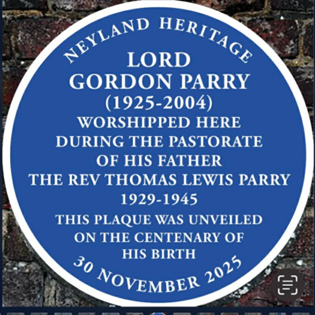
On 30 November 2025, the Neyland and Llanstadwell Heritage Group marked the centenary of the birth of Lord Parry of Neyland with a commemorative event that brought together memory, place, and public history. He had been born 100 years ago on 30 November 1925. A blue plaque was unveiled on the wall of Bethesda Baptist Chapel, Neyland, where his father, the Rev. Thomas Lewis Parry, had served as minister from 1929 to 1945.
Inside Neyland Library at the Neyland Hub, Lord Parry is further remembered through his bronze bust, a striking likeness that is often mistaken by visitors for Isambard Kingdom Brunel, a confusion that reflects both the strength of the sculpture and the wider historical associations of the town.
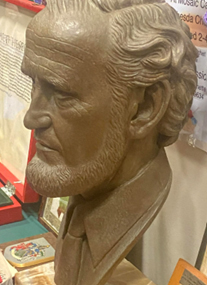
Yet behind that familiar face lies a story that is unmistakably Neyland’s own. The Neyland boy who became - Lord Parry of Neyland.
Gordon Samuel David Parry was born on 30 November 1925, at Molleston, near Narberth, where his father was then preaching. In 1929 the family moved to Neyland when his father accepted the ministry of Bethesda Chapel.
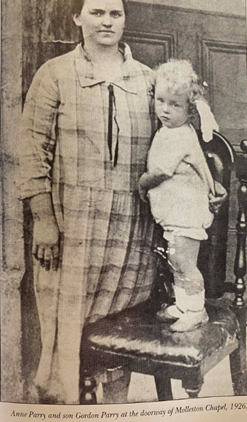
Those formative years, spent in a close-knit railway and chapel community, shaped Gordon’s lifelong sense of identity. In his memoir A Legacy for Life, he recalls the influence of chapel discipline, education, and community life, all of which remained central to his outlook long after he had left Pembrokeshire.[1]
They lived in John Street, and Gordon soon became part of the town, making many friends. He threw himself into everything that Neyland offered. He joined in the sports, the choir, and the dramatics, developing not only confidence but a deep love of community life. These were not passing childhood interests. They were the foundations of a lifelong commitment to people, performance, and public engagement. [1]
From those first years, Neyland to Gordon was not simply a place of residence but a place of belonging. He grew up in this close-knit railway town and had many an adventure when living on the banks of the Cleddau estuary. He later recalled how quickly he became part of the life of the town, making friendships that would endure and immersing himself fully in its social world.[1]
Education began at Neyland Infants’ School, where he appears in the 1929 class photograph under Miss Leggat. (He is top row on the right).
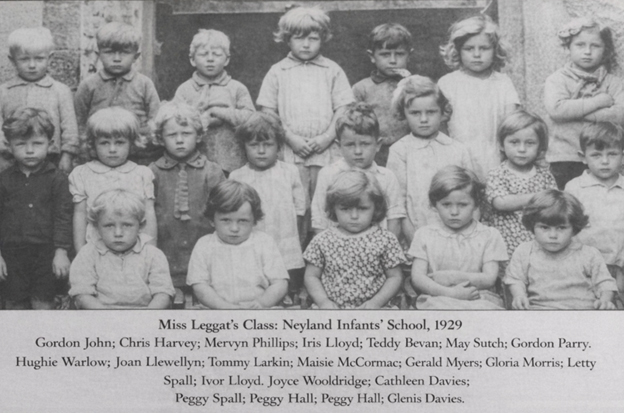
From there he progressed through his schooling during years that were shaped by wider events, including the disruption of the Second World War. Yet throughout these early years, the influence of chapel life remained constant. Bethesda Chapel was not simply his father’s place of work. It was the centre of family life, discipline, and moral grounding, and it placed Gordon at the centre of a network of relationships that extended across the town.
His upbringing combined modest circumstances with strong expectations. The manse brought a certain standing, but it also carried responsibility. Visitors, parishioners, and chapel activities were part of everyday life, and Gordon grew up observing leadership at close hand. At the same time, the ordinary experiences of Neyland life remained central. He was a local boy among local boys, shaped as much by the playground, the streets, and the estuary as by the pulpit.[1]
What emerges clearly from his own recollections is that Neyland gave him confidence, identity, and ambition. The town provided the stage on which he first learned to speak, to perform, and to lead. The friendships he formed, the activities he embraced, and the values instilled through chapel life all combined to shape the young Gordon Parry.[1]
He was educated at Pembroke County School and then at Trinity College, Carmarthen, during the WW2 years - an experience he later described as transformative. Trinity College, Carmarthen marked his transition from a small-town upbringing into a wider intellectual and professional world.
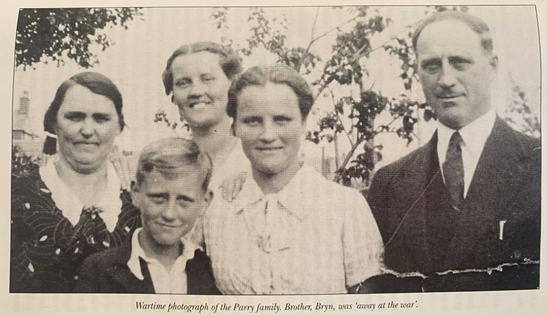
After further study at the University of Liverpool Institute of Education, he returned to Pembrokeshire to begin his career in teaching.
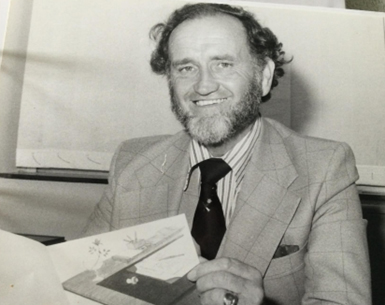
Most of his working life was spent at Haverfordwest Secondary Modern School, where he taught English and served as a House Master. His reputation as a teacher was remembered with warmth and clarity. At his funeral in 2004, his godson, the broadcaster Jamie Owen, recalled: “What a joy to find yourself in a class, being taught English by Gordon Parry.” That remark captures something essential about him. Before he was a peer, a chairman, or a public figure, he was a teacher who inspired people.[2]
He married Glenys Incledon in 1948 and they had one daughter, Catherine (Cathy), born in 1955, who sadly passed away in 2026. Family life remained important to him throughout his career, even as his public responsibilities expanded.[3]
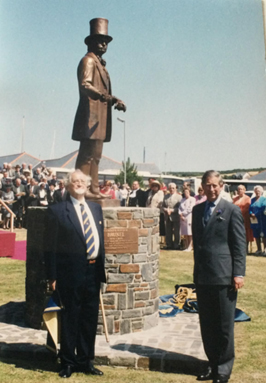
was unveiled on 14 July 1995 by Charles, Prince of Wales
with Lord Parry looking on.
Alongside his work in education, he became increasingly active in public life. He served locally, including as Mayor of Neyland, and stood several times as a Labour parliamentary candidate. Although he did not enter the House of Commons, his political work was recognised, and in 1975 he was elevated to the peerage, becoming Baron Parry of Neyland. The choice of title was deliberate and deeply personal. He carried Neyland with him into the House of Lords, where he served from 1976 until his death in 2004.[4]
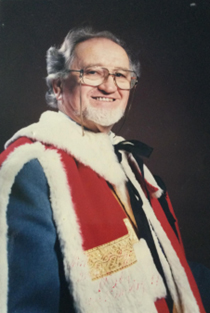
From the late 1970s his career took on a national and international dimension. In 1978 he became Chairman of the Wales Tourist Board, a position to which he was reappointed in 1981. This role placed him at the centre of efforts to promote Wales on the world stage. He travelled extensively in this capacity, visiting Australia, Japan, China, Europe, and the United States, promoting Wales not simply as a destination but as a living culture with its own identity and heritage.[5]
His international work brought him into contact with leading figures of the late twentieth century. In the United States he visited the White House and met President George H. W. Bush, and in Georgia he developed a close association with President Jimmy Carter, even preaching alongside him at Carter’s chapel in Plains, Georgia. His American connections were long-standing, and he became a regular visitor, particularly through Welsh cultural and tourism links.[6]
His global reach extended further. In Australia he lectured at James Cook University, Queensland, recognition of his work in tourism and cultural promotion. His presence at major international events, including discussions surrounding World Expo 88 in Brisbane, reflects his role in connecting Wales to wider Commonwealth and global networks.[7]
At home, his public service was equally extensive. He served as:
- Chairman of the Wales Tourist Board (1978–1984)
- Chairman of Keep Wales Tidy (1979–1986)
- Chairman of the British Cleaning Council (1983–1987)
- Chairman of Milford Docks Company (1984–1991), later President (1991–2004)
- Chairman of the Keep Britain Beautiful Campaign (1986–1996)
- Chairman of Clean World International (1991–1996)
He was also a member of the Welsh Development Agency, associated with the Welsh Arts Council, and involved in broadcasting and public communication. These roles reveal a consistent theme. Gordon believed that environment, culture, tourism, and civic pride were all part of the same task: the presentation and improvement of place.[8]
Cultural life remained central to him. He was President of Côr Meibion De Cymru and a particularly proud President of Neyland Ladies Choir, maintaining close links with local musical traditions. His ability to move easily between local and international spheres was one of his defining characteristics.[9]
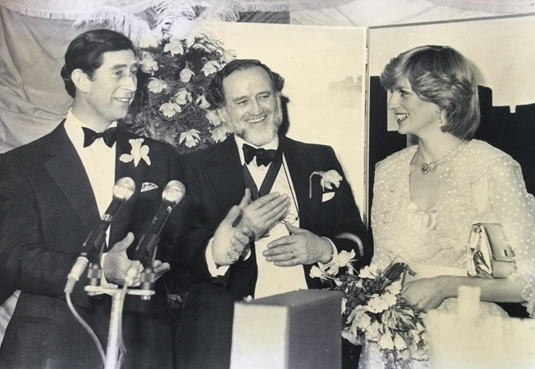
His public life brought him into contact with a wide range of figures from politics, royalty, and culture. Photographic and local evidence records meetings with members of the Royal Family, including Prince Charles and Diana, Princess of Wales, as well as public figures such as Princess Margaret, Margaret Thatcher, Max Boyce, and Catherine Zeta Jones.
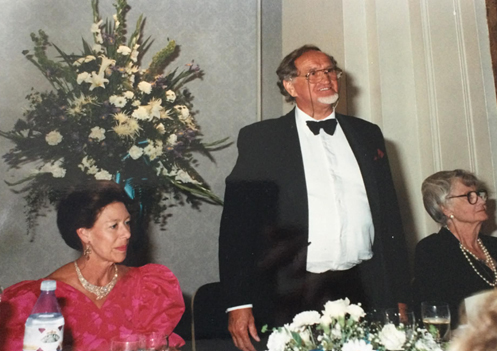
These encounters reflect both his public standing and his role as a representative of Wales in national life. As always, however, he remained grounded in Neyland, where he was affectionately known simply as “Lord Gord.”[10]
He died on 1 September 2004 at Llangwm, Pembrokeshire. His legacy is preserved not only in national records and honours but in the memory of the town that shaped him. The blue plaque at Bethesda Chapel and the bronze bust in Neyland Library are not simply commemorations. They are reminders that one of Neyland’s own carried its name, identity, and values onto the world stage, and never forgot where he came from.
Notes
[1] Gordon Parry, Trinity ’43–’45: A Legacy for Life (Carmarthen: Trinity College, 1996), photographs reproduced within the text.
[2] Funeral tribute quoted in local commemorative material, Neyland (2004).
[3] Meic Stephens, “Lord Parry,” The Independent, 6 September 2004.
[4] UK Parliament, “Lord Parry: Parliamentary career”; Hansard, House of Lords, 27 January 1976.
[5] Wales Tourist Board records; Stephens, “Lord Parry,” The Independent.
[6] Stephens, “Lord Parry,” The Independent; corroborated by Welsh National Gymanfa Ganu historical material.
[7] Hansard, House of Lords, “World Expo 88,” 10 March 1988; Gymanfa Ganu history.
[8] Stephens, “Lord Parry,” The Independent; National Archives, political accessions (Wales Tourist Board).
[9] Neyland Ladies Choir, historical notes; local choir records.
[10] Local photographic archive and exhibition material, Neyland and Llanstadwell Heritage Group.
Bibliography
Stephens, Meic. “Lord Parry.” The Independent, 6 September 2004.
Parliamentary Archives and Hansard Debates.
Parry, Gordon. Trinity ’43–’45: A Legacy for Life.
National Archives, political accessions (Wales Tourist Board).
Welsh National Gymanfa Ganu Association, historical publications.
Neyland Ladies Choir, local historical records.
Neyland and Llanstadwell Heritage Group, exhibition materials.