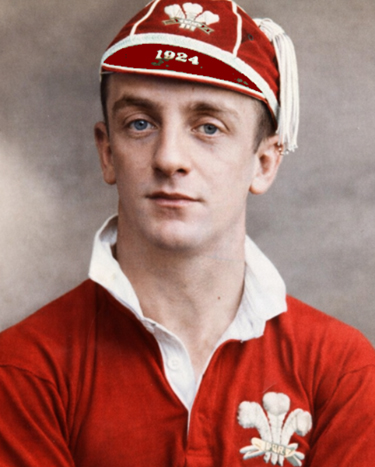
There are moments in the life of a town when one of its own steps beyond its boundaries and carries its name into the wider world. For Neyland, in the early decades of the twentieth century, that figure was Thomas Evans, A Neyland rugby player, the town’s first and, for many years, only full Welsh international.
Evans was born on 8 May 1902 in Neyland, at a time when the town itself was still in its formative years. The arrival of the South Wales Railway in 1856 and the development of the harbour had transformed what had once been a quiet stretch of shoreline into a working port community, alive with industry and opportunity. It was in this environment that rugby flourished, becoming the natural outlet for the strength and energy of its people.
A record preserved in the Neyland Women’s Institute scrapbook of 1953 notes that he was the son of Neyland’s first surveyor, Mr Thomas “Tommy” Evans, a position central to the planning and development of the settlement [1]. This detail is of particular importance, for it situates Evans not simply as a sportsman, but as part of the generation whose families were directly involved in shaping the physical and civic fabric of Neyland itself.
In the book, Neyland Rugby Football Club Centenary History it records Evans in its section on international honours, identifying him as the club’s only full international and noting his Welsh cap of 1924 [2]. It is highly probable that Evans’s earliest rugby was played locally during the immediate post-First World War years. By the late 1910s and early 1920s, Neyland RFC was rebuilding after wartime disruption, and younger players were stepping into senior roles as the club re-established itself within Pembrokeshire rugby.
Evans’s progress beyond Neyland followed a well-established pathway. He moved to play for Plymouth Albion, a club formed in 1920 and closely associated with the naval and maritime communities of Devonport and Plymouth [3]. From there he advanced to represent Devon County, a level of rugby that brought him into contact with players of recognised regional and national standing [4]. Such progression was essential, as Welsh selectors of the period drew heavily upon players competing at the highest levels of club and county rugby.
Playing as a centre, Evans occupied a position that demanded both physical resilience and tactical awareness. His selection for Wales in 1924, for the Five Nations Championship match against Ireland at Cardiff Arms Park, marked the culmination of this rise [5]. Although he won only a single cap, the achievement remains of considerable significance, particularly for a player whose origins lay in a small and comparatively young town.
A further distinction in Evans’s career lies in his participation against the touring New Zealand side of 1924–25, later known as the “Invincibles.” During that season, he appeared for Swansea RFC in their match against the tourists at St Helen’s Ground on 27 September 1924 [5]. Evans’s inclusion places him firmly within the upper tier of players active in Britain at that time. At this game, Swansea RFC met the touring New Zealand side, the famed “Invincibles”, at St Helen’s Ground in what was one of the most prestigious fixtures of the tour. Before a large and knowledgeable Welsh crowd, Swansea, one of the strongest club sides in Britain, faced a team whose speed, organisation and skill were already proving unmatched. The All Blacks dominated the match throughout, running in multiple tries to secure a decisive 39–3 victory, a result that confirmed their formidable reputation and marked one of the earliest demonstrations in Wales of their exceptional standard of play. The All Blacks of this tour were among the most formidable teams ever assembled, playing 32 matches without defeat and establishing a reputation that has endured in rugby history [6].
He did not add further caps to his Welsh record, a circumstance not uncommon in an era of intense competition for places. Nevertheless, his achievements ensured his place within both national and local sporting history.
Evans died on 6 August 1969 in Carmarthen, but his legacy endures. In him, Neyland produced a player who not only reached international honours but also took part in one of the defining encounters of early twentieth-century rugby. The Neyland RFC history, in recording him simply as its only full international, captures his importance, even if much of his story lies beyond its pages [2].
His career reflects both the opportunities and the limitations faced by players from smaller communities. It illustrates the necessity of moving beyond local rugby to achieve recognition, while also demonstrating the depth of talent that such communities could produce. Above all, Thomas Evans remains a figure of enduring pride in Neyland’s history: a player shaped by the town, who carried its name onto the wider stage.
References
[1] Neyland Women’s Institute, Scrapbook of Local History and Notable Residents, 1953, manuscript entry relating to Thomas Evans (unpublished; private collection).
[2] Neyland Rugby Football Club, Neyland Rugby Football Club Centenary History, 1885–1985 (Neyland: Neyland RFC, 1985), section “International Caps.”
[3] Terry Godwin, The Official History of Plymouth Albion RFC (Plymouth: Plymouth Albion RFC, 2000); see also “Plymouth Albion R.F.C.”, Wikipedia, https://en.wikipedia.org/wiki/Plymouth_Albion_R.F.C.
[4] Devon Rugby Football Union, History of Devon County Rugby Football Club (Exeter: Devon RFU, various editions); see also “Devon County Rugby Football Club”, Wikipedia, https://en.wikipedia.org/wiki/Devon_County_Rugby_Football_Club
[5] “Tommy Evans (rugby union)”, Wikipedia, https://en.wikipedia.org/wiki/Tommy_Evans_(rugby_union); includes biographical details, Welsh cap (1924), and association with Swansea RFC.
[6] Ron Palenski, Century in Black: 100 Years of All Black Test Rugby (Auckland: Hodder Moa, 2003); see also “1924–25 New Zealand rugby union tour of Britain, Ireland and France”, Wikipedia,