By Carol Elliott
This article is based on the published work of Richard Parker, together with primary material drawn from the Desmond Davies Collection, including contemporary notices, photographs, and Great Western Railway records preserved within the National Railway Museum archive. These sources allow the development, operation, and eventual decline of the Irish packet service at Neyland to be reconstructed from both narrative interpretation and surviving contemporary evidence.[1]
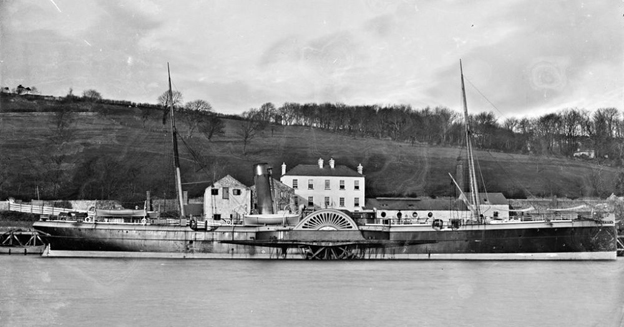
This photo shows the Paddle Steamer Milford. It is courtesy of the National Library of Ireland, and is from a glass plate by commercial photographers AH Poole of Waterford, and published by the NLI with no known copyright restrictions. The date of the photo would have been after 1884
Above : The Paddle Steamer Milford, was a new build when the GWR took over the Irish Packet Steamers in Neyland. It one of three sister ships ordered from Simons of Renfrew immediately after the Great Western Railway took over the Neyland - Waterford crossing in 1872. The ship above, the Milford, was scrapped in 1901 after it was deemed not worth repairing storm damage. Already antiquated at twenty-eight years, the turbine steamer revolution was about to begin and spelt a quick replacement for her two sisters
-o0o-
This story begins on 1 February 1872, when the Great Western Railway purchased the core of the Ford and Jackson fleet, packet steamers including the Malakoff, South of Ireland, and Great Western, for £36,500. The steamer Vulture was acquired shortly afterwards in April for a further £9,000.[2] This was not simply a financial transaction. It represented the consolidation of the entire route into a single, integrated system under railway control.
This takeover of the Irish packet service by the Great Western Railway in 1872 marked the start of the ‘Golden Era’ of Neyland (or New Milford as it was called until 1906).
What had been an uncertain and often struggling private enterprise under Ford and Jackson was now transformed into a fully organised and strategically important operation. With the backing of the GWR, who had the resources, the authority, and the vision of a major railway company behind it, Neyland was no longer simply a working harbour at the end of the line. It became a key gateway between Britain and Ireland.
The GWR brought order and reliability to a service that had previously struggled with inconsistency. Timetables were regularised, vessels were better maintained, and the connection between rail and sea was refined into a coordinated operation. Trains from London arrived at Neyland in direct connection with the departing steamers, creating a continuous journey from Paddington to Waterford. Mail, passengers, and goods moved through the system with a speed and efficiency that earlier operators had been unable to achieve.[3]
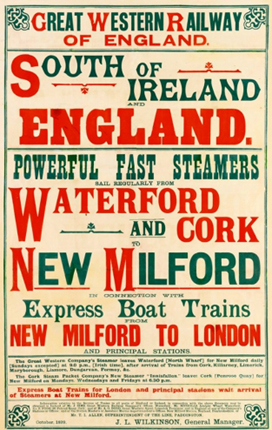
Everything was efficient and ran 'like clockwork’, and the scale of the operation expanded. New and improved vessels were introduced over time, and the service became a vital artery of communication between Britain and southern Ireland.
The GWR introduced new vessels. Ships such as the Milford, Waterford, and Limerick became familiar names at Neyland, carrying passengers, livestock, and freight across the Irish Sea on a regular schedule.[4]
Vessels taken over from Ford & Jackson in 1872
Malakoff (1872-1884, built in 1851 for use at Antwerp. After use by the British government in the Crimean war she was taken over by Ford & Jackson in 1856)
Great Western (1872-1878, built in 1867 by Simons of Renfrew 220.4 ft : 447 GRT. Oscillating. On Cherbourg route after 1878. Sold to David MacBrayne in 1891)
South of Ireland (1872-1883, built in 1867 by Simons of Renfrew 220.2 ft : 475 GRT. Oscillating. On Cherbourg route after 1872. Wrecked off Dorset coast on Dec 25th 1883)
Vulture (1872-1886, built in 1864 by Aitken & Mansell of Glasgow 243.2 ft : 382 GRT. Oscillating. To Ford & Jackson in 1870. Operated from Weymouth from 1879 until 1886)
GWR New Builds
Milford (1873-1901, built by Simons of Renfrew. 250.6 ft : 961 GRT. Compound diagonal 52 x 90 in x 70 in)
Limerick (1873-1874, built by Simons of Renfrew. 250.6 ft : 961 GRT. Compound diagonal 52 x 90 in x 70 in, lost)
Limerick (1874-1902, built by Simons of Renfrew. 251.8 ft : 961 GRT. Compound diagonal 52 x 90 in x 70 in)
Waterford (1874-1905. built by Simons of Renfrew. 251.4 ft : 963 GRT. Compound diagonal 52 x 90 in x 70 in)
With the new additions to the fleet, the integration of railway and maritime transport improved and allowed goods to move quickly from the industrial centres of Britain to Irish markets, while passengers could travel in a single, coordinated journey without the delays that had once defined the route.
This was the period in which Neyland was at its busiest and most important. Neyland was a bustling town. The harbour was active with the movement of vessels, the pontoon and landing stages were in constant use, and the railway station handled a steady flow of traffic linked directly to the packet service. The town itself benefited from this activity, with employment, trade, and local businesses all tied in some way to the operation of the route.
At the heart of this success was the principle that had underpinned the original vision of the railway. Neyland was not simply a harbour, it was ‘part of a system’. The railway brought the traffic, the ships carried it onward, and the entire operation depended on timing, coordination, and reliability.
Yet even at its height, there were signs that this position might not be permanent.
The limitations of Neyland’s location gradually became more apparent. The approach through the Haven, while sheltered, added distance to the sea crossing, and the facilities, though effective, were not purpose-built on the scale that modern traffic demanded. As the nineteenth century progressed, attention began to turn towards the possibility of a more direct route.
That alternative was Fishguard
By the early twentieth century, the Great Western Railway had begun to invest in the development of a new harbour at Fishguard, designed specifically to serve as a packet station. The key advantage was geographical. Fishguard offered a shorter sea crossing to Ireland and the potential for faster overall journey times between London and Irish ports. In an era where speed and efficiency were becoming increasingly important, this represented a significant advantage.[5]
The decision to transfer the Irish packet service was made in this context.
It was indeed a sad day in 1906, when the Great Western Railway moved its Irish Packet Steamer service from Neyland to Fishguard, bringing an end to fifty years of packet operations at the Haven.[6]
The impact on Neyland was immediate and profound
The departure of the packet steamers, removing the central function around which the town had developed, was dramatic. The steady flow of passengers, mail, and goods ceased, and with it the economic activity that had sustained local businesses and employment. The harbour, once busy with regular sailings, fell quiet, and the infrastructure that had been built to support the service was left without its primary purpose.
This was not simply a change in route. It was the loss of Neyland’s place within a national and international network.
In the years that followed, attempts were made to establish new industries, including the development of the fishing port, a fish market and ice factory in 1908, but these represented a different kind of activity, and they never fully replaced the scale or significance of the packet service.
Looking back, the GWR era stands as both the height of Neyland’s importance and the beginning of its decline. Under railway control, the Irish packet service reached its most efficient and organised form, placing Neyland at the centre of communication between Britain and Ireland. Yet it was that same drive for efficiency that ultimately led to its transfer elsewhere.
For a time, Neyland had been the ‘western gateway’ of the Great Western Railway, a place where rail met sea and where the movement of people, goods, and information passed through in a continuous flow. When the packets left in 1906, that role passed with them.
Footnotes
[1] Richard Parker, Neyland: A Great Western Outpost (2000); Desmond Davies Collection, including Great Western Railway material preserved in the National Railway Museum archive.
[2] Parker, Neyland, p. 32; Desmond Davies Collection; Great Western Railway acquisition records.
[3] Parker, Neyland, pp. 33–36; Desmond Davies Collection; contemporary Great Western Railway operational records.
[4] Parker, Neyland, pp. 33–36; Desmond Davies Collection; Great Western Railway vessel records and National Railway Museum archives.
[5] K. R. H. Mackenzie, The Railways of Pembrokeshire (Oakwood Press, 1987), pp. 90–95; Great Western Railway development plans for Fishguard Harbour.
[6] Parker, Neyland, pp. 45–47; Mackenzie, Railways of Pembrokeshire, pp. 90–95; contemporary railway reports on the opening of Fishguard Harbour, 1906.