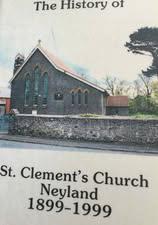
By Carol Elliott
The remarkable history of St. Clement’s, Neyland, was retold in the Western Telegraph on Wednesday, March 27th, 1985, in an article by Colin East entitled 'The Church That Blew Down'. The article was illustrated with photographs kindly provided by Mrs. Evelyn Skone of Saundersfoot and enriched by the research of Rev. Martin Likeman of Llanstadwell, to whom thanks and acknowledgements were given.
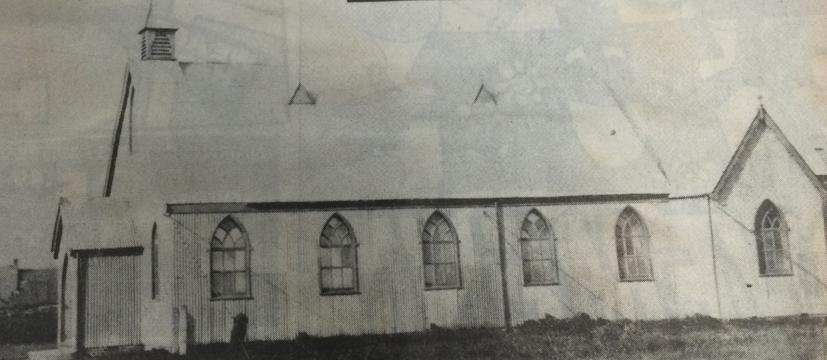
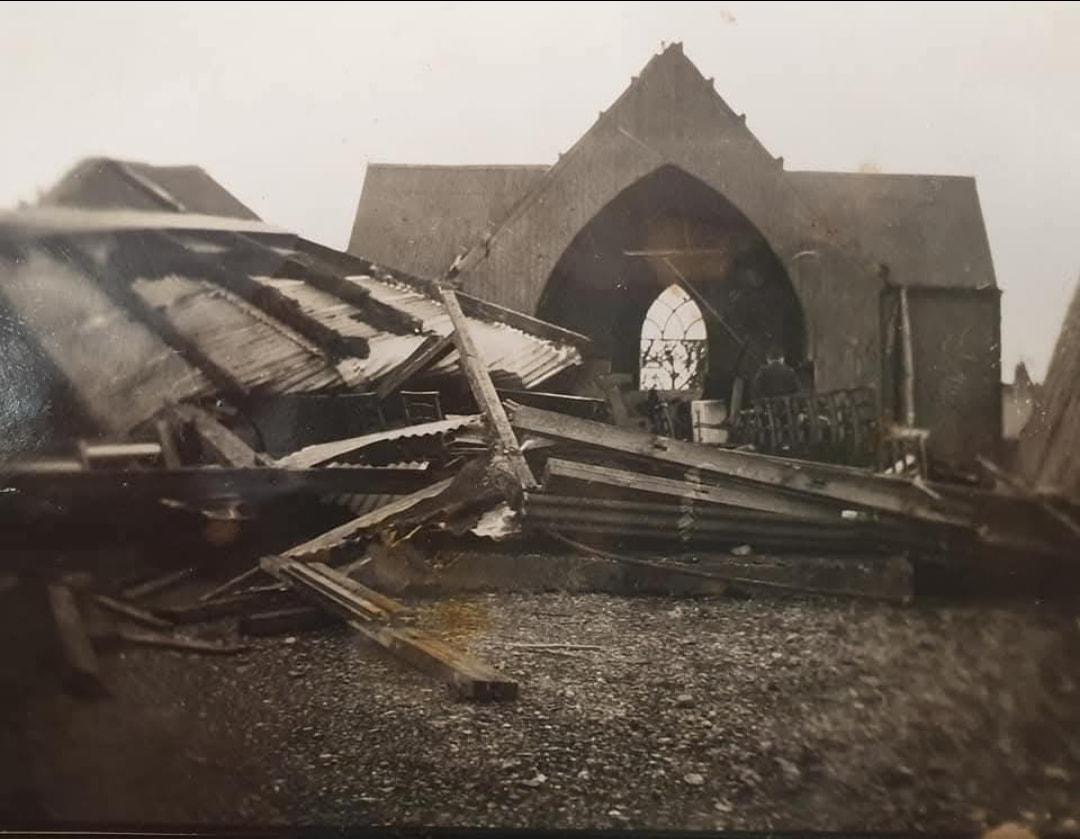
The first St. Clement’s was built of corrugated iron with pitch pine interior, designed to hold around 300 worshippers. It was dedicated on All Saints’ Day, November 1st, 1899, by Bishop John Owen of St Davids, during the incumbency of Rev. Lacey H. Rumsey, Vicar of Llanstadwell (d. 1915). For nearly 30 years it served as Neyland’s place of worship — until, on November 16th, 1928, a violent storm tore through the town and blew the building to the ground.
Determined to rebuild, the congregation laid the foundation stone of the present church on September 2nd, 1930, and it was dedicated on June 11th, 1931. The formal consecration service was conducted on July 18th, 1938 by Bishop Prosser, when Archdeacon Rice Thomas was Vicar of Llanstadwell.
Later, in 1940, Canon Barnard Jones became vicar. Though not present at the consecration, he later marked the 50th anniversary of the new St. Clement’s, celebrating its resilience and service to the people of Neyland.
St. Clement’s Church Today
Now, in 2025, the story of faith and resilience continues. The present incumbent is Rev. Alan Chadwick, leading an active congregation that gathers faithfully every week.
The adjoining Church Hall, adapted from the original corrugated-iron church, remains one of Neyland’s busiest and most beloved community venues:
- Souper Saturdays bring warmth and fellowship through the winter.
- Little Lambs baby and toddler group fills the space with life and laughter.
- Ladies’ exercise groups keep spirits high and bodies active.
- Local history talks connect the community with its past.
- And countless coffee mornings and tea afternoons keep friendships strong.
From its corrugated-iron beginnings in 1899, through the storm of 1928, to its thriving ministries and community spirit in 2025, St. Clement’s stands as a living testimony to the resilience of both faith and community.
NEWSPAPER EXTRACT with permission from the Western Telegraph
Western Telegraph, Wednesday, March 27th, 1985
The church that blew down
Then and Now No. 261
By Colin East
Designed as a daughter church to the Parish Church of Llanstadwell in the wake of the industrial development that spawned the town of Neyland, St. Clement’s church continues to play a useful part in the community some 50 years after it ceased in its original religious role.
What was once the site of religious worship for 300 parishioners in Neyland now provides an equally vital function as a church hall for the new St. Clement’s church built in 1930, and as the venue for the local badminton club, as a lecture hall and as a venue for special events.
With the growth of Neyland in the last century it was felt that there was need for a daughter church to the long-established Parish Church of Llanstadwell.
St. Clement’s church was therefore designed as a temporary church, being constructed of corrugated iron sheeting with pitch pine in the interior. The building, designed by Mr. M. L. Nichols, was erected by Messrs. Wilson and Company of London for the sum of £450. The church was dedicated on All Saints’ Day (Wednesday, November 1st) 1899 by the then Bishop of St. Davids, the Right Reverend John Owen.
An extract from the Haverfordwest and Milford Haven Telegraph of the following week read:
“The new structure which is of iron, sheeted interiorly with pitch pine, is quite an ornate little edifice, furnished throughout with a view to the comfort and the convenience of worshippers.
There is sitting accommodation altogether for about 300 people, which will be quite sufficient to meet the ordinary requirements of the district, although at the opening ceremony a large number were unable to get into the church at all, much less obtain seats.
The design of the building is that usually followed in churches of this kind. There is a vestry room, choir stalls, reading-desk and porch at the chief entrance, and the pulpit and reading desk are so situated that the preacher or reader may be heard in all parts of the house.”
Gospel
The report goes on to state that the afternoon ceremonies, which commenced at 3.30 p.m., included the ordinary church service. The prayers were intoned by the Rev. Lacey H. Rumsey, the Vicar of Llanstadwell. The sermon was preached by the Bishop, the Right Reverend John Owen, who took as his text St. Mark’s Gospel, chapter 14, verse 8, “She hath done what she could.”
During the service several musical items were rendered in excellent style by the choir of the parish church, about 40 voices, led by Mr. T. E. Williams.
Miss Gwen Griffiths presided at the organ, and it is stated, “rendered the accompanist in a faultless manner.”
The prayers included a new one sanctioned by the Bishop, for a speedy deliverance from war: “That it might end in a righteous issue and that friends who had gone to fight for their country might be comforted.”
The report ends with the postscript that an “excellent tea provided in the schoolroom afterwards by a number of generous ladies and their friends.”
Storm
The building was used continuously for church worship until November 16th, 1928 when a storm the whole structure was blown to the ground.
Both the original photograph and the present picture show the wire supports at the side of the building helping to keep it upright.
Following the damage church authorities decided to erect a new church adjacent to the old site. Work started on the new building which on completion had cost £4,500, just ten times the amount on the cost of the old church in 1899.
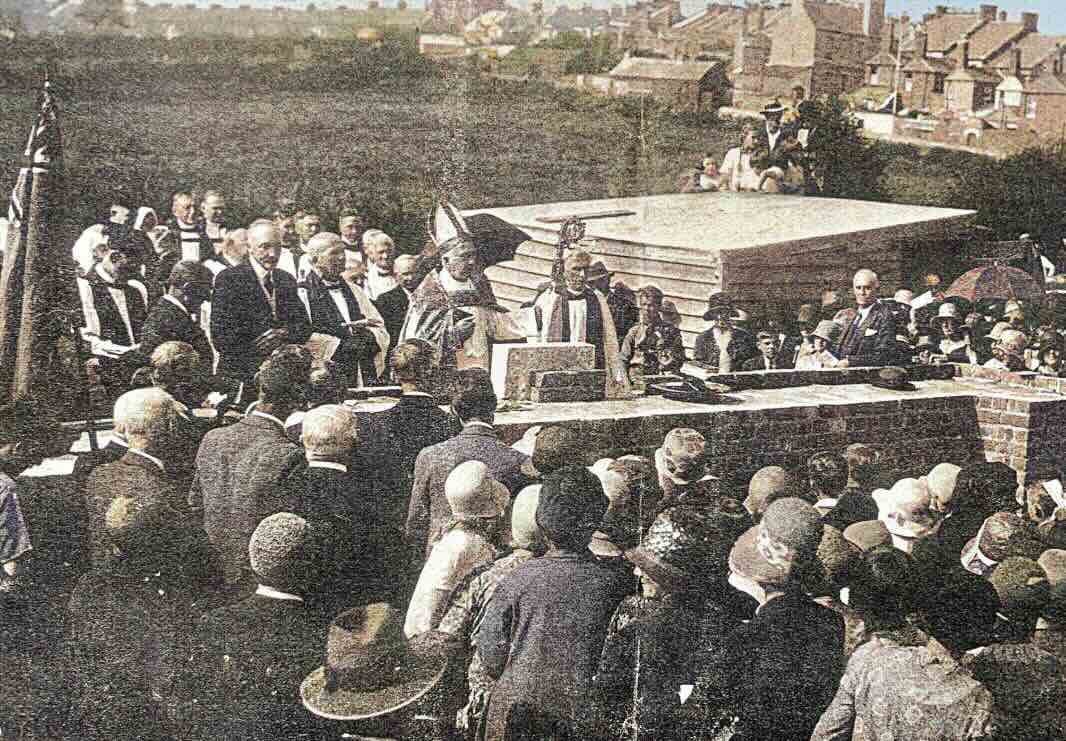
The then Bishop of St. Davids, Bishop Prosser, conducted the consecration service on July 18th, 1938 when Archdeacon Rice Thomas was Vicar of Llanstadwell.
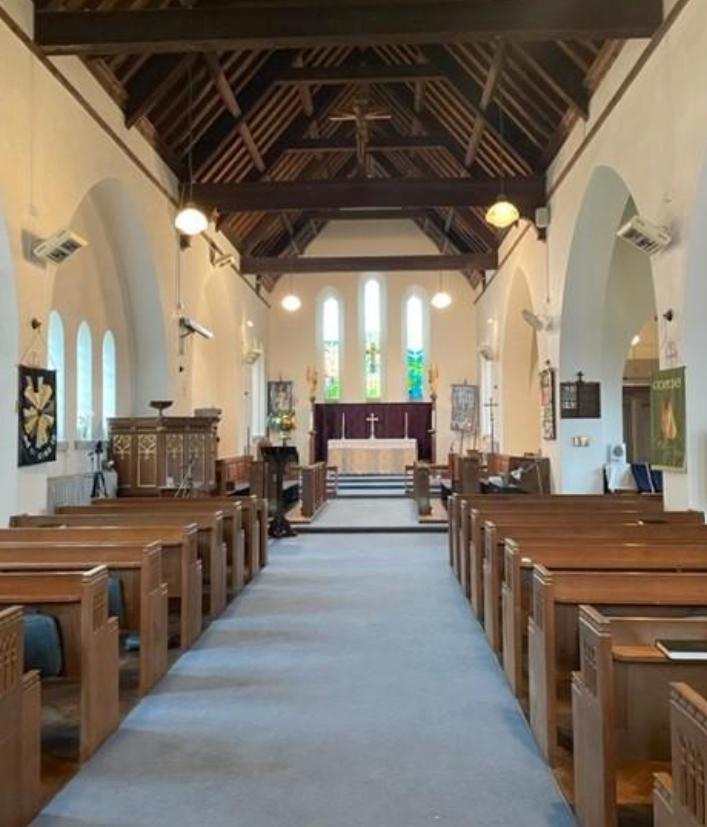
Some five years ago the new church celebrated its jubilee and the old church is still in use. The original structure, Canon Barnard Jones reported, was adapted to become the Church Hall of St. Clement’s and has served the people of Neyland for 50 years.
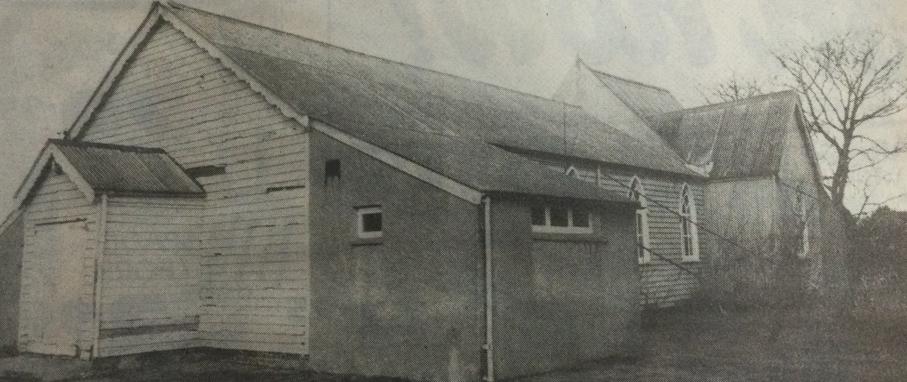
Since its re-erection the church hall has provided a much-needed facility for church organisations and events and has supplied a venue for community events of various kinds including plays, dramas, eisteddfodau, dances, sewing guilds and numerous other activities.
Today the church hall is still very much alive, hosting many church functions including the regular meetings of the Sunday School, meetings of the Girls’ Friendly Society and the Mothers’ Union branch. The local badminton club uses the hall which is also the venue for a number of lectures and for special events in the town. Last year a four-day Flower Festival was held at St. Clement’s in the last week-end in July, which was attended by hundreds of visitors.
It would seem that despite the storm of 1928 the church hall at St. Clement’s looks likely to continue in its religious and social role for many years to come.
This week’s old photograph is courtesy of Mrs. Evelyn Skone, Saundersfoot, with acknowledgements and thanks to the Rev. Martin Likeman of Llanstadwell for his extensive research and assistance.
BOOK EXTRACT – DISASTER STRIKES
This was the disastrous gale of 1928 as reported in the book "The History of St Clements Church 1899-1999" by Dr Simon Hancock. Chapter 3 is printed here with permission.
Chapter 3. Disaster Strikes.
Friday 16 November 1928 was a day that Neyland would never forget. Gale force winds of up to 100 miles an hour lashed Pembrokeshire, causing the Hobbs’ Point to Neyland Ferry service to be abandoned for a time, leaving passengers stranded on both sides of the Haven. Much damage was done to houses in Neyland, with roofs stripped and slates sent flying in all directions and many chimney stacks dismantled.
A big plate glass window, belonging to Mr Stanley Williams, draper, was blown in and smashed to atoms and damage caused to the Congregational schoolroom roof and some lead stripped from one of the tall spires of Bethesda Baptist Church. This was small beer in comparison with the havoc wreaked upon St. Clement’s Church.
The little church was practically destroyed, with the nave just a mass of broken timber and shattered iron sheets. The chancel did not entirely collapse but the east end was blown out and the roof and walls left in a precarious condition. Portions of the roof and side were carried by the wind across the road to the adjacent field. Under the direction of the Revd R. Rice Thomas the communion plate and other valuables were removed from the ruins when the wind subsided. It must have been a heartbreaking task. The vicar and the curate, the Revd H. Lewis, presented a sad picture as they viewed their demolished Church. Tears could be seen trickling down their faces.
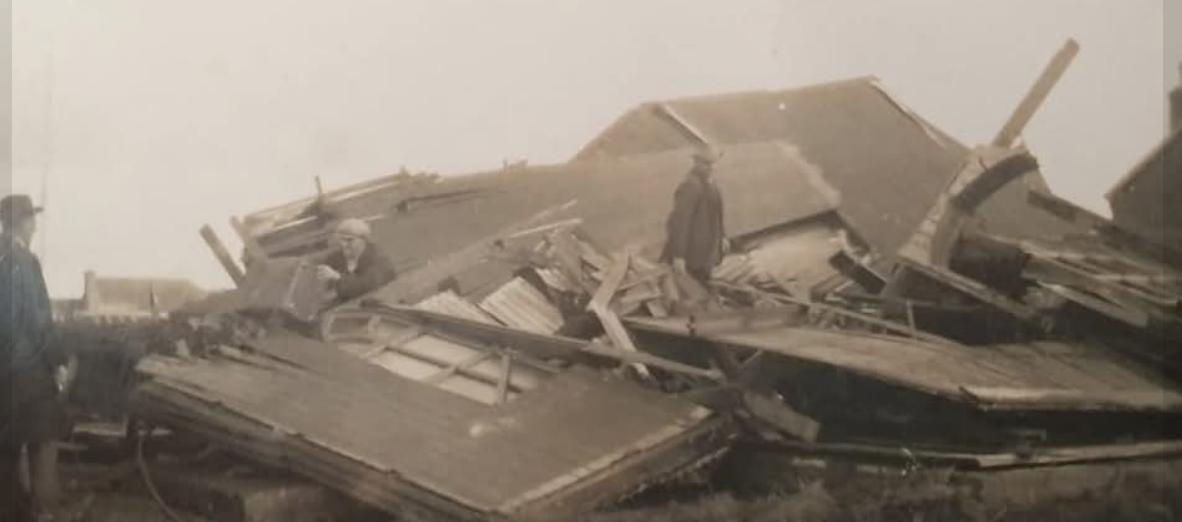
The terrible damage done to St. Clement’s Church attracted the attention of the whole area. In the log book of the National School, the Headmaster, Mr S. C. Webb, duly recorded “St. Clement’s Church was razed to the ground at about 12.30 on Friday.”
The St. David’s Archidiaconal Monthly Magazine for December 1928 gave a full account of the tragic situation. It paid tribute to those who on Friday afternoon made strenuous efforts to save all that they could from the wreckage. The article continued how…
“At any time the destruction of St. Clement’s Church would have been a disaster, but our difficulties have been made far worse by the fact that it has come upon us while we are straining hard to raise funds to save our Church Day School. About four years ago, the parochial church council decided to raise a fund for the building of a permanent church in Neyland, and a start was made, and there is at this moment the sum of about £250 on deposit at the Bank. The late Mr Coates Carter was consulted and he drew up plans for a beautiful little church, and these plans are still available if we decide to use them.”
In response to the disaster an emergency parochial church council meeting was held on Monday 19 November 1928. Mr George Harries, builder, was in attendance and helped the council with practical advice as to St. Clement’s Church.
The chairman, the Revd R. Rice Thomas M.A., informed the council that he had contacted the Lord Bishop of St. David’s, the Rt Revd D. L. Prosser immediately and his Lordship had replied most sympathetically and that he would visit the site and see the damage himself on 20 November. Archdeacon Joyce had also written sympathetically.