By Carol Elliott
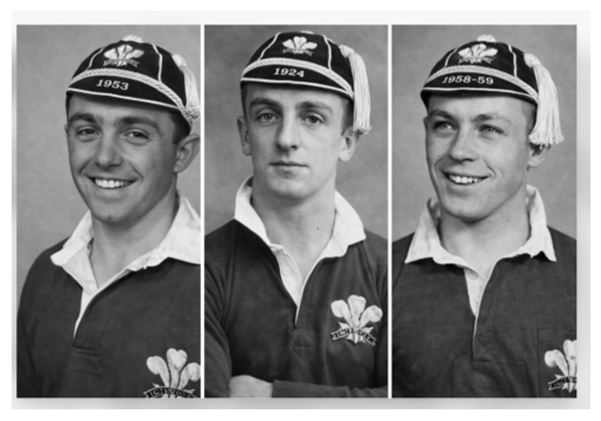
Notable Neyland RFC Players:
Graham L. Tregidon (left) – Won his Welsh Secondary Schools caps in 1952 and captained the Welsh team in 1953.
Thomas David Evans (centre) – Neyland’s first full international, winning his Welsh cap in 1924. Son of the town’s first surveyor, he went on to play at the highest level of the game.
Roland Price (right) – A Neyland winger who gained a Wales Youth cap in 1958–59, representing the next generation of the town’s rugby talent.
Neyland RFC - In the Beginning
Neyland Rugby Football Club was founded in 1885, at a time when the town itself was still taking shape as a railway and maritime settlement on the Haven. Unlike the older, more established communities of Pembrokeshire, Neyland was a place of industry, movement and new beginnings, and it was within this environment that rugby quickly found fertile ground.[1]
The early game in Neyland reflected the character of the town. The players were drawn from the railway, the docks and the sea, men accustomed to physical labour, and rugby suited them well. In these formative years, organisation was often loose and facilities rudimentary, but the enthusiasm for the game was unmistakable. Matches were played against neighbouring sides such as Pembroke, Haverfordwest and Llangwm, while teams from Llanion Barracks provided strong and disciplined opposition, helping to shape the standard of play in the district.[2]
By the late nineteenth century, rugby had become embedded in the life of the town. The Neyland RFC Centenary History notes how quickly the word “rugby” became synonymous with Neyland itself, an association that would endure for generations.[2] Though sometimes lacking the structure and resources of larger clubs, Neyland sides were known for their resilience and physical commitment, qualities that earned them respect across Pembrokeshire.
By the closing years of the nineteenth century, Neyland Rugby Football Club had begun to produce players whose names would be recognised locally, even if the records that survive today are fragmentary. Matches against the regimental sides stationed at Llanion Barracks proved particularly formative, exposing Neyland players to disciplined and physically demanding opposition. It is within this context that some of the earliest identifiable figures in the club’s history emerge.
Among those recorded in later recollections of the club are players such as Phillips, Harries, Bryant, Devondale and Wilks, names associated with the hard-fought encounters of this early period.[2] These men, alongside others now less clearly remembered, formed the backbone of Neyland sides that were beginning to establish both a reputation and a sense of identity. They were not professionals, nor were they widely celebrated beyond their district, but they represent the first generation of Neyland rugby men whose efforts carried the club forward.
One surviving reference to a Neyland side of this era, fielded against naval opposition, includes a line-up featuring Phillips, Harries, Bryant, Devondale, Wilks, Voyle, Martin, W. Harries, Everitt, Reeves, A. Lewis, J. Williams and Webb, a roll call which captures something of the character of the team: local men, many drawn from working backgrounds, united by the game and by the growing pride of their town.[2]
Contemporary reporting of rugby in this period was often sparse, yet what survives conveys both the roughness and the spirit of the game. Local newspapers occasionally captured glimpses of Neyland’s rugby life. One such report described a player as “a dead tackler, a sure kickist and slippery as the mackerel which slips through his grips,” a phrase that reflects both the humour and the toughness of the game as it was played on the Haven.[2]
These early players did more than simply take part; they established a tradition. They laid the foundations upon which later generations would build, ensuring that Neyland was already a place where rugby was deeply embedded in community life.
As the club moved into the early twentieth century, it began to develop a stronger sense of organisation. Match reporting became more regular, and there was a growing awareness within the town of the importance of recording and promoting the club’s achievements. Yet progress was interrupted abruptly by the outbreak of the First World War in 1914. Like so many communities across Wales, Neyland lost players to military service, and organised rugby all but disappeared during the war years.
The resumption of rugby after 1918 marked a period of rebuilding, and it was in this post-war generation that Neyland produced its most notable early figure: Thomas David Evans. Born in Neyland and the son of the town’s first surveyor, Evans stands as the clearest example of the club’s ability to nurture talent capable of reaching the highest level.[3]
Evans began his rugby in Neyland before moving on, as many ambitious players of the period were required to do, to stronger clubs beyond the county. His progression through Plymouth Albion and Devon County, and ultimately to Swansea RFC, reflects the pathway by which players from smaller towns could come to national attention. His selection for Wales in 1924 remains a landmark moment in the town’s sporting history, and he is rightly regarded as Neyland’s first full international.[2][4] In that same year, he took the field for Swansea against the touring New Zealand side at St Helen’s, placing a Neyland man directly in opposition to the famous All Blacks.[4]
The inter-war years saw Neyland RFC continue as a competitive and respected club within the local rugby landscape. Though it did not regularly produce players of international standing, it remained a vital part of the sporting life of the Haven, drawing its strength from the same working community that sustained the town itself.
Once again, however, the club’s progress was halted by global events. The outbreak of the Second World War in 1939 brought organised rugby to a standstill. Many players entered the armed forces, and the continuity of the club was again broken.
With the return of peace in 1945, Neyland RFC entered a new phase of reconstruction and renewal. A significant step came in 1946, when the rugby club joined with the town’s cricket club in a joint effort to secure and develop a permanent playing field, providing a foundation for stability in the years that followed.[2]
By the late 1940s and into the 1950s, the club was once again firmly established, and it is in this period that we see a new generation of representative players emerging from Neyland, continuing the tradition first embodied by Evans.
Among them was Graham L. Tregidon, who gained Welsh Secondary Schools honours in 1952 and captained the Welsh Schools side in 1953, a distinction that reflects both his ability and the strength of rugby in the town at that time.[2][3] A few years later, Roland Price, a winger from Neyland, gained a Wales Youth cap in the 1958–59 season. The Women’s Institute scrapbook preserves valuable local detail, identifying him as the son of Horace Price and Nellie (née Davies) of Kensington Road, Neyland, rooting his achievement firmly within the community.[3]
These men represent an important continuity. From Evans in 1924 to Tregidon and Price in the 1950s, Neyland consistently produced players capable of reaching representative honours, a testament to the enduring strength of rugby within the town.
By the end of the 1950s, Neyland RFC had emerged from two world wars and decades of change with its identity intact. It remained a club shaped by its people, sustained by local pride, and defined by a tradition of hard, uncompromising rugby.
Alongside the players themselves, Neyland Rugby Club depended upon a wider circle of townsmen whose commitment underpinned its early survival. Among them was Mr “Ted” Davies, long-serving treasurer of the club, described at his death in 1914 as an “old Neyland boy” deeply interested in all outdoor sports, and a man who rarely missed a match.[5] His role, and that of others like him, reminds us that Neyland RFC was never simply about those who took the field.
In all the history and the stories, we can see that Neyland RFC was, and remains, a community institution, rooted in service, loyalty and shared endeavour, where the manner of participation mattered as much as the result itself.
Footnotes
[1] Neyland Rugby Football Club, Neyland Rugby Football Club Centenary History 1885–1985 (Neyland: Neyland RFC, 1985), introduction.
[2] Neyland Rugby Football Club, Neyland Rugby Football Club Centenary History 1885–1985, early history sections and player references.
[3] Neyland Women’s Institute, Scrapbook of Local History and Notable Residents, 1953 (manuscript entries relating to Thomas Evans, Graham Tregidon, and Roland Price; private collection).
[4] Swansea RFC v New Zealand, St Helen’s Ground, Swansea, 27 September 1924; match records of the 1924–25 New Zealand tour.
[5] Haverfordwest and Milford Haven Telegraph, 16 December 1914, obituary of Mr “Ted” Davies.