The Reverend Lacy Henry Rumsey served the parish of Llanstadwell for 38 years during the “Golden Age of Neyland” (from 1873 to 1911).
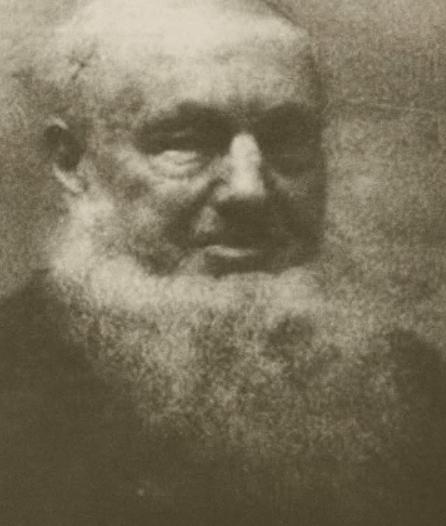
The Rev. Lacy Henry Rumsey, B.A. was born on 17 November 1824 at Sloane Street, London. He was the son of Lacy Rumsey (d. 1839), who served as Clerk of the Bills at the Treasury, and Elizabeth Churchill Spencer (1799–1870/71) the daughter of the 4th Duke of Marlborough. Through his mother, he was connected to the Spencer–Churchill line and the Dukes of Marlborough, whose descent can be traced back to King Edward III, William the Conqueror, and Charlemagne.
He studied at Cambridge, graduating BA in 1850 and MA in 1853. He developed wide scholarly interests and was competent in a number of languages including Latin and Greek, of course, but also in French and German while he was credited with a reading ability in Flemish, Dutch, Italian and Spanish, and, to quote, “even the complexities of Oriental speech did not deter him from acquiring an elementary knowledge of Chinese”.
He contributed articles on liturgical studies, chronology, theology, heraldry, and music and his published works included “The Office of Tenebrae in Music”, The True Date of the Crucifixion and Resurrection (c.1880), and To Find Easter (1900). He also wrote on liturgy, chronology, mathematics, astronomy, heraldry, and church music. His involvement in the London Gregorian Choral Association reflected his commitment to the revival of plainsong in Anglican worship.
His clerical career began overseas. In Jamaica he served as Vice-Principal of the Bishop’s College in Kingston and ministered in local parishes. He then moved to Australia, where he became incumbent of St Paul’s, Ipswich, Queensland. There he helped complete the church, introduced the first pipe organ in a Queensland church, and contributed to civic life through involvement in the hospital, the School of Arts, and local music societies. His time in the colonies gave him broad experience in pastoral, educational, and community leadership. In 1873 Rumsey was appointed Vicar of Llanstadwell in Pembrokeshire, a post he held until 1911.
His achievements in Llanstadwell included restoring St Tudwal’s Church, overseeing the construction of St Clement’s in Neyland, enlarging and supporting parish schools, and promoting healthcare through the appointment of a parish nurse and was also the instigator for the building of the bridge at Church lakes. He also encouraged many parish events and community gatherings as part of his ministry.
Rumsey’s study of mathematics and astronomy found practical expression in his navigation of the Cleddau and the Milford Haven Waterway. He kept detailed logs and applied astronomical methods to chart his course, an example of his ability to use scholarship in practical contexts.
He and his wife, Anne Nowell Bussell, raised several children, many of whom contributed to parish life. At his 80th birthday in 1904 and again at his retirement in 1911, parishioners honoured him with public tributes for his long service.
He remained at the vicarage until his death in 1915, a few weeks after his wife. Both were buried in Llanstadwell churchyard.
Memorials inside the church, include a pulpit, altar frontal, mural tablet, and later a pair of memorial doors were dedicated in his memory, ensuring that his work and service to the parish would be remembered.
Here is an except from “The Life and Times of Rev. Lacy Henry Rumsey”
St Tudwal’s Church - A Parish Transformed - Rev. Lacy Henry Rumsey’s Years in Llanstadwell
When Rev. Lacy Henry Rumsey accepted the living of Llanstadwell in 1873, he entered a parish under transformation. The arrival of the Great Western Railway terminus at Neyland in the 1850s had begun to shift the population and economic focus of the area.
Llanstadwell, Hazelbeach, and Neyland were no longer quiet rural hamlets but communities bound up with the new railway, the new gateway port to Ireland and the shipyard at Pembroke Dock. Rumsey, with long experience in colonial parishes, immediately grasped that the role of a vicar in such a place was not simply to preach sermons, but to organise, build, and educate for the benefit of his parishioners.
Restoring St Tudwal’s Church, Llanstadwell
When Rumsey arrived, the medieval parish church of St Tudwal’s at Hazelbeach was in the midst of extensive works. The ground level around the building had been raised, requiring the walls and floor to be lifted by four feet, and a new roof was under construction.1 During this period, services were held in the National School in Neyland. Rumsey supervised the completion of the restoration, ensuring that the building was not only repaired but made suitable for modern Anglican worship. He oversaw later improvements as well: heating, improved lighting, a larger vestry, and refinements to the chancel. The combination of structural work and liturgical attention reflected his belief that the church building was the centre of parish identity, and that its beauty and functionality were a form of ministry in themselves.2
Founding St Clement’s Church, Neyland
As Neyland grew into a railway town, it became clear that Llanstadwell church was no longer sufficient for the spiritual needs of the expanding population. Rumsey took the lead in establishing a mission church, which culminated in the building of St Clement’s, Neyland, that was consecrated in 1899.3 By promoting this new church, he recognised that the geography of the parish had shifted. Neyland was no longer a hamlet; it was the community’s hub, and it needed its own place of worship. The creation of St Clement’s was both a pastoral and a strategic act, anchoring the church of England in a rapidly industrialising settlement.
Schools and Education
Rumsey’s commitment to education was long-standing, rooted in his own teaching background at Clapham and Glenalmond. At Llanstadwell, he became a driving force behind the National School. Reports from diocesan inspectors noted that the National School in Neyland, maintained “good order” and obtained “favourable reports” under successive headmasters, something parish accounts credited to Rumsey’s consistent oversight.4 As Neyland’s population expanded, the school was enlarged and altered to accommodate more pupils, with Rumsey advocating for better facilities. His efforts reflected his conviction that parish schools were not simply for literacy but for moral and religious training, ensuring that the children of dockworkers and railwaymen had the grounding to become responsible parishioners.
Caring for the Poor: The Parish Nurse
Rumsey also helped establish a system of parish nursing, providing care for the poor and sick who could not afford medical treatment. In the later nineteenth century, such initiatives were part of the “parish nurse movement” within the Church of England, combining Christian charity with public health.5 By instigating the appointment of a nurse for Llanstadwell and Neyland, Rumsey responded directly to the needs of a community where industrial accidents, poverty, and epidemics were frequent. His concern for the poor was practical: he sought not only to preach the Gospel but to relieve suffering in tangible ways.
The New Bridge at Church Lakes
Another often-forgotten initiative was Rumsey’s role in promoting a new bridge at Church Lakes, which was to connect Llanstadwell and Neyland. Local accounts recall his involvement in advocating for improved communication and safer passage across what had previously been a difficult ford or tidal crossing.6 By supporting the bridge project, he showed a clear understanding that infrastructure was part of parish well-being: easier movement meant better access to church, school, and market, and reduced isolation for parish families. Such an action demonstrates his broader philosophy, that the clergy’s duty extended to every aspect of communal life, not only worship.
The Sailing Vicar
Beyond his visible works of building and education, Rumsey was remembered throughout Pembrokeshire as the “sailing vicar.” His knowledge of mathematics and astronomy, first developed at Oxford, was applied directly to navigation on the Milford Haven estuary. Parishioners recalled him setting out in his own boat, keeping meticulous ship’s logs and tidal charts, and calculating positions from celestial tables.7
Surviving fragments of his nautical journals, preserved in the parish papers, show the precision of his observations. One entry from August 1887 records:
“Wind WSW, 3–4 knots. At 10h 47m observed Arcturus for position; bearing confirms latitude by dead reckoning. Haven tide slack at 11h 15m. Confirmed by mark at Llanstadwell spire.”
Another note, dated April 1893, reveals both his navigational skill and his reflective temperament:
“By the stars we may trace a sure path though the tide run strong. Thus is the sailor taught patience, and the Christian also, to steer by steadfast lights above.”3
He took pride in navigating by the stars, demonstrating the practical value of his scholarly learning. His voyages around the Haven were not mere leisure: they connected him to his parishioners, many of whom worked on the water as boatmen, ferrymen, and dockyard workers. In engaging with their daily world, Rumsey bridged the gap between pulpit and harbour.
Rumsey also saw sailing as an educational exercise for local boys. Accounts survive of him encouraging younger parishioners to learn basic seamanship and navigation, linking practical skills with moral lessons about discipline and perseverance.4 In this way, his sailing achievements became part of his ministry, reinforcing his reputation not only as a man of learning but as a vicar who lived in and among the working life of his community.
A Pastoral Vision
Taken together, Rumsey’s projects in Llanstadwell reveal a consistent vision. He sought to restore and beautify the old parish church, to expand worship into the growing town of Neyland, to educate the young through schools, to relieve suffering through nursing care, to improve daily life with infrastructure like the Church Lakes bridge, and to share the life of his parishioners through his seamanship and navigation. He did not see these as separate tasks, but as interrelated expressions of Christian ministry. For him, serving God meant serving the people of Llanstadwell, Hazelbeach, and Neyland in every aspect of their lives—spiritual, educational, social, material, and even maritime.
Footnotes:
- Pembrokeshire Archives, Llanstadwell Parish Records (HPR/131), “History of Restoration Works.”
- Pembroke County Guardian, 21 Apr. 1911 (Retirement article).
- Pembrokeshire Archives, HPR/131, entry on St Clement’s, Neyland, consecrated 1899.
- Diocesan School Inspectors’ Reports, cited in Pembrokeshire Archives, HPR/131.
- Western Telegraph, 17 July 1895, “The Parish Nurse Movement in Pembrokeshire.”
- Local reminiscence, cited in Pembrokeshire Archives, HPR/131, “Church Lakes Bridge.”
- Pembrokeshire Archives, HPR/131, memorial description: Rumsey remembered as “the sailing vicar.”
- Oral tradition recorded in Western Telegraph, 1920 retrospective on Neyland parish life.