By Carol Elliott
Introduction
This article draws upon a combination of key local and historical sources, including Desmond N. Davies’ 'The End of the Line: A History of Neyland', the research of Dr Simon Hancock, and the invaluable Neyland Women’s Institute 1950 scrapbook. Together, these sources allow the story of the Neyland ferry to be reconstructed with both documentary evidence and local memory, tracing its development from a medieval passage to a vital crossing on the Milford Haven Waterway.
Before the Railway, before 15 April 1856
Before Isambard Kingdom Brunel brought the railway to Neyland on 15 April 1856, the ferry across the Cleddau was already an essential and well-established crossing. Long before steam, schedules, or railway timetables, small sailing boats worked steadily between Neyland, Burton, and the Hard at Front Street in Pembroke Dock, carrying workers, traders, livestock, and goods across the water. The crossing was part of a much older route known simply as 'the Passage', recorded as early as the medieval period, and by the nineteenth century it remained a working artery of everyday life.
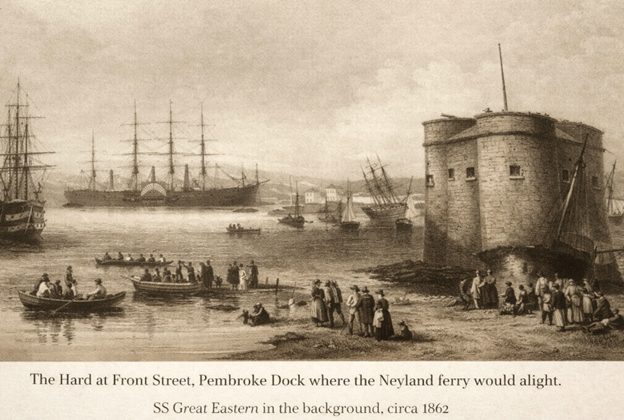
This picture shows passengers disembarking from the Neyland Ferry at the Hard in Front Street, Pembroke Dock. The SS Great Eastern is moored off Neyland in the background. [4].
On the Neyland shore, ferrymen operated from simple landing places along the foreshore, while on the opposite side passengers disembarked directly into the growing dockyard settlement. The work was hard and often dangerous, dependent on tide, weather, and visibility, yet it was constant. Independent boatmen such as Charles Child and others built their livelihoods from this trade, using small fleets of rowing and sailing craft, including boats capable of carrying horses and heavy goods. There was no single ferry, no single landing point, and no fixed system. Instead, there was a network of crossings, flexible, competitive, and rooted in centuries of local practice.
By the early nineteenth century, pressure on the crossing was already increasing. The opening of the Royal Dockyard at Pembroke Dock in 1813 had begun to draw more traffic across the Haven, and the development of Hobbs Point as a packet station in the 1830s added further movement of passengers and goods. Attempts were made to regulate and even monopolise the ferry trade, most notably through the legal challenges brought by Mr. Huzzey in the 1830s, but the reality remained a busy and competitive crossing served by multiple operators.
Thus, on the eve of the railway, the Neyland ferry was not a new invention waiting to happen. It was already a living, working system, shaped by geography, necessity, and centuries of use. What Brunel’s railway would do was not create the crossing but transform it beyond recognition.
I. The Front Street and small boat era, from the dockyard years to 1855
Before Hobbs Point became the established landing for the Neyland ferry, the crossing from the Neyland side of the Haven went chiefly to the Hard at Front Street in Pembroke Dock. That was the practical landing place for workers, traders, and market people, because it brought them directly into the developing dockyard town. Desmond Davies states that when the industrialisation of the Milford Haven waterway began with the opening of the Dockyard at Pater in 1813, many ferrymen found that a good living could be made by starting a ferry service from the Neyland area to the town growing across the Haven.[1]
This early crossing must be understood alongside the older and better established Burton to Pembroke Ferry route, the medieval Passage or Passagium, which James Huzzey claimed as his preserved right. Davies is very clear that Huzzey tried to extend that old right beyond Burton and Pembroke Ferry and to monopolise the broader cross Haven trade. He took the rival ferrymen to court at the Haverfordwest Assizes in the summer of 1834, and after losing there, he appealed again in 1835 and lost once more.[1] The Women’s Institute scrapbook preserves the same essential story, adding that the legal decision held his exclusive right, to operate a ferry, to apply only between Pembroke and Burton, and not to every crossing on the Cleddau.[2]
Davies also names the principal rival ferrymen from Neyland, who contested Huzzey’s assertion, as William Evans, William Bowen, and William Vaughan, and they said that they were running a profitable business between Pembroke Dock and Neyland, landing either at Hobbs Point or at the Hard in Front Street, and on the Neyland side near the Shipwrights Arms opposite Barnlake.[1] This is important, because it shows that before the regular steam ferry, Neyland already had an active network of crossings serving several landing points.
One of the best known of the early ferrymen was Charles Child, whom Davies says operated one of the early ferries from Neyland to Pembroke Dock. Child landed his passengers at the Hard, owned three passenger boats and one horse boat, and lived near his ferry in Chapel Row in the original village of Neyland before it was demolitioned by the railway in 1856.[1] The Women’s Institute scrapbook preserves exactly the same detail.[2]
The ferry crossing was never easy work. The Cleddau could be rough, foggy, and dangerous. The WI scrapbook records the drowning of Tom Huzzey in 1845 and the death of Thomas Warlow in 1849 when his boat capsized off Neyland Point.[2] Yet the traffic continued because the need was constant. Before steam and before a fixed timetable, the ferry was a working necessity.
II. Hobbs Point, the packets, and the first steam experiment, 1830 to 1851
Hobbs Point itself was a product of the packet age. The Women’s Institute scrapbook records that the foundation stone of the new pier at Hobbs Point was laid on 9 October 1830, that the pier was completed in 1832, and that packet vessels including the Prospero, Pygmy, Jasper, Advice, and Adder were transferred there from Milford. Hotels and stables at Hobbs Point were built at the same time for the accommodation of passengers.[2] In 1837 the Admiralty took over both the packet service and Hobbs Point, but by 1848 the Irish route had given way to Holyhead.[2]
The first real steam ferry venture on the Cleddau followed quickly. In 1849, according to the WI scrapbook, William Robertson, a timber merchant and shipyard owner in Front Street, introduced the steam ferries Pearl and Cambria and advertised a scheduled service “between the principal towns on Milford Haven.”[2] This was a striking innovation, because the service was planned to run to a timetable and in all weathers. But it was too early. The same source says the venture petered out by 1851 for lack of support.[2]
So by the early 1850s the infrastructure for a more modern crossing had begun to appear, but the conditions that would make it viable had not yet fully arrived.
III. The railway and Captain Jackson era, 1856 to 1882
The true turning point came with the railway. When the South Wales Railway reached Neyland in April 1856, and when the Waterford and Cork steamship connection was established, passenger traffic rose sharply. Simon Hancock places Captain Thomas Thompson Jackson and his partner Robert Ford at the centre of this world, running the passenger steamers between Neyland and Ireland and profiting from the boom created by the railway terminus.[3]
The Women’s Institute scrapbook says that in 1856 Ford and Jackson, as a sideline to the mail traffic, started a regular ferry service from the new pontoon to Hobbs Point using the former Thames ferryboat Little Eastern.[2] Desmond Davies gives a slightly more specific statement, writing that the first steam ferry service from Neyland Pontoon to Hobbs Point was begun by Captain Thomas Jackson, that the Admiralty agreed to allow Hobbs Point to be used for the ferry service, and that the service commenced in 1858.[1] The best way to reconcile these two accounts is to say that the railway and pontoon changed the scale of traffic from 1856 onward, but that the fully established Jackson steam ferry to Hobbs Point was operating by 1858.[1][2]
Davies also says that among the earliest steam vessels on this crossing were the tenders Thames and Long Ditton, which met the Waterford trains at Neyland to collect passengers bound for the south side of the Haven.[1] This is an important detail because it ties the ferry directly to the railway and mail system. The ferry was no longer simply a local crossing. It had become part of a combined rail and sea transport network.
Yet the older sailing boat ferrymen did not disappear. Davies stresses that the steam ferry boats were always in competition with “a flotilla of sailing boats,” especially when the steam ferry was tied up, and that the sailing boats often worked at night or when the steamer was unavailable.[1] In other words, the steam ferry did not abolish the small boat era. For decades the two systems coexisted.
IV. The John Henry Coram era, 1882 to 1902
After Captain Jackson, the ferry service passed into the hands of John Henry Coram, whose wider business empire Simon Hancock has reconstructed in detail in his article : “The ‘Neyland Sensation’: the Rise and Fall of John Henry Coram (1847–1907),” Pembrokeshire Historical Society Journal . Hancock shows that in 1882 Coram purchased Jackson’s Neyland based business operations from Caroline Jackson, and that the steamers acquired in that agreement included the Milford Haven and the Long Ditton, along with other craft and barges.[3] This is extremely valuable because it gives documentary support to the broader fleet history preserved in local memory and in the Women’s Institute scrapbook.
Hancock also states plainly that Coram’s business concerns eventually encompassed the Neyland to Hobbs Point ferry service, together with general contract work, coal shipping, and government haulage.[3] He further notes the 1889 agreement with the Great Western Railway for the use of the Neyland landing stage for cattle traffic and the 1890 agreement relating to fish and other traffic landed at New Milford.[3] These details show that the ferry operation under Coram was not just a passenger service. It formed part of a larger transport business tied closely to railway, livestock, and fish traffic.
The Women’s Institute scrapbook names several of the steam ferries associated with the later nineteenth century service, including Milford Haven, Amy, Resolute, Menai, and Pioneer.[2] Coram’s role therefore sits at the centre of the period when the ferry moved from a railway adjunct into a mature local transport enterprise.
But the downfall of John Henry Coram came suddenly, the era was ending with devastating effect. In 1901 he was tried at the Central Criminal Court and found guilty of fraud relating to government haulage contracts, having knowingly allowed inflated and falsified claims for the transport of military stores. Despite his position as one of Neyland’s leading figures, a county councillor, magistrate, and major employer, he was sentenced to eighteen months’ imprisonment with hard labour at Pentonville. The scandal, widely reported in the national press, shattered his reputation and marked the collapse of his commercial empire. In the immediate aftermath, his ferry and business interests were broken up and sold, bringing an abrupt end to the Coram era in Neyland’s ferry history.[3]
V. The Hitchings era, 1902 to 1933
The downfall of Coram led directly to the next ferry era. Hancock records that the Neyland and Hobbs Point Ferry was purchased by Mr Frederick Hitchings in 1902 and remained under his management until the early 1930s.[3] Desmond Davies then fills in the practical detail of what Hitchings did with it.
Davies says that it was in 1902 that a regular timetable service from Neyland to Hobbs Point was first firmly established under steam, and that this was when Fred Hitchings took over the ferry business from Henry Coram. In 1903 Hitchings purchased Amy, another wooden screw vessel, built at Chester in 1894 and weighing 10.5 tons.[1] After the First World War he added the Pioneer, a 48 ton wooden screw craft, to replace the Menai.[1]
Davies also notes that Hitchings supplemented ferry income by using these vessels for excursions to Blackpool Mill and other beauty spots along the shores of the Cleddau.[1] That is a useful insight into the mixed economy of the ferry business. These boats were not only utilitarian. They were also part of local leisure and excursion traffic.
Meanwhile the small boat ferrymen continued alongside the steam service. Davies names the Lloyd brothers, Tom, Davy, Jim and Bill, as among the best known small boat ferrymen of Neyland, men who worked the river for more than seventy years.[1] Bill Lloyd’s sailing craft was The Fair Maid, always kept in immaculate condition and locally remembered as unbeatable in regattas up and down the Haven.[1] He says that the small boat ferrymen usually operated from the Great Western Railway wooden slipway, extending into the Haven, and that during the last war this was replaced by a concrete slip later demolished in 1989.[1]
VI. The Frederick F. Lee era, 1933 to 1947
In 1933 Hitchings sold his ferry business to Frederick F. Lee, who soon sold the old Amy and Pioneer for scrap.[1] Davies says that these ageing vessels were replaced by two steamers capable of carrying a few cars each, namely Lady Magdalen and Alumchine.[1]
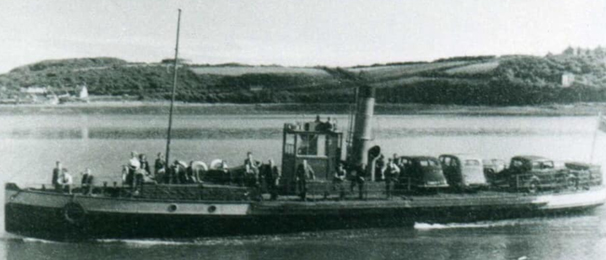
His details here are especially valuable. He states that the Lady Magdalen had been built in Glasgow in 1896 and that Alumchine, a 76 ton paddle steamer, had been built in Queensferry in 1923 and had worked on the Menai Straits in north Wales.[1] He also gives carrying capacities, saying that Lady Magdalen could carry 250 passengers and four cars, while Alumchine could carry 216 passengers and five or six cars.[1] This is one of the clearest pieces of evidence we have for the actual carrying scale of the interwar ferry.
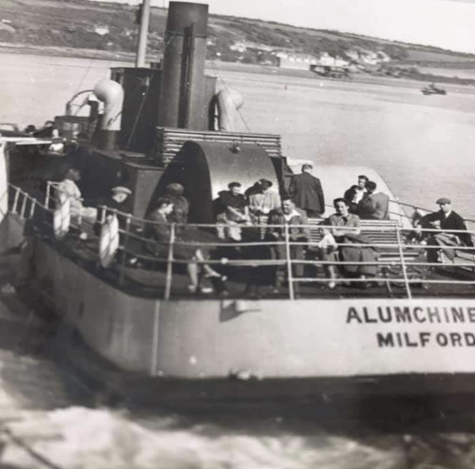
The Lee era therefore marks the proper beginning of the vehicle ferry phase on the route. The crossing was no longer just about foot passengers and small goods. Cars were now part of the ferry’s daily work.
VII. British Conveyances and the County Council era, 1947 to 1956
Davies states that in 1947 Frederick Lee closed down his ferry service and that it was then taken over by British Conveyances Limited, a Newton company which also operated the Severn River Ferry from Aust to Beachley.[1] This company found the Neyland to Hobbs Point route less lucrative than expected and pulled out after a couple of years.[1]
With no private concern willing to take over the unprofitable service, Pembrokeshire County Council stepped in.[1] This was a major structural change. The ferry ceased to be a private family or company business and became a publicly supported transport service.
VIII. The Cleddau Queen and Cleddau King era, 1956 to 1975
In 1956 Pembrokeshire County Council introduced the Cleddau Queen, which Davies describes as the last paddle steamer to be reconstructed for ferry service anywhere in Britain.[1] She could carry 16 cars and 250 passengers, and was later converted to diesel power and driven by twin propellers at a cost of £20,000.[1]
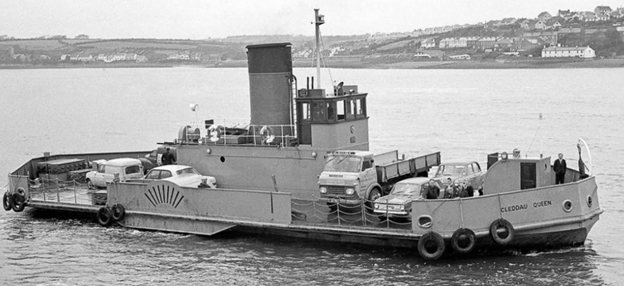
In 1965 the Queen was joined by the Cleddau King, built at Hancock’s yard at a cost of £73,000.[1] Davies says that the King could carry 24 cars and 350 passengers, that landing was improved by a new ramp, and that she was fitted with radar to cope with fog.[1] The arrival of these new vessels spelled the end of both Lady Magdalen and Alumchine, which had provided what Davies calls a “sometimes unreliable but nevertheless cheerful service” along the 15 minute crossing for over twenty years.[1]
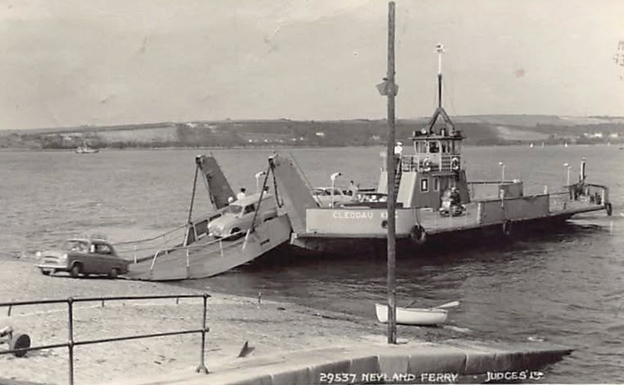
Davies also records the end of the older ferries. The Alumchine was put on the beach at Neyland and slowly rusted while arguments continued over her future. The Paddle Steamer Preservation Society was interested in saving her, but the cost proved too great and she was scrapped in 1962. The Lady Magdalen met a similar fate in 1965.[1]
Despite the much greater carrying capacity of the new ferries, the volume of traffic generated by tourism and by the oil industry along the waterway proved too much for the service to cope with. Davies notes that in summer there were often queues of cars and other vehicles stretching from the bottom of High Street to the pontoon.[1]
He adds several details that bring the working life of the ferry into sharper focus. The ferry boats were always based at Neyland, where there was a repair workshop just west of the pontoon.[1] Among the local crew remembered with affection were the skippers Phil Lloyd and Charlie Sweeny, together with local characters such as Eli Burton and Mike Hughes.[1] Davies also makes the striking claim that although many thousands of people were carried across the Haven between Neyland and Pembroke Dock, whether by sail or steam, there was never a fatal accident on the crossing itself.[1] This is especially significant given the potentially disastrous angle of the slip at Hobbs Point!! That is a remarkable statement, and one that sits in interesting tension with the earlier losses among the independent boatmen operating outside the later formal ferry service.
IX. The last crossing and the aftermath, 7 March 1975 and after
Davies gives a particularly vivid account of the end of the ferry. Friday 7 March 1975 was the last day of the service between Neyland Pontoon and Hobbs Point. The new Cleddau Bridge had been completed and was ready to begin carrying traffic from Saturday 8 March.[1]
The final crossing was marked ceremonially. According to Davies, the Mayor of Pembroke Dock, Dilwyn Davies, accepted a gift of a model ferry boat from Hobbs Point. At 8.20 pm a bottle of champagne was opened at Neyland Pontoon by the Mayor of Neyland, Councillor Frank Locke. At 9.05 pm the Cleddau King, with flags flying and burners alight, left Hobbs Point for its final voyage. Crowds gathered on both shores to wave goodbye. The last passenger to cross from Neyland was James Carpenter, who had walked from Neyland to the bridge to make the occasion memorable.[1]
Davies even preserves the names of the crew on that last nostalgic crossing. The skipper was Kevin Rowland, the ticket collector Ivor Evans, the engineer Bill Mayhew, and the deck hands John Cross and Peter Waters.[1] He also mentions the memories of one long term passenger, Bert Morgan, who had travelled on the ferry boats for fifty years and whose schooldays had begun with crossings on the old Amy.[1]
Here Davies records the recollections of Bert Morgan, one of the last generation to have known the ferry as a daily part of life. Morgan had used the crossing for over fifty years, beginning as a schoolboy travelling from Neyland across to Pembroke Dock. He remembered starting his crossings on the old ferry Amy, one of the earlier steam vessels, and continued using the service throughout his working life. [1]
By the time Davies spoke to him, Morgan was in his eighties and could look back on the ferry not just as transport, but as a constant presence in the rhythm of the town. His memories spanned the transition from the small wooden steamers to the larger vehicle ferries, and he recalled both the reliability of the service and the personalities who worked it. He also spoke of the familiarity of the crossing, something done so often it became almost unnoticed, yet which in retrospect marked out the shape of everyday life in Neyland. [1]
Davies notes that Morgan had attended Pembroke Dock Intermediate School, crossing daily as a boy, and later spent time at Cardiff University and in the army, but returned to Neyland where the ferry remained part of his routine. His recollections therefore bridge the working, social, and educational use of the ferry across several generations. [1]
The County Council fought hard for the retention of the ferry service after the bridge opened, claiming that the town would be more isolated without it and that many people would still wish to use the boats.[1] But the pontoon was already in poor condition, and the service was not economically realistic once the bridge was available. In April 1976 the pontoon and bridge works were dismantled and sold for scrap.[1]
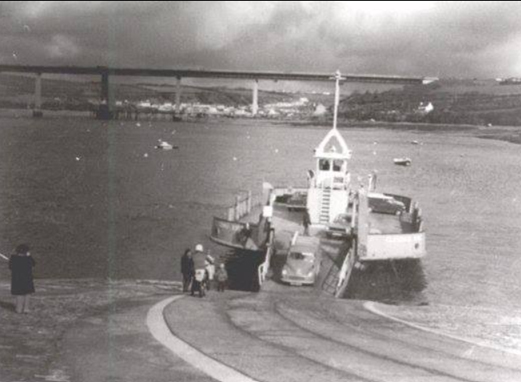
Davies ends on a note that is both practical and emotional. The bridge brought obvious benefits in time and travel, but for many people who had crossed that short distance by water over many years, much of the enjoyment and romance went out of the journey with the passing of the ferry boats.[1]
Taken together, the evidence from 'The End of the Line', the Women’s Institute scrapbook, and Simon Hancock’s study allows the history of the Neyland ferry to be told with much greater precision. It began as a network of small boat crossings to Front Street and other local landing points. It was reshaped by Hobbs Point and the packet era, transformed by the railway and Captain Jackson’s steam service, absorbed into the broader commercial world of John Henry Coram, formalised and expanded under Hitchings, modernised for vehicles under Frederick Lee, rescued and rebuilt by the County Council, and finally brought to a ceremonial close in March 1975 when the Cleddau King made the last crossing.
References
[1] Davies, Desmond N., The End of the Line: A History of Neyland (n.p., n.d.), pp. 124–127.
[2] Women’s Institute Scrapbook, 1950, “Some Notes on the Ferry,” with associated manuscript notes.
[3] Hancock, Simon, “The ‘Neyland Sensation’: the Rise and Fall of John Henry Coram (1847–1907),” Pembrokeshire Historical Society Journal, 2022.
[4] “Front Street Hard” is from Pembroke Dock 1814–2014: A Bicentennial Look Back by Phil Carradice & Roger MacCallum (Amberley, 2014).