By Carol Elliott
The Admiralty Dockyard at Westfield Pill (c.1759–1765)
Long before the railway arrived at Neyland in 1856 and transformed the small agricultural settlement into a railway port, the north shore of Milford Haven was already connected with maritime industry. Evidence from eighteenth-century sources shows that shipbuilding was taking place at Neyland nearly a century earlier, when the Admiralty briefly established a naval shipbuilding yard on the Haven.
During the mid eighteenth century the sheltered waters of Milford Haven were recognised as one of the finest natural harbours in Europe. Its deep water, protected anchorage and access to timber and maritime labour made it an attractive location for naval construction. At that time the area that would later become the town of Neyland consisted only of scattered farms belonging to the medieval manor of Honeyborough and a few small waterside activities around the creeks of the Haven.
By the 1750s the site had already become an active maritime centre. Neyland possessed an important salt refining industry associated with the curing of herrings. Salt was imported from continental Europe and from Liverpool, arriving in vessels from France, Spain and Portugal. This trade created a local maritime workforce of fishermen, mariners and labourers who were closely connected with the sea.
Between 1751 and 1782 Neyland became one of the largest herring ports in Wales. Contemporary records show that in 1766 alone more than 185,000 thousands of red herrings were landed at the port. The fishing industry required boats, curing houses and a steady supply of salt, and it was this maritime activity that helped create the skilled workforce that made shipbuilding possible.
The Strategic Importance of Milford Haven
During the eighteenth century Britain faced repeated threats of invasion from France. Between 1744 and 1815 Britain and France were engaged in a series of conflicts including the Seven Years War and later the American Revolutionary War. In response the British government examined strategic harbours where naval forces could be built, supplied and protected.
Milford Haven was widely regarded as one of the most secure natural harbours in Europe. Its deep sheltered waters provided a safe anchorage capable of accommodating large fleets.
In 1757 a Parliamentary report titled Plans and Estimates for Fortifying Milford Haven, prepared by Lieutenant Colonel Bastide, Director of Engineers, discussed the strategic importance of the harbour. The report identified Barnlake above Neyland as an especially suitable location for shipbuilding. According to experienced shipbuilders consulted during the investigation, there could be no more appropriate place for constructing ships of any size.
The report further suggested that if a permanent naval dockyard were ever to be established at Milford Haven, the area around Neyland would be ideally suited because of its natural advantages and safe anchorage.

Although the proposal for a permanent dockyard was not implemented at that time, these discussions led to the establishment of a private Admiralty shipyard at Westfield Pill and Barnlake.
The Dockyard at Westfield Pill
Around 1759 a shipyard was established at Westfield Pill, just west of present-day Neyland. The yard was operated by private shipbuilders working under Admiralty contract to construct warships for the Royal Navy.
Unlike the later Royal Dockyard at Pembroke Dock, the Neyland yard was not a permanent government facility. Instead it functioned as a contract yard where private builders carried out naval construction under Admiralty supervision.
The existence of this dockyard was recorded by the Pembrokeshire historian Richard Fenton in his book A Historical Tour Through Pembrokeshire (1811). Writing about the north shore of Milford Haven he noted:
“Almost opposite is Nayland, where formerly sugars from Ireland were discharged and paid the English duty at Pembroke, and woollen yarn from Ireland was imported. At this place there was also a salt refinery that supplied the whole country and here, about thirty five years ago, there was a dock yard in which a seventy four and a frigate were built.” [1]
Fenton’s description confirms that two naval vessels, a frigate and a seventy-four-gun ship of the line, were constructed at Neyland during the eighteenth century.
HMS Milford (1759)
The first ship built at the Neyland dockyard was HMS Milford, constructed by the shipbuilder Richard Chitty and launched in 1759.
HMS Milford was a 28-gun Coventry-class sixth-rate frigate of the Royal Navy. Frigates were among the most versatile vessels in the fleet. Designed for speed and manoeuvrability, they were commonly used for convoy escort, patrol duties and reconnaissance.
The ship carried a complement of around 200 officers and men including sailors, marines and specialist crew. Her design incorporated a strong hull, heavy masts and a large magazine for powder and shot, enabling the ship to remain at sea for extended periods without resupply.
During the Seven Years War HMS Milford captured a Spanish aviso carrying dispatches to Havana after a prolonged engagement off Cape Tiburon in the Caribbean. Later, during the American Revolutionary War, the ship captured the American privateer Yankee Hero in a battle off Cape Ann in June 1776.

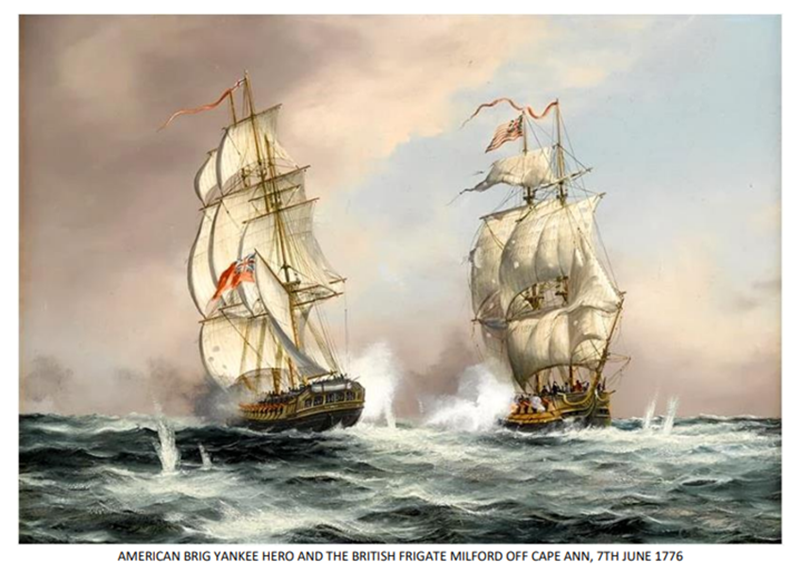
This painting shows the Frigate HMS Milford (built in Neyland) in action off Cape Ann on 7th June 1776.
In another engagement in 1777 HMS Milford pursued the American vessel USS Cabot, forcing her ashore in Nova Scotia.
After more than twenty-five years of service the ship was finally sold for breaking at Woolwich on 17 May 1785.
HMS Prince of Wales (1765)
The second vessel built at Neyland was the much larger HMS Prince of Wales, launched on 4 June 1765.
The ship was built by the shipbuilders Henry Bird and Roger Fisher and was a seventy-four-gun third-rate ship of the line, one of the most powerful types of warship used by the Royal Navy in the eighteenth century.
Ships of this class formed the backbone of the British battle fleet. The seventy-four-gun design represented an ideal balance between firepower and sailing performance and became the dominant type of ship used by European navies during the period.
Originally planned under the name Hibernia, the ship was renamed Prince of Wales shortly before launch.
The launch was a major public spectacle. According to a report in the Gentleman’s Magazine (June 1765), as many as ten thousand spectators gathered on the surrounding hills to watch the great ship slide into Milford Haven.
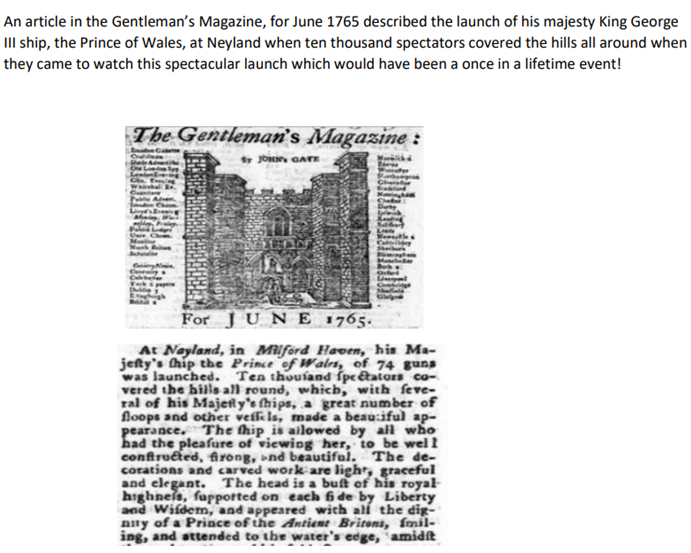
The report praised the vessel as strongly built and beautifully decorated, with elegant carved ornamentation and a figurehead representing the Prince of Wales supported by allegorical figures of Liberty and Wisdom.
The Admiralty design plan for HMS Prince of Wales built in Neyland in 1765
One of the most remarkable pieces of evidence for early shipbuilding at Neyland is an eighteenth-century Admiralty draught showing the design of HMS Prince of Wales, a powerful warship of the Royal Navy built on the north shore of Milford Haven.
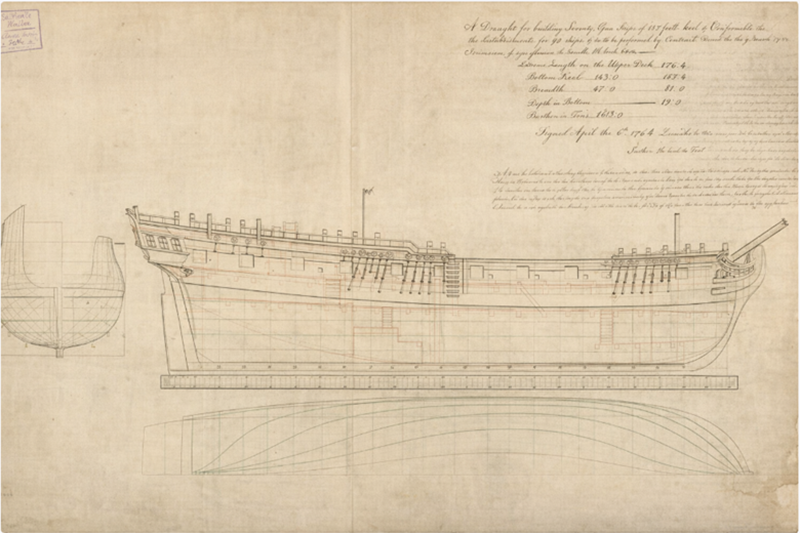
The drawing is a naval architectural plan produced for the Admiralty, the government body responsible for the Royal Navy. Plans such as this were used by master shipwrights to guide the construction of large warships. They provided precise measurements for every part of the vessel and ensured that ships built in different yards followed the same approved design.
HMS Prince of Wales was constructed at Westfield Pill shipyard at Neyland and launched on 4 June 1765. The ship was built by the shipbuilders Henry Bird and Roger Fisher, who were working under Admiralty contract. At the time Neyland was not yet a town but a small maritime community on the shore of Milford Haven, surrounded by farmland belonging to the medieval manor of Honeyborough.
The vessel was a third-rate 74-gun ship of the line, one of the most important types of warship in the eighteenth-century Royal Navy. Ships of this class formed the backbone of Britain’s battle fleet and were designed to combine heavy firepower with good sailing performance.
What the Admiralty Plan Shows
The drawing itself is a highly detailed technical blueprint used by shipwrights during construction. It includes several different views of the ship so that the builders could understand both the structure of the hull and the precise shape required for sailing performance.
Side Elevation
The large central drawing shows the side profile of the ship’s hull. This view illustrates the layout of the gun decks, the positions of the cannon ports, and the elaborate stern galleries that were typical of warships of the period. The bow shows the position of the figurehead while the lower section reveals the keel and framing structure that formed the backbone of the vessel. HMS Prince of Wales carried 74 cannon arranged on two gun decks, making it one of the most formidable ships of its time.
Hull Lines
Beneath the profile drawing is the lines plan, which displays the curves that defined the ship’s underwater shape. These lines represent the waterlines and structural contours of the hull. Shipwrights used them to understand the hydrodynamic form of the vessel and to cut the timber frames that gave the hull its strength and speed.
Body Plan
At the left side of the drawing is the body plan, showing a cross-section of the hull. This reveals the width of the ship, the curvature of the sides and the spacing of the wooden frames. The body plan allowed shipbuilders to construct the massive ribs of the vessel with great accuracy, ensuring that the ship would be strong enough to carry heavy guns while still sailing efficiently.
Size and Power of the Ship
HMS Prince of Wales was an immense wooden warship for its time.
Approximate specifications were:
- Length: about 170 feet
- Beam: about 47 feet
- Burthen: approximately 1,600 tons
- Armament: 74 guns
- Crew: about 600 officers, sailors and marines
Ships of this class formed the core of the British battle fleet throughout the eighteenth century. The seventy-four-gun design achieved an ideal balance between firepower, speed and manoeuvrability. For this reason the type became the dominant warship used by the great naval powers of Europe.
Naval Service of HMS Prince of Wales
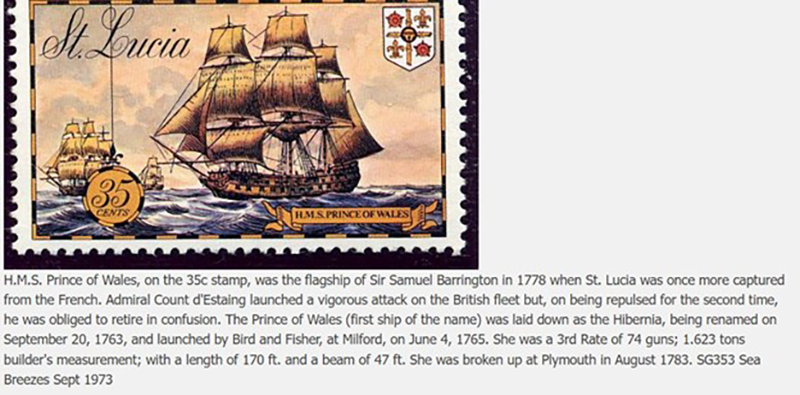
After entering service HMS Prince of Wales later became the flagship of Rear Admiral Sir Samuel Barrington during the American Revolutionary War.


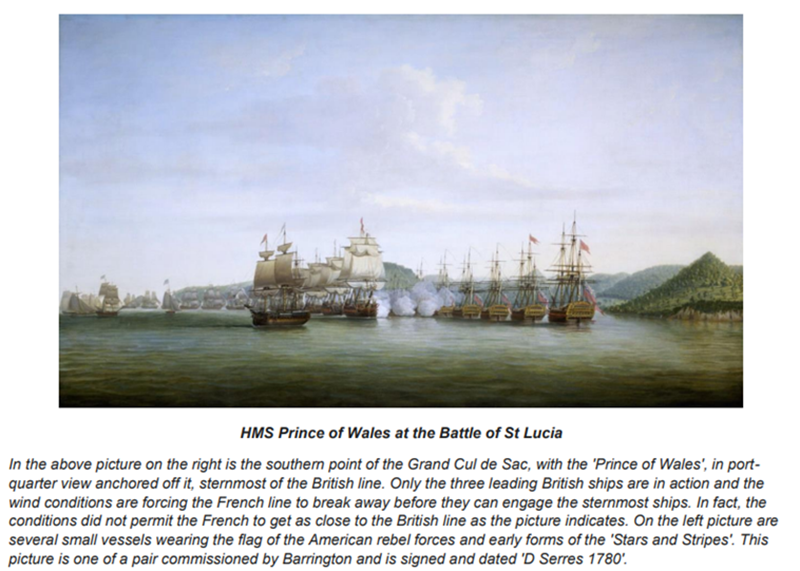
In 1778 Barrington commanded British forces in the capture and defence of St Lucia in the Caribbean. The ship played an important role during the naval battle fought there when the French fleet under the Comte d’Estaing attempted to retake the island.
Barrington successfully repelled the French attack and secured the island for Britain. During the later Battle of Grenada the ship suffered significant casualties and Barrington himself was wounded.
The End of the Ship
After nearly two decades of service the ship eventually became worn and outdated. Like most wooden warships of the eighteenth century she was dismantled when her structure could no longer be economically maintained.
After nearly two decades of service the HMS Prince of Wales was broken up at Plymouth in August 1783.
The ship holds a special place in naval history as the first Royal Navy vessel to bear the name HMS Prince of Wales, and it was built at Neyland.
The End of the Admiralty Yard
Despite the successful construction of these ships the Admiralty shipyard at Neyland did not remain in operation for long. Government records suggest that considerable resources were invested in the project, but the site proved unsuitable for the large permanent dockyard the Admiralty ultimately required.
Instead the government established the Royal Dockyard at Pembroke Dock in 1814, which became one of Britain’s most important naval shipbuilding centres.
With the opening of Pembroke Dockyard the brief Admiralty experiment at Neyland came to an end.
Neyland Before the Railway
At the time these warships were built Neyland was not yet a town. The area consisted mainly of farmland belonging to the manor of Honeyborough with a few scattered houses along the shoreline.
Development remained small scale throughout the eighteenth century. Only after Isambard Kingdom Brunel’s railway reached Neyland in 1856 did the settlement begin to develop into the port town that exists today.
The railway transformed the area into an important ferry terminal and maritime centre, replacing the earlier shoreline industries with docks, rail facilities and shipping infrastructure.
A Forgotten Beginning
The construction of HMS Milford and HMS Prince of Wales at Westfield Pill demonstrates that Neyland’s maritime history stretches much further back than is often realised.
Nearly a century before the railway arrived, and decades before the Royal Dockyard at Pembroke Dock was established, the quiet shoreline of Neyland had already witnessed the building of Royal Navy warships.
Although little physical evidence of the eighteenth-century yard survives today, these ships remain powerful reminders that the origins of Neyland’s maritime tradition reach deep into the eighteenth century, when shipwrights and mariners along the Haven helped build vessels for the Royal Navy.
Sources
[1] Richard Fenton, A Historical Tour Through Pembrokeshire (London: Longman, Hurst, Rees, Orme & Co., 1811).
Fenton records that a dockyard existed at Nayland where “a seventy four and a frigate were built,” referring to HMS Prince of Wales and HMS Milford.
[2] Basil H. J. Hughes, Pembrokeshire Names in Its History Records, 3rd ed. (Tenby: B. H. J. Hughes, 1996).
Includes references to the construction of HMS Milford (1759) and HMS Prince of Wales (1765) at Neyland.
[3] National Maritime Museum, Greenwich, Admiralty Draughts Collection.
Original Admiralty construction plan for the seventy-four-gun ship HMS Prince of Wales (1765).
[4] Brian Lavery, The Ship of the Line: The Development of the Battlefleet 1650–1850 (London: Conway Maritime Press, 1983).
Describes the design and importance of seventy-four-gun ships in the Royal Navy.
[5] Rif Winfield, British Warships in the Age of Sail 1714–1792 (Barnsley: Seaforth Publishing, 2007).
Provides the specifications, builders, launch date and service history of HMS Prince of Wales (1765).
[6] The Gentleman’s Magazine, June 1765.
Contemporary account of the launch of HMS Prince of Wales.
[7] J. Matheson, historical studies of Welsh fisheries and herring landings in Milford Haven during the eighteenth century.
[8] Barbara George, research on the salt trade and maritime industries of Milford Haven.
[9] Royal Navy service records relating to HMS Prince of Wales and the Battle of St Lucia (1778).