By Alan Brown
The first national census of the population of England, Scotland and Wales took place in 1841, and the exercise has been repeated every ten years since that date; the only exception being 1941, when wartime conditions made it impracticable. The amount of detail in these documents has progressively increased over the years, while a further feature of the census of 1911 is the fact that the surviving documents are the originals that were completed by the householder’s own hand, or else by a younger member of the household or a neighbour: while literacy had become nearly universal amongst the younger generation, many of the older citizens of Neyland had had little or no formal schooling, and there were still a few who could not even write their own name. Despite the loss of the Irish ferry service, Neyland was thriving economically at this time, and this census gives a valuable snapshot of life in Neyland shortly before the social dislocation of the Great War.
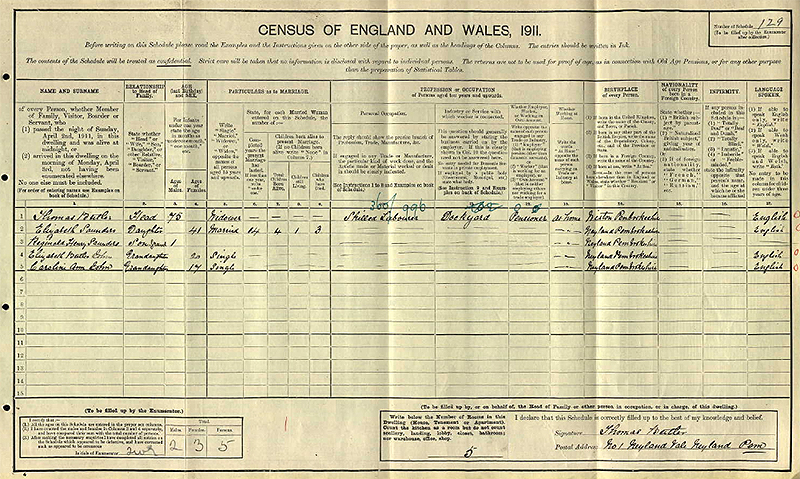
The total population of Neyland in 1911 was 2,396, living in 554 households. There were 1,142 males and 1,254 females. The figure for males does not take into account the fact that some of the local men will have been working away from home on the night of the census, so they will have been left out. In 53 examples, the head of the household was described as a married woman, and it is likely that in many of these cases their husbands were temporarily absent.
Unsurprisingly, the overwhelming majority (2,267, or 94.6%) of the residents of Neyland were monolingual English speakers. 128 (5.4%) described themselves as bilingual in English and Welsh, while one female stated that she spoke Welsh only; nearly all of the Welsh-speakers had either been born outside of Pembrokeshire, or else in the northern parts of Pembrokeshire beyond the Landsker line.
The economic prosperity of South Pembrokeshire in the years before the Great War had drawn in workers from far outside the local area. 187 of the people living in Neyland in 1911 had been born in other counties of Wales; 364 had been born outside of Wales: of these, 315 came from England, 24 from Ireland and six from Scotland. Others were from even further afield: eight from Jersey, and one each from Guernsey and the Scilly Isles. In the days of the British Empire, it was not particularly surprising to find that two of the people then living in Neyland had been born in South Africa, and one in India; finally, there was one each from Switzerland, France and Denmark, plus one who was a native of the USA. Two entries in the census omitted to state their place of birth.
The universal old age pension was introduced in the United Kingdom in 1909, just two years before this census was taken. Both men and women became eligible at the age of 70, at a time when it was uncommon for people of either sex to live for many years past this age; this is the ‘three score and ten’ of the Bible. In the years prior to this, many people were obliged to work for as long as they were physically capable, since the alternatives were either to become dependent on younger members of their family or else to take refuge in parish relief or the meagre hospitality of the workhouse. 96 people (4%) in Neyland were aged 70 or more and, of these, 17 (0.7%) were over 80. Neyland’s oldest inhabitant at that time was 89 year-old Thomas Davies, a bachelor who had worked for Trinity House, the lighthouse service.
The census gives us an accurate picture of employment at that time. The first world war had the effect of creating a shortage of manpower across the whole of the domestic economy, as the result of which many women went out to work for the first time. Before 1914, however, prospects for men and for women were very different.
Males
There were 745 men and boys aged 14 or over, of whom 62 were described as ‘retired’; 131 were working in shipbuilding, with the great majority of these at the Royal Naval Dockyard in Pembroke Dock, while a few would have been employed in the smaller private boatyards that were still working locally; 125 were working for the Great Western Railway; 92 were working in the fishing industry, either on the trawlers or else in various capacities in the fish market which stood alongside the station; 67 were working in retail; 38 were working in construction; 28 were working as general labourers; 16 were in agriculture, as farmers or farmworkers; 14 were working for Trinity House, the organisation that ran and supplied the lighthouses and lightships around the coast; 12 were ferry workers; nine men worked for the General Post Office; there were seven clerical workers and seven working in hospitality, i.e. innkeepers and barmen, etc. Five were church ministers, four tailors and one bootmaker. 21 males over the age of fourteen were still at school, or college, while eight men were employed as teachers. There were two policemen; two doctors, one actor and one maker of artificial teeth. Officially, just two men of working age were described as ‘unemployed’. Three men stated that they were of independent means, and presumably had no need to work.
Females
904 women and girls were over the age of 14. Employment prospects for females outside of the home were very limited in 1911. 676 were described as being in ‘domestic’ occupation, with 37 of these ‘in service’, i.e. working as servants in other people’s households, while the other 639 would have been housewives. 51 were earning an income as dressmakers, which was then a very common way for women to make some money while working from home. 61 were working as shopkeepers or shop assistants; another 16 worked variously as innkeepers, barmaids and waitresses. 14 females were schoolteachers: all of these were unmarried, which was the expectation at that time; marriage would bring an end to a woman's teaching career. Two young ladies gave their occupation as music teachers. Six worked in the field of health, comprising one district nurse, two nurses, two midwives and one nursemaid.
In 1911, school attendance was compulsory only up to the age of 12, although in general the practical minimum age for employment seems to have been 14, with just three boys under the age of 14 working as messengers or errand boys, plus there was one 12 year-old girl who was described as being in 'domestic' employment, which probably meant helping out at home. 35 girls who were aged 14 or over were recorded as still being at school: this is significantly greater proportionately than the number of boys, which was possibly a consequence of the lack of employment opportunities for them.
For all married couples, widows and widowers, this census records the number of children that had been born during their marriage, and also breaks down this figure into the number of those who were still living, and the number who had died. While this statistic is fairly crude, since it would include deaths at any age, it suggests that child mortality numbers were still very high at that time, with possibly as many as 20% of births dying before they reached adulthood. Families that would appear improbably large by our present-day standards were then still commonplace: there were 41 families who had had ten or more children, with the record being held by Mrs Elizabeth Evans at 51 Kensington Road: aged 46, she had had 17 children, with 12 of them being alive at the time of the census, and six of them still living at home. Her husband, Mr Thomas Evans, is not listed in the household, for reasons unknown.