By Carol Elliott
Sometimes it is strange to think where a much-loved local vessel, like our Alumchine Ferry, first began her life. But some of the ferries we remember as part of everyday life in Neyland did not start here. They had earlier stories, in other places, serving other communities. This is one such story.
This article is based on the research of John Hannavy, whose detective work in “Mrs Richards’ Silver Plaque – a detective story” (Vintage Spirit, March 2014, p.40) helped piece together the history of the vessel.
In the Beginning
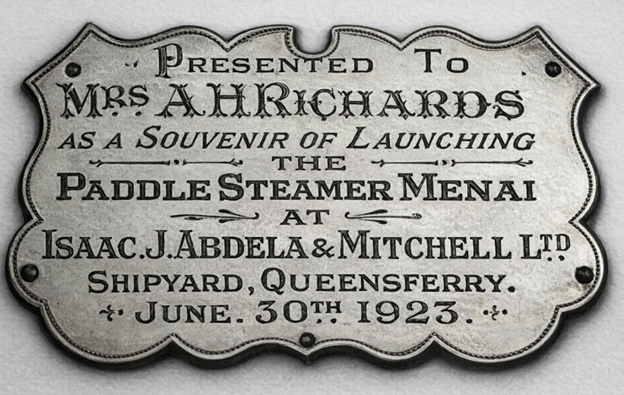
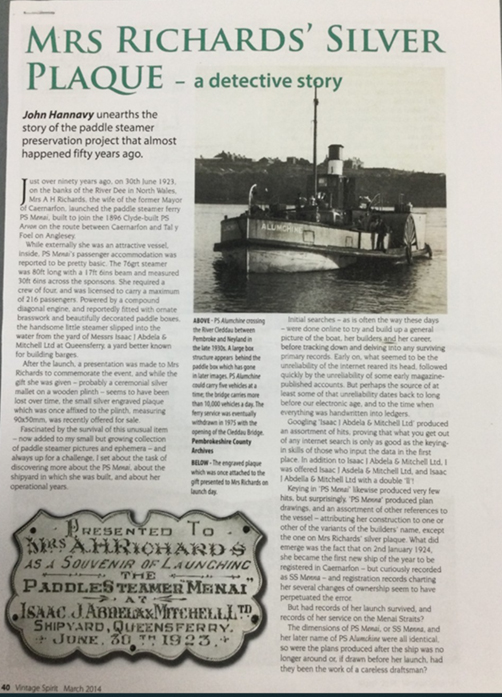
On 30 June 1923, on the banks of the River Dee at Queensferry, a small but elegant paddle steamer slipped into the water. She was named Menai, built for service on the Menai Straits, and at that moment there was nothing to suggest that she would one day become one of the most familiar and well-loved vessels on the Cleddau. She became the ferry we in Neyland came to know as PS Alumchine.
This is her story. And like all good local history, it is also a detective story.
From the Menai Straits to the Cleddau
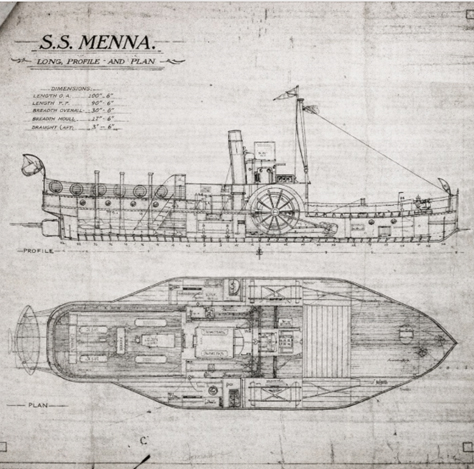
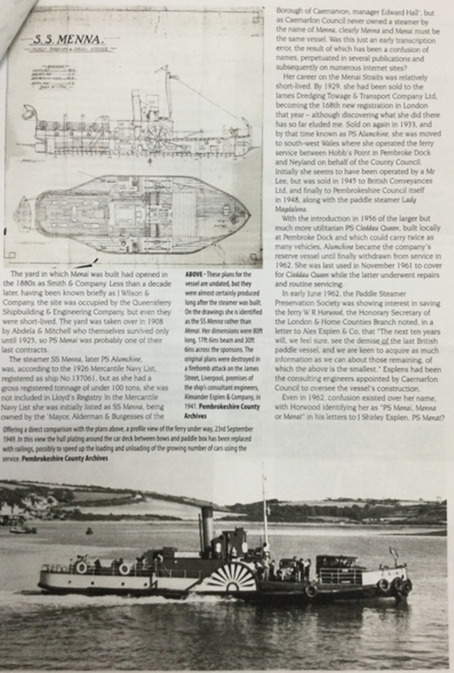
There was excitement on the banks of the River Dee as a new vessel was launched in 1923. She had been built by Isaac J. Abdela & Mitchell Ltd of Queensferry, in a yard better known for barge construction but this one turned out to be a compact passenger steamer and it was one of its final contracts.[1] She measured approximately 80 feet in length, with a beam of 17 feet 6 inches and paddle boxes extending to around 30 feet across.[2] Powered by a compound diagonal engine, she was designed to carry passengers across the Menai Straits, and contemporary accounts describe her as a particularly smart vessel, adorned with brasswork and decorative paddle boxes.[3]
Yet her career in North Wales was short-lived. Although built for the route between Caernarfon and Anglesey, she was sold in 1929 to James Dredging Towage & Transport Company Ltd, and by 1933 she changed hands again. This time she found her way to south-west Wales.[4]
It was here that her story became part of ours.
Arrival at Neyland
By 1933, she was now renamed PS Alumchine, and she entered service on the Cleddau, operating the ferry between Hobbs Point, Pembroke Dock, and Neyland.[5] This was a vital crossing, forming part of everyday life for a lot of Neylanders who used her services daily, for school, work and pleasure before the Cleddau Bridge was built.
Photographic evidence and later modifications show that she was adapted to changing needs, including the carrying of vehicles. At one point she was capable of transporting up to five cars per trip, serving a crossing that could see thousands of vehicle movements daily.[6]
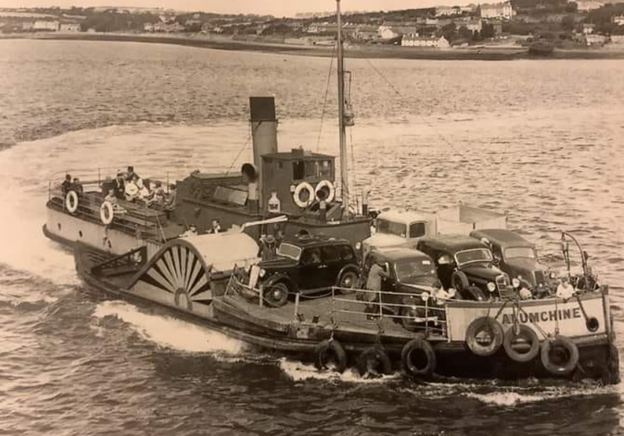
Her ownership changed several times over the years. In 1933 when she came to Neyland, she was operated by Frederick Lee a private proprietor, who took over the Neyland–Hobbs Point ferry in 1933 from Fred Hitchings. She was then sold in 1945 to British Conveyances Ltd, before finally passing into the hands of Pembrokeshire County Council in 1948, alongside another paddle steamer, Lady Magdalena.[7]
The Final Years of Service
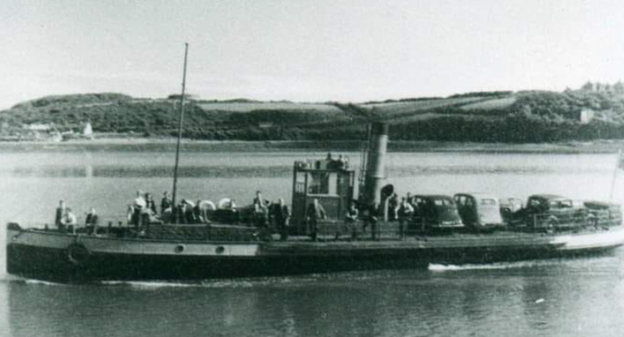
By the 1950s, however, the writing was on the wall for vessels like Alumchine. The introduction in 1956 of the larger and more efficient PS Cleddau Queen, built locally at Pembroke Dock, relegated her to a secondary role.[8]
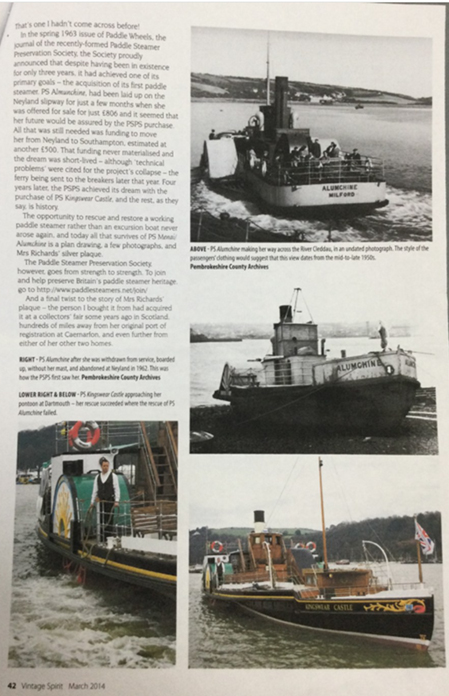
She continued in reserve service for a few years, stepping in when needed, but her working life was nearing its end. Her final recorded use came in November 1961, and by early June 1962 she was withdrawn from service altogether.[9]
So by the early 1960s, her working life was over, and she lay beached at Neyland awaiting her fate. I can still remember her there, a familiar but fading presence on the shoreline, moored right next to the old wooden barge at Neyland. It was here that she was finally broken up in the early 1960s by Hughie Warlow, bringing to an end the life of a vessel that had once carried generations across the Cleddau. For those who saw her in those final days, it is a memory that has never quite left us.
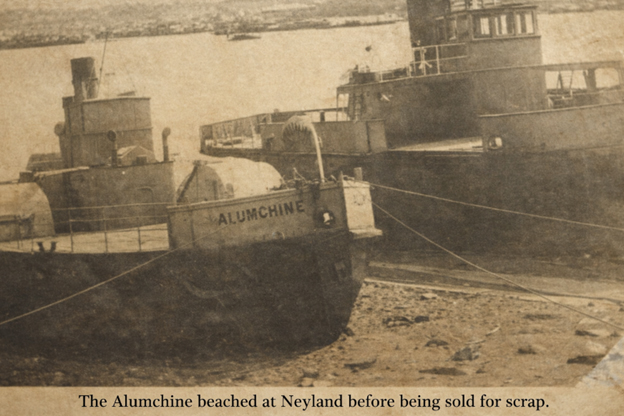
For a vessel that had quietly served generations of local people, it could have ended there.
But this is where the detective story begins.
A Plaque, a Mystery, and a Missed Opportunity
The story resurfaced decades later through an unexpected survival. A small engraved silver plaque, originally presented to Mrs A. H. Richards at the vessel’s launch in 1923, preserved crucial details about the ship’s origins, including her builders and launch date.[10] This object had once been attached to a ceremonial plinth.
From this single surviving artefact, questions began to emerge.
Why did records refer to both Menai and SS Menna? Were these transcription errors, or evidence of multiple identities? Surviving plans, themselves produced after the vessel had gone, added further confusion and sometimes attributed her construction incorrectly.[11]
Even official registration records perpetuated inconsistencies, recording her as SS Menna in Caernarfon in 1924, despite clear evidence of her true name.[12]
Piece by piece, the true story had to be reconstructed.
The Preservation That Almost Happened
Perhaps the most remarkable chapter came after her working life had ended.
In early June 1962, the newly formed Paddle Steamer Preservation Society identified Alumchine as a vessel of national importance. This was same movement that would later save the famous PS Waverley. Writing at the time, the Society’s honorary secretary noted that the remaining British paddle steamers were rapidly disappearing and that urgent action was needed to preserve at least one.[13]
By 1963, the Society had acquired Alumchine, with plans to restore her and return her to steam:
“to ensure that Alumchine is a credit to all of us when she departs on her first voyage flying the PSPS flag, every member will want to play a full part… bringing the ship round is going to cost money…”[14]
For a moment, it seemed that Neyland’s familiar ferry might become a national treasure, steaming again. It is not hard to imagine her on the Cleddau alongside vessels such as Waverley.
But the project never came to fruition.
Financial realities, practical difficulties, and the rapid decline of working paddle steamers meant that the opportunity slipped away. The last British paddle steamer of her type was lost before restoration could be achieved.[15]
What Might Have Been
Looking back, it is hard not to imagine what might have been.
To see Alumchine once more under steam, making her way up the Cleddau, would have been something extraordinary. It would have been a living link between the working river of the past and the heritage we now strive to preserve.
Instead, her story survives in fragments. Photographs, plans, archival records, and that small silver plaque allow us to piece her history back together.
And through them, the detective work continues.
Conclusion
The story of PS Alumchine is not just the history of a ferry. It is a reminder of how easily local history can be lost, misrecorded, or misunderstood, and how important it is to piece it back together.
From a launch on the River Dee in 1923 to her final journeys across the Cleddau, and from a forgotten plaque to an unrealised preservation dream, her story connects North Wales and Pembrokeshire in a way few vessels ever did.
She may be gone, but in Neyland, she is certainly not forgotten.
This was John Hannavy’s article, “Mrs Richards’ Silver Plaque – a detective story,” found in the pages of Vintage Spirit, March 2014.
Footnotes
[1] John Hannavy, “Mrs Richards’ Silver Plaque – a detective story,” Vintage Spirit, March 2014, p.40.
[2] Ibid., p.40.
[3] Ibid., p.40.
[4] Ibid., p.41.
[5] Ibid., p.41.
[6] Ibid., p.40.
[7] Ibid., p.41.
[8] Ibid., p.41.
[9] Ibid., p.41.
[10] Ibid., p.40.
[11] Ibid., p.41.
[12] Ibid., p.41.
[13] Ibid., p.41.
[14] Paddle Steamer Preservation Society statement, 1963, quoted in Hannavy, 2014.
[15] Hannavy, 2014, p.41.