By Carol Elliott
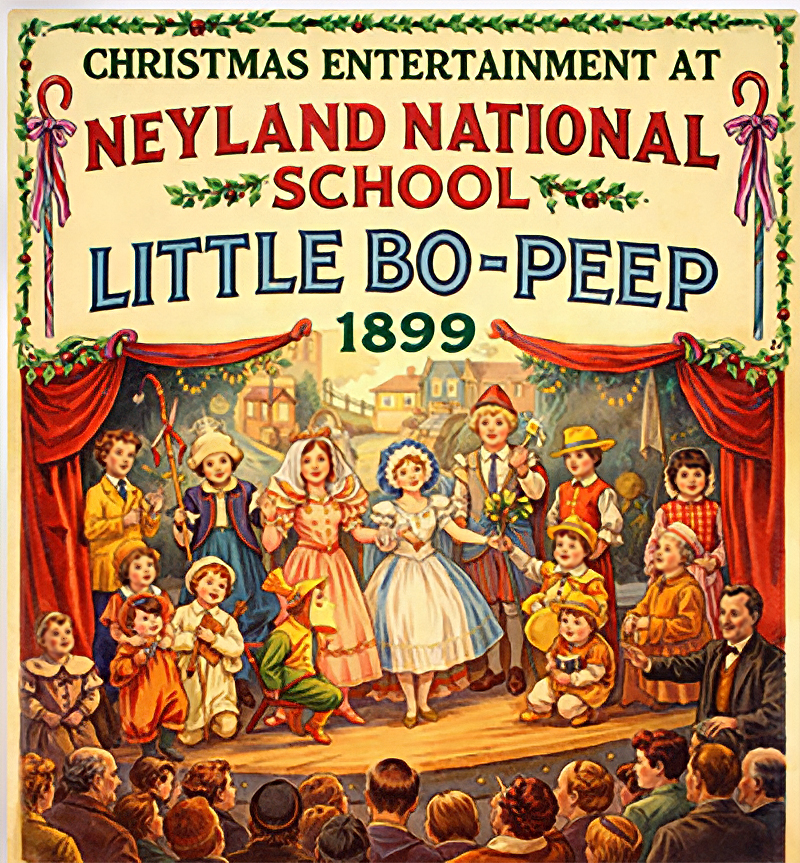
I recently discovered a newspaper report from December 1899 that gives us a wonderful glimpse into everyday life in Neyland over 120 years ago.
On Wednesday 6th December 1899, the pupils of Neyland National School performed a Christmas entertainment in the schoolroom under the direction of their teachers Mr Hollis and Miss Tucker. Victorian school concerts like this were an important social event for the whole community.
I can just imagine the room would be lit by lamps (as there was no electricity) and filled with parents, neighbours and friends.
The main performance was a nursery-rhyme play called “Princess Tiny Tot”. The children appeared in colourful costumes as familiar characters including Little Bo Peep, Jack-in-the-Box, Humpty Dumpty, Old Mother Hubbard and Red Riding Hood. Costumes were likely made by mothers and teachers using shawls, ribbons, paper crowns and simple props.
The programme also included songs, recitations and action drills. Pupils performed pieces such as “Bootblack Brigade,” “Jolly Jack,” and a Fan Telegraph drill, while others delivered humorous recitations like “The Quack Doctor”. Pianoforte solos were played by Enna Scurlock and Gwen Griffiths. The evening ended with the entire audience standing to sing “God Save the Queen,” as Queen Victoria was still on the throne.
The report lists many of the children who took part, including Maud, Nellie and John Button; Hilda and Dorothy Christian; Phyllis, Oscar and Foster George; Walter and Mabel Evans; William Sydney Rees; Stanley Herbert; Tom Rowlands; Maggie Mason and John Jenkins.
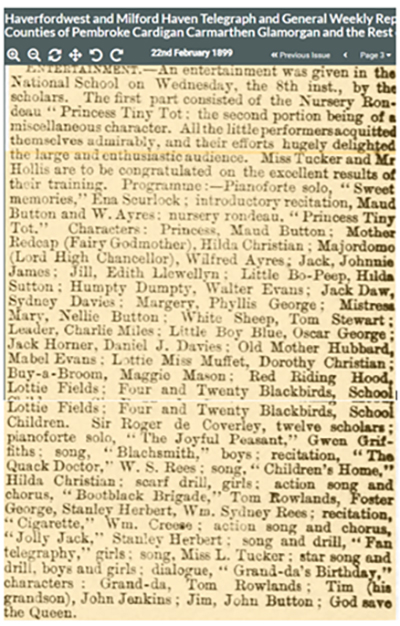
By comparing these names with the 1901 census for Llanstadwell parish, we can identify many of the families who lived in Neyland’s streets such as James Street, High Street and Railway Terrace. Most fathers worked in the industries that shaped the town at the time, including the railway, docks and maritime trades.
This small newspaper clipping gives us a remarkable snapshot of the town’s children and families at the end of the Victorian era. It allows us to picture a winter evening in 1899, a crowded schoolroom, proud parents in the audience, and the voices of Neyland’s children performing songs and nursery rhymes on stage.
A wonderful glimpse into school life in Neyland more than a century ago.