By Carol Elliott
This article is based on the published work of Richard Parker together with primary material drawn from the Desmond Davies Collection, including photographs, contemporary notices, and Great Western Railway records now preserved within the National Railway Museum archive. Parker’s narrative provides the structural account of Neyland’s development, while the Davies material offers direct contemporary evidence of the operation, scale, and conditions of the Irish packet service, allowing the history of the port to be reconstructed through both interpretation and surviving primary sources.[1]
The partnership of Captain Thomas Jackson and Captain Robert Ford represents the first sustained attempt to operate a regular and integrated steam packet service from the railway terminus at Neyland, linking rail and sea into a single working system.[2]
The Jackson and Ford operation began formally in August 1856, shortly after the opening of the South Wales Railway to Neyland in April of that year.[3] Their service developed out of the earlier Milford Haven and Waterford Steam Ship Company, but it was the arrival of the railway that made a regular and commercially viable service possible. The railway removed the delays and inefficiencies of the long overland journey across South Wales and created, for the first time, a coordinated route between London and southern Ireland.[4]
From the outset, however, the partnership faced significant operational difficulties. Their fleet consisted largely of paddle steamers of varying size and condition, and within the opening months they were forced to borrow heavily, including £7,500 from the South Wales Railway, to carry out repairs, notably to the vessel Malakoff.[5] This immediate reliance on financial support placed the enterprise on an uncertain footing.
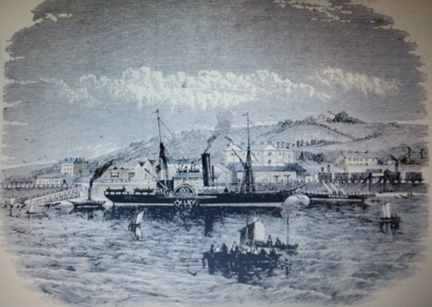
Neyland has yet to be developed up the High Street
Despite the challenges faced, Jackson and Ford expanded their operations. By 1857, additional vessels such as the City of Paris and Courier had entered service, and by 1858 a more regular Monday to Saturday sailing pattern had been established.[6] Their fleet at this stage included the Malakoff, Great Western, South of Ireland, and chartered vessels such as the Griffin, allowing them to maintain frequent sailings between Neyland and Waterford.[7]
The scale of the service is clearly evidenced in contemporary material preserved within the Davies Collection. Sailings were advertised as capable of carrying up to 500 passengers together with large numbers of cattle, sheep, and pigs, with crossings of approximately 118 nautical miles taking eight to nine hours.[8] This combination of passenger and livestock traffic became a defining feature of the route, though it brought persistent complaints. Conditions on board were often difficult, and contemporary accounts refer to overcrowding, the movement of animals through passenger areas, and the general discomfort created by the proximity of livestock.[9]
Expansion beyond Waterford followed. Between 1858 and 1860, a Cork service was intermittently attempted and later formalised with the establishment of the Milford Haven and Cork Royal Mail Company.[10] The arrival of the Talbot at Neyland in August 1860 marked the beginning of a more regular Cork connection, with sailings soon operating three times weekly.[11] This reflects a wider ambition to establish Neyland as a principal Irish Sea port rather than a single route station.
However, operational instability remained a constant problem. Mechanical failures and accidents affected several vessels. The Malakoff required a new boiler after being taken out of service, while other vessels including Waterford, Milford, and Limerick were involved in collisions, groundings, and breakdowns during the 1860s.[12] These incidents disrupted schedules and added to the already heavy costs of operation.
Financial pressure continued throughout the partnership. In May 1867, a formal agreement was made between the Great Western Railway and Captain Jackson, requiring the maintenance of a minimum number of vessels and defined service standards.[13] This agreement illustrates both the importance of the route and the dependence of the operators on railway support. Even with this backing, the business struggled to remain profitable, with losses estimated at around £2,000 annually, largely due to maintenance costs, loan repayments, and the limitations of the existing fleet.[14]
Attempts to strengthen the operation included the acquisition of a 793-ton steamer, the Vulture, and it arrived at Neyland on 12 July 1870. By this stage, however, the fleet had become a mixed and uneven collection of vessels of varying age and condition, requiring constant maintenance and careful management. The difficulty of sustaining a reliable Waterford service under these conditions appears to have played a significant part in the Great Western Railway’s decision to assume direct control. This came on 1 February 1872, when the GWR purchased the core of the fleet, including the Malakoff, South of Ireland, and Great Western, for £36,500. The Vulture was acquired separately in April for a further £9,000. With this, the Ford and Jackson era effectively came to an end, although Captain Jackson remained at Neyland for a short period as manager until July 1873, ensuring continuity during the transition to railway control.
In retrospect, the years 1856 to 1872 represent the experimental and formative phase of the Irish packet service at Neyland. Jackson and Ford established the operational model, demonstrated the viability of integrating rail and sea transport, and generated the traffic that the Great Western Railway would later develop into a fully coordinated system. Their period was marked by ambition and expansion, but also by instability and financial strain. Without it, however, Neyland could not have emerged as one of the principal packet ports of the Irish Sea.
The end of the Jackson and Ford period came in February 1872, when the Great Western Railway purchased the partnership and its vessels, including the Great Western, Malakoff, and South of Ireland, for £36,500.[16] This marked a decisive transition from private enterprise to direct railway management and opened the way for the more organised and profitable phase of the Neyland packet service that followed.
Below is a list of all the Ford & Jackson Vessels.
Ford and Jackson Packet Fleet at Neyland, c. 1856–1872
|
Vessel |
Year in Service |
Type |
Notes |
Recorded Cost |
|
Malakoff |
1856 |
Paddle steamer |
Core early vessel; required major repair |
£7,500 loan for repairs[5] |
|
Great Western |
1856 |
Paddle steamer |
Principal packet vessel |
Not recorded |
|
City of Paris |
1857 |
Paddle steamer |
Added during early expansion |
Not recorded |
|
Courier |
1857 |
Paddle steamer |
Supplementary vessel |
Not recorded |
|
Griffin |
c. 1857–58 |
Chartered vessel |
Used to maintain service frequency |
Not recorded |
|
South of Ireland (early) |
Late 1850s |
Paddle steamer |
Key vessel on route |
Not recorded |
|
Talbot |
1860 |
Paddle steamer |
Introduced for Cork service |
Not recorded |
|
Waterford |
1860s |
Paddle steamer |
Recorded in incidents |
Not recorded |
|
Milford |
1860s |
Paddle steamer |
Working vessel |
Not recorded |
|
Limerick |
1860s |
Paddle steamer |
Recorded in incidents |
Not recorded |
|
South of Ireland (new) |
1867 |
Paddle steamer |
Replacement vessel |
Not recorded |
|
Vulture |
1870 |
Larger steamer |
Late fleet reinforcement |
Not recorded |
Analytical Note on Ford & Jackson Operation
The Ford and Jackson fleet was never a unified or modern operation. It developed incrementally from 1856, relying on a mixture of ageing vessels, chartered ships, and continual repair work. The early need to borrow £7,500 to repair the Malakoff demonstrates that the enterprise began under financial pressure rather than strength.[5]
Although additional vessels were introduced during the late 1850s and early 1860s, this expansion masked underlying structural weaknesses. The use of chartered vessels such as the Griffin and the frequent appearance of ships in repair or involved in accidents reflects the difficulty of maintaining a reliable service with limited capital and inconsistent assets.[12]
Later attempts to modernise the fleet, including the introduction of a new South of Ireland in 1867 and the acquisition of the Vulture in 1870, came too late to stabilise the business. By this stage, operational costs, maintenance demands, and the pressures of maintaining a scheduled service had combined to undermine profitability.
The final sale of the entire operation to the Great Western Railway in 1872 for £36,500 confirms this position.[16] The figure represents not a highly profitable enterprise, but a working system in need of consolidation and reinvestment. It explains both the financial strain experienced by Jackson and Ford and the persistent reliability issues that characterised the service during their period of operation.
Footnotes
[1] Richard Parker, Neyland: A Great Western Outpost (2000); Desmond Davies Collection, including Great Western Railway material preserved in the National Railway Museum archive.
[2] Parker, Neyland, p. 29; Desmond Davies Collection.
[3] Parker, Neyland, p. 29.
[4] Parker, Neyland, pp. 27–28.
[5] Parker, Neyland, p. 29; Desmond Davies Collection.
[6] Parker, Neyland, pp. 29–30; Desmond Davies Collection.
[7] Parker, Neyland, pp. 29–30.
[8] Great Western Railway notice, Waterford Mail, 31 May 1870; Desmond Davies Collection, NRM GWR B.Box 161.
[9] Parker, Neyland, pp. 33–34; Desmond Davies Collection.
[10] Parker, Neyland, p. 30.
[11] Parker, Neyland, p. 30.
[12] Parker, Neyland, p. 35; Desmond Davies Collection.
[13] Parker, Neyland, p. 31.
[14] Parker, Neyland, p. 32.
[15] Parker, Neyland, p. 32.
[16] Parker, Neyland, p. 32; Desmond Davies Collection.