By Alan Brown
When the Second World War came to an end in 1945, it introduced a prolonged period of peace, for which the people of Pembrokeshire were unquestionably thankful; however, the winding up of military activity on the Milford Haven waterway also brought an end to the economic benefits that it had brought to the area and, as with much of the UK, the post-war years were a period of stagnation, with a return to low wages and high rates of unemployment.
When the petrochemical industry saw the potential for development in the deep and calm waters of the Haven, with its surrounding flat and open farmland, it was the start of a new era for the people of south Pembrokeshire. In 1957 the Esso company began the construction of an oil refinery on the fields of the former South Hook farm, near Herbrandston. This opened in 1960; the work of building the refinery had created a massive demand for labour, with a peak workforce of over 3,000. Four years later, a second refinery was opened at Rhoscrowther, on the southern shores of the Haven, by Regent Oil, a subsidiary of Texaco. This again brought a welcome boost to the economy of the area.
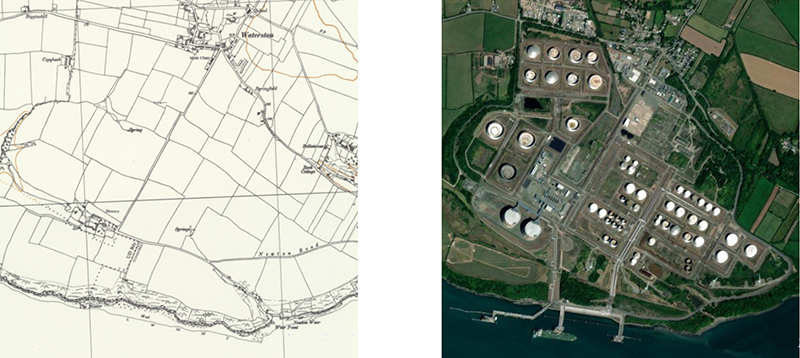
The third petrochemical plant on Milford Haven was built entirely within the bounds of Llanstadwell parish. Gulf Oil took over a large tract of land stretching from the waterway to the village of Waterston, consisting almost entirely of open fields; the sole significant habitation was the historic manor of Newton, which vanished beneath the storage tanks. The Gulf refinery opened in 1968; in 1985 Gulf merged with Standard Oil and the resulting venture was re-branded as Chevron. The refinery ceased operation in 1997.
After several years of inactivity, a second transformation took place when Dragon LNG chose the site for the construction of a terminal for receiving and storing liquefied natural gas and also by Sem Logistics for the storage of Petro Chemical products. Work on the Dragon LNG Site began in 2004 and the terminal became operational in 2009. The LNG is delivered to the plant by container ships and stored until needed in huge tanks. It is then ‘regasified’ and distributed to the UK’s natural gas network by pipeline. In addition to their gas operation, Dragon LNG have been active in the promotion and use of renewables; on coastal land to the south of the main plant they have built a solar farm, housing over 18,500 solar panels and three onshore wind turbines.
Land on the Waterston Site is owned by Dragon LNG, Valero Pembrokeshire Oil Terminal, Egnedol and Wear Point Farm Ltd. Egnedol’s planning applications for various ideas have so far been refused. Wear Point Farm operate four wind turbines to South and Southeast of the site.