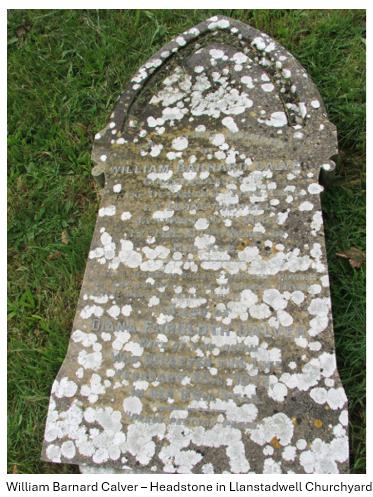
Sometimes we do not realise that people of real national importance have lived quietly in Llanstadwell and Neyland. These notable people lived and died in our parish and their gravestones are the only reminder we have that they were here.
One such figure was William Barnard Calver (1826–1883), a senior Royal Navy officer whose work helped shape Admiralty charts still in use today. After more than thirty years at sea, William Calver chose to retire to Llanstadwell, and his family remained at Llanstadwell House on Church Road for a generation after his death.
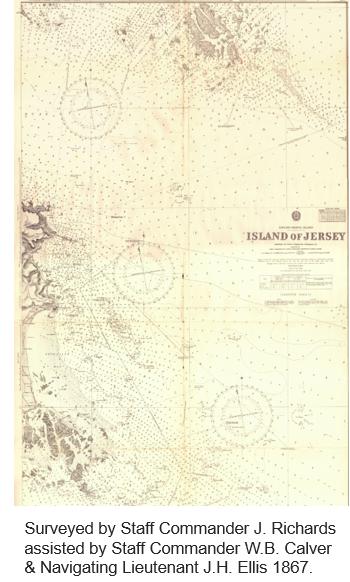
William Calver was born in Southwold, Suffolk, in 1826. He entered the Navy in the 1840s, training as a navigating officer in the Master’s Branch. His career was spent in hydrographic survey service. He worked on the Kerry coast of Ireland in the 1850s, helping to chart Tralee Bay, Brandon Bay, and Castlemaine Harbour. He later served in the West Indies, where his name appears on Admiralty charts of the Grenadines and St Vincent. By the 1860s he was engaged in re-surveys of British waters, including the Humber Estuary and approaches to the Thames. In 1867 he assisted Staff Commander J. Richards in charting the east coast of Jersey, his name appearing on Admiralty Chart 62A.
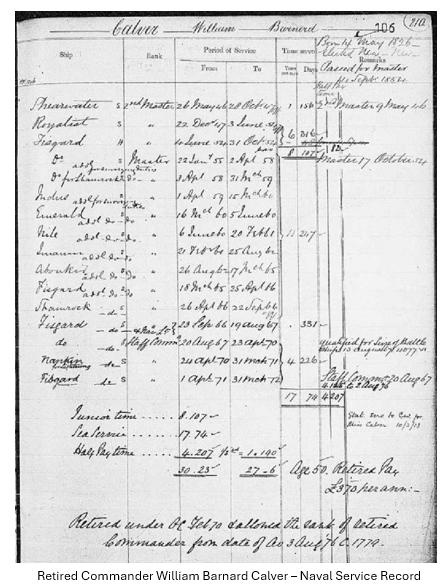
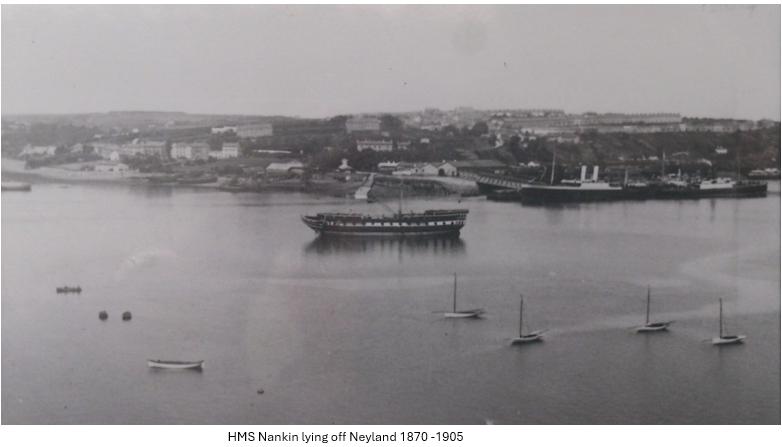
Calver’s service also brought him to Pembroke Dock. In 1870 he was posted to HMS Nankin, a 50-gun frigate and continued his surveying work. He was later posted to HMS Lightning. However HMS Nankin remained as a receiving and a hospital ship at Pembroke Dock for the Dockyard. The Nankin remained moored off the waters of Neyland, many of my ancestors can remember the Nankin in the Haven for years. It is almost certainly this connection to HMS Nankin that later influenced Calver’s decision to settle at Llanstadwell, directly across the water from where the ship was lying and she laid there until 1905 when she was eventually broken up.
William Calver retired on 3 August 1876 with the rank of Commander and a naval pension. By then he had served on ships including Thunderer, Regulus, Indus, Emerald, Nile, Havannah, Archer, Fawn, Shannon, Nankin, and Lightning. His career had not been about battles, but about the painstaking task of hydrographic survey, producing accurate maps and charts for the safe navigation of the fleet.
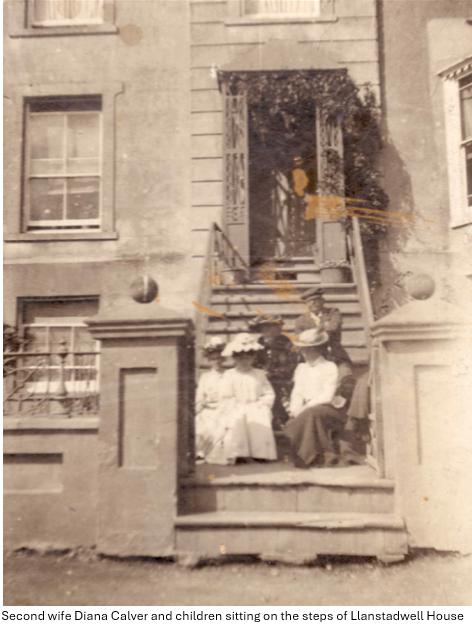
At home, Calver’s life was marked by two marriages. His first wife, Elizabeth Allan of Glasgow (1830–1870), bore him eight children in Ireland, Scotland, Jersey, and Pembrokeshire, reflecting his many postings. Elizabeth died young and is buried in Llanstadwell churchyard. In 1872 he remarried, taking Diana F. Calver (1833–1913) as his wife at Llanstadwell Church. Together they had three more children.
The 1871 census shows Calver living with his family at Milford House in Neyland. By 1881 he was settled at #3 Hazel Bank in Llanstadwell, recorded as a retired Commander, with Diana and their younger children. He died in 1883 and is buried in Llanstadwell church yard. After his death in 1883, the family moved into Llanstadwell House, where Diana and her children lived until her death in 1913. For over forty years the Calvers were part of village life, their presence linking Llanstadwell with global naval service.
Calver’s story reminds us that behind the headstones in the graveyard, and the doorways of our village houses, lie histories that stretch far beyond the parish. From Southwold to the West Indies, from Kerry to Jersey, his career touched many parts of the world, yet it ended quietly here, overlooking the same waters where HMS Nankin was once moored. This is a tribute to a man and his family that should not be forgotten!