By Carol Elliott
Llanstadwell Church and the dedication to St Tudwal, a 6th century Celtic Saint
Introduction
While church dedications were traditionally fixed at consecration, in many Welsh parishes the original dedication was either lost or never clearly recorded. In such cases, later antiquarian interpretations, particularly in the nineteenth century, often influenced the identification of a patron saint. The history of Llanstadwell Church can be traced with confidence to at least the twelfth century, yet no medieval source records a dedication to St Tudwal. The association appears only in the work of the antiquarian Rice Rees in 1836, whose brief attribution was later adopted more widely. Even so, it is difficult not to find something rather compelling in the idea that this church, set on the banks of the Cleddau, might preserve a much earlier religious tradition, perhaps reaching back in memory to the age of the Celtic saints of the fifth and sixth centuries.
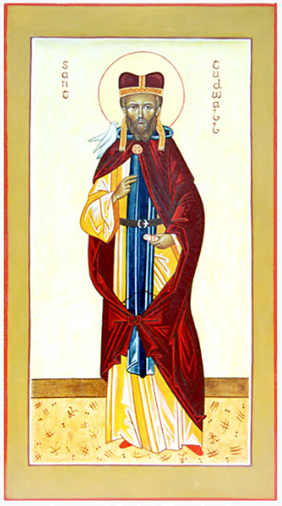
Llanstadwell in the Medieval Record
In medieval times, and indeed for centuries afterwards, the church at Llanstadwell was known simply by its placename, without any explicit association with a named saint.
Writing in the twelfth century, Gerald of Wales (Giraldus Cambrensis) refers to the manor in Latin as:
“…maneria de Lanstadhewal…” [1]
This is a direct medieval form of the name, clearly identifying the settlement but making no reference to any dedication.
A later piece of primary evidence survives within the church itself. The Elizabethan silver chalice, still held at Llanstadwell, bears the inscription:
“Lanstowel” [2]
This sixteenth-century form again preserves the name in use at the time. Taken together, these sources demonstrate that the church was consistently known as Llanstadwell, without any recorded medieval dedication to a named saint.
The Meaning of “Llan”
The name Llanstadwell begins with the Welsh word llan, a term fundamental to the understanding of early ecclesiastical sites in Wales.
In its earliest usage, llan referred to an enclosed piece of land, particularly one set aside for religious purposes. As Sir Ifor Williams observed, the word originally denoted “an enclosed area, especially a sacred enclosure” [3]. Over time, its meaning developed to refer more specifically to a church and its surrounding community.
E. G. Bowen similarly explains that llan “denotes a sacred enclosure which later became the site of a church” and that such places often formed the nucleus of early Christian settlement [4]. The term therefore reflects not simply a building, but an early religious community.
Many Welsh placenames follow the pattern llan combined with a personal name, and these have often been interpreted as indicating a dedication to a saint. However, this interpretation is not always straightforward. In some cases, the second element of the name has been altered over time or is no longer clearly identifiable. The presence of llan alone does not provide conclusive evidence of a specific dedication.
The Attribution to St Tudwal
The association of Llanstadwell with St Tudwal does not arise from medieval sources, but from the work of the nineteenth-century antiquary Rice Rees.
In 1836, Rees published:
"An Essay on the Welsh Saints or the Primitive Christians Usually Considered to Have Been the Founders of Churches in Wales"
His aim was to systematise the dedications of Welsh churches by linking placenames with known saints and reconstructing the structure of the early Welsh church.
Within this work, he lists:
“Llanstadwell - St Tudwal.” [5]
This single line is the origin of the modern attribution. Rees appears to have interpreted the name as an abbreviated form of Llan-sant-Tudwal, although he does not provide a detailed linguistic explanation.
Importantly, he offers no supporting documentary evidence and cites no medieval source. The identification is therefore asserted rather than demonstrated.
Who Was St Tudwal?
St Tudwal, known in Latin as Tugdual and in Breton as Tudwal, is generally placed in the sixth century and is associated primarily with Brittany.
The principal source for his life is the Vita Sancti Tugduali, preserved in the Bollandist collection Acta Sanctorum [6]. This text, compiled several centuries after his lifetime, reflects an established tradition rather than contemporary record.
The Vita describes him as:
“Tugdualus, Britanniae ortus, vir nobilis et religiosus…” [6]
(“Tugdual, born in Britain, a man of noble and religious character…”)
Association with Wales and the Llŷn Peninsula
Although the name Tudwal survives at Ynys Tudwal on the Llŷn Peninsula, the physical evidence there is limited and inconclusive. On Ynys Tudwal Fawr, the remains of a small stone structure have traditionally been identified as a chapel or hermitage. However, the site has not been securely dated, and no excavation or documentary record confirms its origin or dedication. It is often suggested, by comparison with similar coastal and island sites in Wales, that the remains may be early medieval in date, perhaps associated with a small religious retreat. Nevertheless, there is little evidence linking the site directly with St Tudwal of Brittany, and the association rests on later interpretation of the placename rather than on demonstrable historical proof.
Journey to Brittany and Family Tradition
Later hagiographical tradition provides a much fuller account of Tudwal’s life, though this material was compiled several centuries after the events it describes. According to these sources, Tudwal was said to be the son of Hoel Mawr and his wife Pompeia, and the brother of St Leonorius. He is described as travelling to Ireland to study scripture before returning to Britain, where later tradition associates him with a hermitage on Ynys Tudwal off the Llŷn Peninsula. He subsequently crossed to Brittany with a group of followers, often given as seventy-two, and established a monastic settlement at Lan Pabu under the patronage of a local ruler, sometimes identified as King Deroch of Domnonée. Further tradition records that he travelled to the Frankish court of King Childebert I and was confirmed as Bishop of Tréguier. These accounts reflect the fully developed medieval cult of the saint rather than contemporary historical record, but they illustrate the way in which Tudwal came to be understood as both a missionary and a founding bishop in Brittany. [6][12]
The Vita records that Tudwal crossed the sea to Brittany:
“…cum sociis mare transiit, et in Armorica consedit…” [6]
(“…he crossed the sea with companions and settled in Armorica…”)
Armorica is the ancient name for the coastal region of north-west Gaul, which corresponds broadly to modern Brittany in France.
Later tradition expands this account considerably. It states that he travelled with his mother, named Pompaea or Copaia, together with his brother St Leonorius and his sister St Scaeva. He is also said to have been accompanied by a group of disciples, often given as seventy-two monks.
The number seventy-two is generally understood as symbolic, reflecting biblical tradition rather than a precise historical count. These family and companion details derive from later hagiographical sources and should be treated with caution.
Some later accounts also associate Tudwal with St Goneri of Brittany, though such connections are not supported by early evidence and reflect the tendency of later writers to link saints into extended networks.
Foundation in Brittany and the Meaning of “Pabu”
According to the Vita, Tudwal established a religious foundation:
“…monasterium construxit et ecclesiam instituit…” [6]
(“…he built a monastery and established a church…”)
He is associated with an early settlement known as Lan Pabu.
The element pabu has been interpreted in Breton tradition as meaning “father,” suggesting a title of respect or authority. In this context, it may be understood as indicating Tudwal’s role as a spiritual father within his community. However, this interpretation belongs to later linguistic and devotional development rather than contemporary evidence.
St Tudwal at Tréguier Cathedral
The clearest historical association of St Tudwal is with Tréguier in Brittany. The cathedral dedicated to him stands on the site of an earlier religious foundation traditionally attributed to the saint. The present Gothic structure, built between the thirteenth and fifteenth centuries, became the centre of the bishopric of Tréguier [9][10][11].
In later iconography, Tudwal is represented as a bishop, often holding a staff or book as symbols of authority. In Breton tradition he is sometimes associated with a dragon, a motif that later became linked with the region of Trégor, though this forms part of the symbolic development of his cult rather than early evidence.
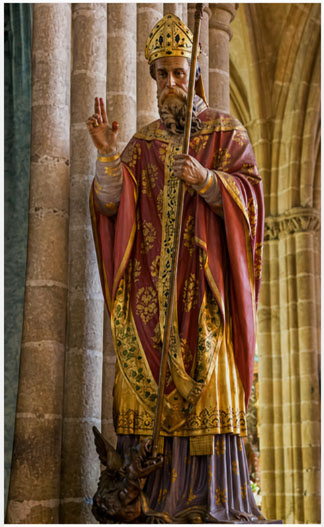
Within Breton tradition, Tudwal is regarded as a founding bishop. His presence is reflected in statues and representations in and around Tréguier, where he is depicted in episcopal vestments, often holding a book or staff as symbols of authority [13].
This strong and continuous tradition in Brittany contrasts with the absence of early evidence linking him to Llanstadwell.
Beyond Brittany, the name and cult of St Tudwal spread more widely, though often in forms that reflect later interpretation rather than early evidence.
The wider distribution of dedications to St Tudwal beyond Brittany illustrates how the saint’s cult developed and was reinterpreted over time. At Barmouth in north Wales, a Catholic mission established in the later nineteenth century included a temporary chapel dedicated to St Tudwal in 1891, followed by the construction of the present church, which prominently displays a statue of the saint at the top of the church. [14][15].
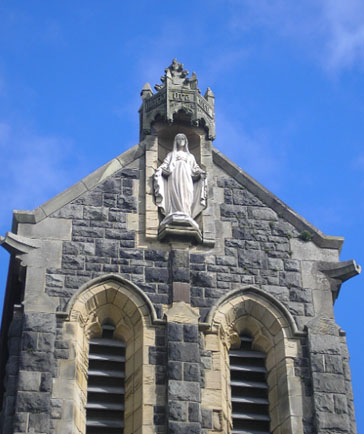
This dedication clearly post-dates the work of Rice Rees (1836) and belongs to a period of revived interest in Celtic saints, when such figures were consciously adopted in new church foundations.
A different but related example is found in the Channel Islands, where St Tugual’s Chapel on Herm, an eleventh-century building, preserves the saint’s name within a much earlier ecclesiastical context; however, even here it remains uncertain whether the dedication reflects a direct historical connection with the saint or a later attribution influenced by his Breton cult [16][17].
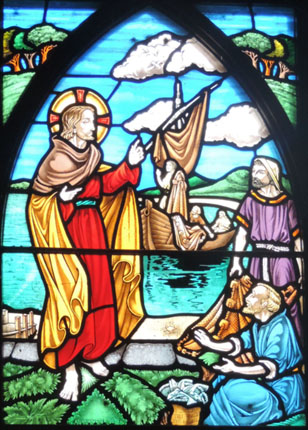
These examples, taken together, demonstrate how the name and reputation of St Tudwal spread geographically and chronologically, with firm historical foundations in Brittany, but more variable and often uncertain associations elsewhere.
One of the Seven Founder Saints of Brittany
Tudwal is counted among the Seven Founder Saints of Brittany: St Pol Aurelian, St Samson, St Brieuc, St Malo, St Patern, St Corentin, and St Tudwal.
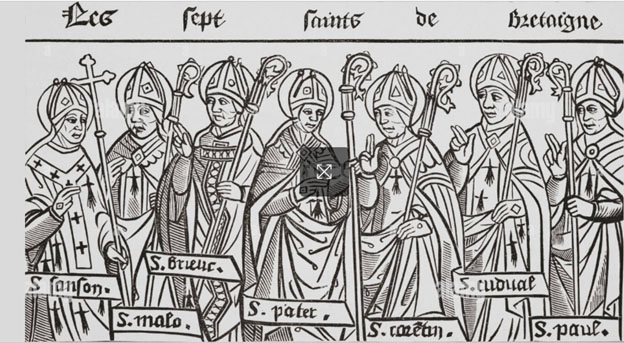
This grouping reflects the organisation of the Breton church and is associated with the medieval pilgrimage known as the Tro Breizh [7].
Reputation, Feast Day, and Invocation in Calamities
St Tudwal’s feast day is observed on 30 November, sometimes 1 December.
In Brittany, he became a major regional saint, associated particularly with Tréguier. He was invoked in times of calamity, including disease, famine, and maritime danger, reflecting the wider medieval belief in saints as protectors and intercessors [8].
Nature of the Evidence
The detailed accounts of Tudwal’s life derive from hagiographical sources written several centuries after his lifetime.
Such texts were intended to promote the cult of the saint and to organise traditions into coherent narratives. They therefore reflect how Tudwal was remembered and venerated, rather than providing direct contemporary evidence [6].
Conclusion
The evidence for the dedication of Llanstadwell Church to St Tudwal rests not on medieval record, but on later interpretation. The earliest sources, including the reference of Gerald of Wales to Lanstadhewal and the Elizabethan chalice inscription Lanstowel, show continuity of the placename without any explicit dedication to a saint [1][2]. No medieval document records St Tudwal in connection with Llanstadwell church.
The attribution first appears in 1836 in the work of Rice Rees, whose brief one line only entry says “Llanstadwell -St Tudwal” and provides no supporting evidence or explanation [5]. It reflects a wider nineteenth-century attempt to reconstruct the early Welsh church by linking placenames with saints, rather than preserving an earlier tradition. While the absence of medieval evidence makes it clear that the dedication cannot be traced to the earliest history of the church, this does not diminish the significance it has acquired since.
By contrast, St Tudwal’s historical and devotional centre lies firmly in Brittany, particularly at Tréguier, where his role as a founding bishop became established within the medieval Breton church [9][12]. Elsewhere, his name appears more loosely attached to places through later tradition, as at Ynys Tudwal on the Llŷn Peninsula, the chapel on Herm, and the nineteenth-century church at Barmouth.
Llanstadwell fits within this wider pattern. Its association with St Tudwal is a product of later antiquarian interpretation, subsequently adopted into local and ecclesiastical usage. The lack of early evidence clarifies the historical position, but it need not detract from the present. Today, the dedication forms part of the church’s identity and is one that parishioners can embrace as a meaningful link, whether historical or symbolic, to the wider tradition of the Celtic saints.
References
[1] Giraldus Cambrensis, Opera, ed. J.S. Brewer et al., Rolls Series (London, 1861–1891).
[2] Elizabethan silver chalice inscription, Llanstadwell Church (16th century).
[3] Ifor Williams, Enwau Lleoedd (Liverpool, 1945).
[4] E. G. Bowen, The Settlements of the Celtic Saints in Wales (Cardiff, 1954).
[5] Rice Rees, An Essay on the Welsh Saints (London, 1836).
[6] Acta Sanctorum, Novembris, vol. III, Vita Sancti Tugduali.
[7] A. Chédeville and N.-Y. Tonnerre, La Bretagne Féodale (Rennes, 1987).
[8] André Vauchez, Sainthood in the Later Middle Ages (Cambridge, 1997).
[9] Jean-Michel Boulbain, La cathédrale de Tréguier (1994).
[10] Yves Thomas, Cathédrale de Tréguier (2000).
[11] Chantal Leroy and Dominique de la Rivière, Cathédrales et basiliques de Bretagne (2008).
[12] Louis Duchesne, Fastes épiscopaux de l’ancienne Gaule, vol. II (1900).
[13] David Hugh Farmer, Oxford Dictionary of Saints (2011).
[14] Diocese of Wrexham, St Tudwal’s Church, Barmouth: Parish History and Architectural Description (19th-century mission records and later parish summaries).
[15] David Hugh Farmer, Oxford Dictionary of Saints, 5th ed. (Oxford: Oxford University Press, 2011), s.v. “Tudwal.”
[16] Channel Islands Heritage, St Tugual’s Chapel, Herm: Archaeological and Historical Survey Reports (Guernsey Museums Service).
[17] John McCormack, “The Early Churches of the Channel Islands,” Proceedings of the Société Jersiaise, vol. 25 (1993), pp. 145–168.