By Carol Elliott
The History of the Welsh All Blacks
& The Silver Fern of Neyland RFC
The History of Neyland RFC and the Silver Fern of the All Blacks
For over 100 years, Neyland Rugby Football Club has worn the silver fern, the famous emblem of the New Zealand national rugby union team. This alone makes Neyland unique. Across Britain, the club is widely regarded as the only one permitted to wear the fern, and this claim is supported not just by tradition, but by clear evidence in photographs, newspapers, and recorded rugby history.
The story begins in New Zealand. The silver fern was seen as an established national symbol in the nineteenth century. It had been used by soldiers and sports teams long before the All Blacks became the famous rugby team from New Zealand.
In 1905, when the New Zealand team toured Britain and Wales, they brought the silver fern emblem with them. It quickly became the symbol of a side whose style of play transformed the game. The All Blacks became legendary, and their black strip and silver fern were recognised across the rugby world.
Newspapers of the day tells us that on 21 October 1905, the New Zealand team played Swansea at St Helen’s Rugby and Cricket Ground. The match drew a large crowd and made a deep impression on Welsh rugby. Contemporary newspapers struggled to describe what they had seen. The Western Mail wrote of “a team of remarkable combination… their passing and backing up being of the highest order,” while The Times observed that “their methods are novel… their combination and anticipation of play are extraordinary.”[1][2] Reports from South Wales noted that the visitors from New Zealand, “handled the ball with great precision… always in support… rarely out of position.”[3] This was not simply a strong team. It was a team that redefined how rugby was played.
It is in the years immediately after this tour that Neyland’s story begins to take shape. Local tradition has long held that the club, were inspired by the New Zealanders, and they adopted both the black strip and the silver fern. Stories speak of admiration and of “a gentleman’s” understanding between Neyland RFC and the All Black’s, that allowed the silver fern emblem to be used by Neyland. No written agreement has yet been found, although some in Neyland say there was a letter, and the timing of this and of these traditions, fits closely with the historical record.[4]
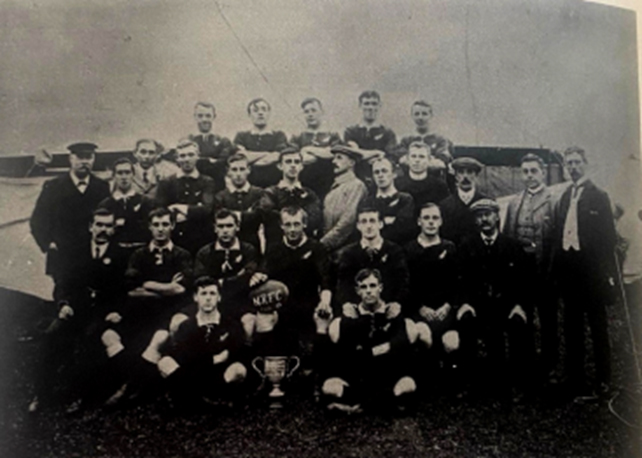
The first firm evidence appears in the 1908 to 1909 season. Richard Howells in his book “Neyland RFC 1885 – 1985, shows a photograph of the Neyland side that won the Pembrokeshire Cup during the 1908 – 1909 season. This photograph shows the players wearing shirts bearing the fern motif, proving that by this date the emblem was already part of the club’s identity on the field.[5]

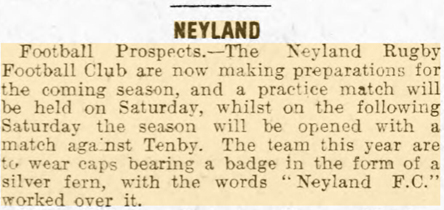
That evidence is confirmed in the newspapers. On 3 September 1909, the Pembroke County Guardian and Cardigan Reporter reported that Neyland players would wear caps “bearing a badge in the form of a silver fern, with the words ‘Neyland F.C.’ worked over it.”[6] This is clear contemporary proof that the fern had been formally adopted and recognised as the club’s badge.
By the following year, the identity had become widely known. On 20 April 1910, the Haverfordwest and Milford Haven Telegraph referred to Neyland as the “Pembrokeshire ‘All Blacks.’”[7] This shows that the connection with New Zealand rugby was already understood at the time. Neyland were not just wearing the fern. They were known for it.
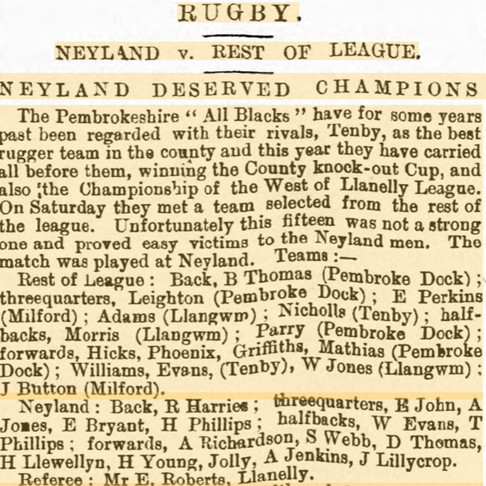
This newspaper report is especially important for what it reveals about Neyland’s identity. In describing the side, the newspaper refers to them directly as the “Pembrokeshire ‘All Blacks,’” a phrase used without explanation, showing that the name was already widely understood at the time. This is not a later nickname or modern interpretation, but a contemporary description, linking Neyland clearly with the black strip and the silver fern associated with New Zealand rugby. The fact that the press could use the term so naturally indicates that the connection had already become established in the public mind. It provides strong evidence that by 1910 Neyland were not only wearing the fern but were recognised beyond the town as the All Blacks of Pembrokeshire.
The connection with New Zealand rugby continued into later years. During the New Zealand All Blacks’ return tour of Britain, Ireland and France in 1924 to 1925, a Neyland man, Thomas David Evans, played against the touring side while representing Swansea. That match took place on 27 September 1924 at St Helen’s Rugby and Cricket Ground. Swansea was defeated 17–0, but the match was a significant occasion. The New Zealand side, often referred to as “The Invincibles,” included outstanding players such as Cliff Porter (captain), George Nepia at full-back, and the powerful centre Bert Cooke, all of whom contributed to their dominance on tour.[8] Evans, representing Swansea, was part of the Welsh resistance to this formidable side, placing a Neyland player directly in opposition to one of the greatest teams in rugby history.
A decade later, the connection became even more remarkable. During the 1935 New Zealand tour, three members of the touring All Blacks played a match for Neyland. This took place in 1935 in Neyland, when the club was already well established in its use of the silver fern and black strip. Writing later, Stephen Cooper in his book “The Final Whistle”, recorded that Neyland wore the “silver fern and all-black strip,” noting how unusual it was to see this combination outside New Zealand.[9]
Taken together, the history is clear. The silver fern was a New Zealand symbol before 1905. The 1905 tour, including the match at St Helen’s on 21 October, made it famous across Britain. Within a few years, Neyland had adopted it, as shown by the 1908 to 1909 team photograph and the 1909 newspaper report. By April 1910, the club was publicly known as the “All Blacks” of Pembrokeshire. In 1924, a Neyland player faced the All Blacks at Swansea, and in 1935, All Blacks players themselves appeared for Neyland.
There is one final detail that captures the spirit of the story. The Neyland fern is traditionally said to curve in the opposite direction from the New Zealand one. Whether this was agreed from the beginning or developed over time, it shows that Neyland did not simply copy the All Blacks. They were inspired by them and made the symbol their own.
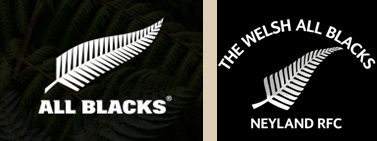
That is why Neyland RFC are known as the Welsh All Blacks. Not through myth, but through history. Not through imitation, but through a tradition that has lasted for more than a hundred years.
Citations
[1] Western Mail (Cardiff), October to December 1905, reports on the New Zealand tour.
[2] The Times (London), November to December 1905, reports on the New Zealand rugby tour.
[3] South Wales Daily News, October 1905, report on Swansea v New Zealand.
[4] Local oral tradition preserved in Neyland RFC histories and community recollection.
[5] Neyland Rugby Football Club Centenary History, 1885–1985, p. 14.
[6] Pembroke County Guardian and Cardigan Reporter, 3 September 1909.
[7] Haverfordwest and Milford Haven Telegraph, 20 April 1910.
[8] Records of the 1924–25 New Zealand tour; Swansea v New Zealand, 27 September 1924, St Helen’s Ground.
[9] Stephen Cooper, The Final Whistle: The Great War in Fifteen Players (Stroud: The History Press, 2012), p. 239.