By Carol Elliott
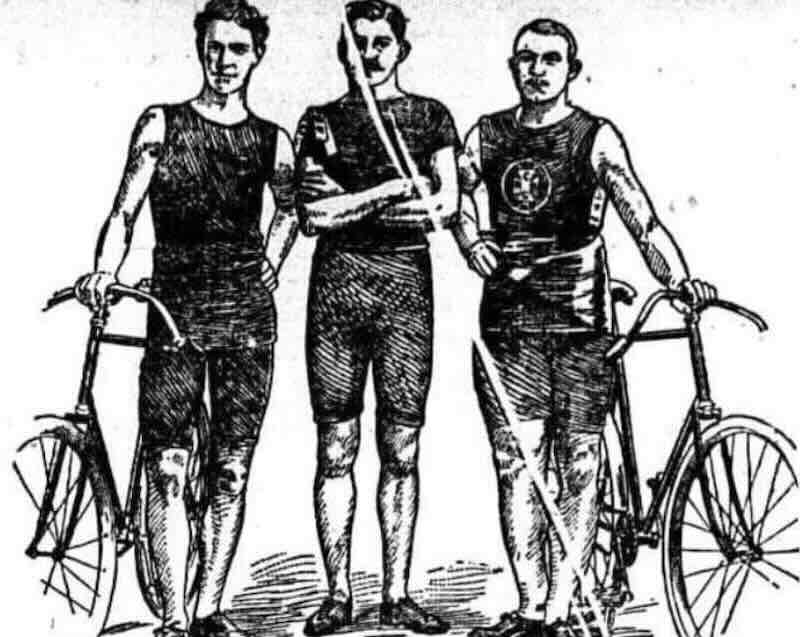
The story of the Neyland Athletic Club starts during the “Golden Era” of Neyland, soon after the arrival of Brunel’s South Wales Railway in 1856. As the town expanded, so too did its appetite for organised recreation, civic pride, and public display.
By the early 1890s, these forces had converged on the town, which had been transformed from Brunel’s terminus into a lively port with hotels, brass bands, and level sports fields above the railway. It was here that the people of Neyland laid out a track and sports green for what would become one of the county’s most anticipated summer events, the Neyland Annual Athletic Sports, Bicycle, and Pony Races.
Visitors could arrive by mid-morning train, compete, listen to the Pembroke Town Band or later the Welsh Regiment Band, take tea on the field for one shilling, and watch the dancing on the green before boarding the late boat home.
The newspaper reports speak of 2,000 to 3,000 spectators crowding the rails, a mix of townsfolk, sailors, miners, and clerks, all cheering the finish of a bicycle race or the spectacle of a trotting pony rounding the bend against the Cleddau sunset.
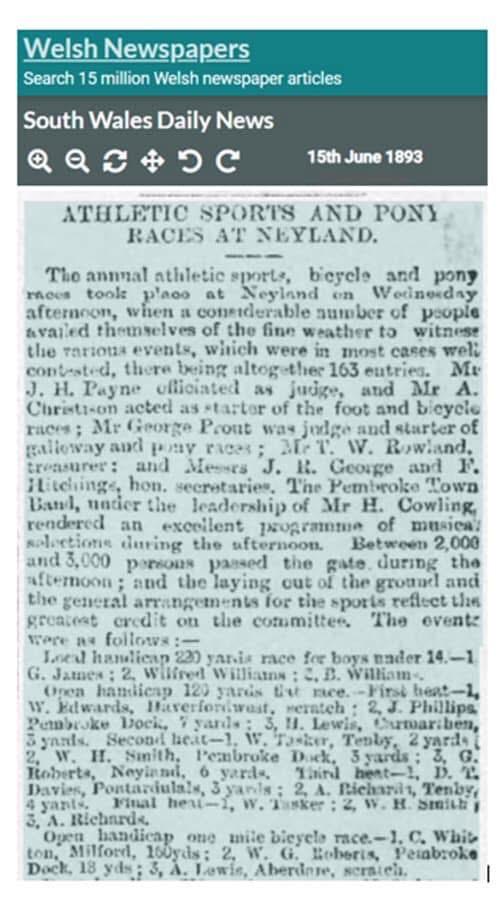
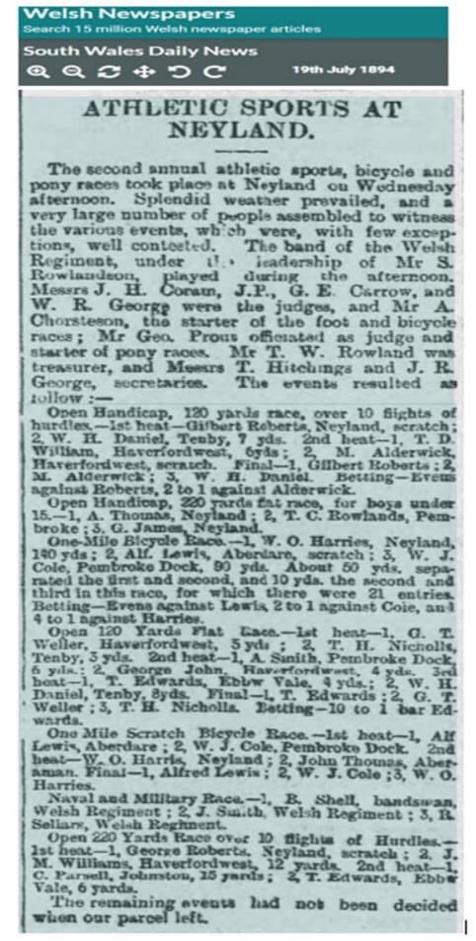
This account traces the development of those early sports meetings, drawing upon contemporary newspaper reports from the South Wales Daily News of 1893 and 1894, as well as the surviving 1919 programme, which marks the post-war revival of the event under the banner of the Neyland Athletic Club.
From inception, the Neyland Sports Club combined local enthusiasm with county-wide participation, attracting competitors from Tenby, Haverfordwest, Pembroke Dock, and beyond. They reveal a community proud of its modern identity, a railway town with the community spirit of a village and demonstrate how sport served as a meeting ground for all classes and callings.
The following narrative reconstructs those early days, illustrating how a small Pembrokeshire town transformed itself into a stage for athleticism, music, and good fellowship, and how the Sports field above the railway line became, for generations, the heart of Neyland’s social life – the Neyland Sports and Athletics Club – now combined as part of the Neyland Hub Community Centre.
Sources: South Wales Daily News, 15 June 1893 & 19 July 1894; Neyland Annual Athletic Sports, Bicycle & Pony Races Programme, 5 July 1919 (private collection).
The Birth of the Neyland Athletic Sports (1893)
The first Neyland Annual Athletic Sports, Bicycle and Pony Races took place on Wednesday, 14th June 1893, marking a defining moment in the town’s social and sporting history. The event was staged during what locals later called Neyland’s “golden era”, when the town had grown from a small settlement on the banks of Westfield Pill, into a bustling railway terminus and maritime hub after the arrival of Brunel’s South Wales Railway in 1856.
As prosperity rose, so too did civic pride, and with it came organised recreation. The 1893 Sports embodied that spirit, a full day of competition, music, and festivity on the fields overlooking the Cleddau.
According to newspapers of the day, over 2,000 to 3,000 people attended that day in June 1893, many travelling from Pembroke Dock, Haverfordwest, Tenby, and beyond. The Pembroke Town Band, under Mr. H. Cowling, provided a rousing programme of music, while the local committee, chaired by Mr. J. H. Payne, ensured everything ran with precision. Mr. A. Christison acted as starter for the foot and bicycle races, Mr. George Pont judged the pony events, and Mr. T. W. Rowland served as treasurer, assisted by secretaries J. R. George and F. Hitchings.
The day saw 163 entries across numerous events, proof of how eagerly athletes, horsemen, and cyclists alike embraced the challenge.
Among the key winners and events were:
- J. James (Neyland) in the boys’ race (14 and under)
- G. George (Milford Haven) and R. George (Pembroke Dock) in cycling and foot events
- The Pembroke Town Band was praised for their contribution to the lively atmosphere
The tone of the report captures a jubilant Neyland, disciplined, competitive, and proud of its community spirit.
The Second Annual Sports – July 1894
A year later, on Wednesday, 18th July 1894, Neyland again became the centre of West Wales’ summer sporting calendar. The South Wales Daily News reported “splendid weather” and another large crowd.
This time, the Welsh Regiment Band, led by Mr. S. Rowlands, played throughout the afternoon. The organising committee had grown in stature: J. H. Coram, J.P., G. E. Carrow, and W. R. George acted as judges; Mr. A. Christison again took charge of the starting pistol, and Mr. George Pont returned as judge and starter for the pony races.
The results read like a roll call of West Wales sport:
- Gilbert Roberts (Neyland) excelled in the hurdles;
- W. O. Harries (Neyland) won the one-mile bicycle scratch race, later becoming a central figure in Neyland’s sporting life.
- C. T. Weller (Haverfordwest) and A. H. Nicholls (Tenby) featured strongly in the sprints.
- B. Shell (Welsh Regiment Band) triumphed in the military races.
Betting at the sidelines and crowds cheering each heat show just how electrifying the day must have felt. It was community theatre, sport, spectacle, and sociability in one.
The Post-War Revival – 1919
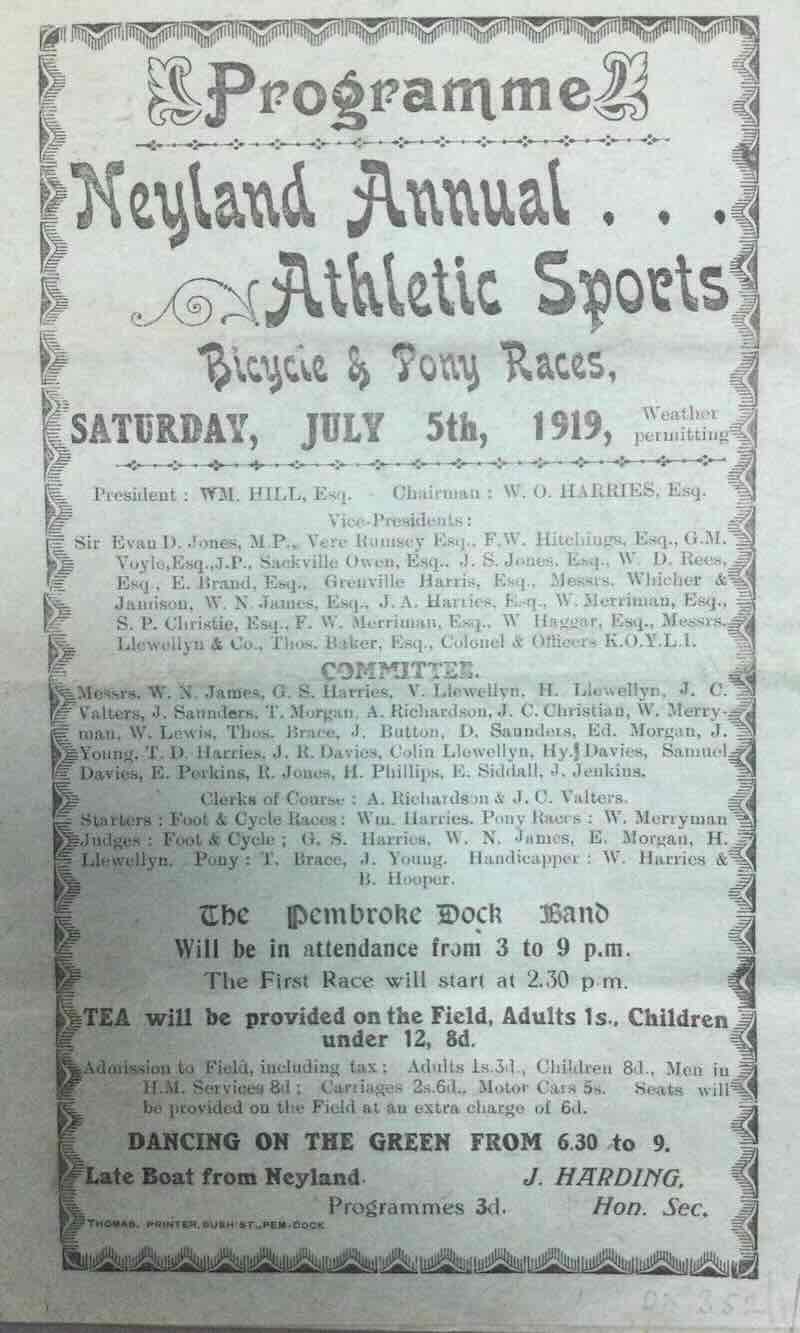
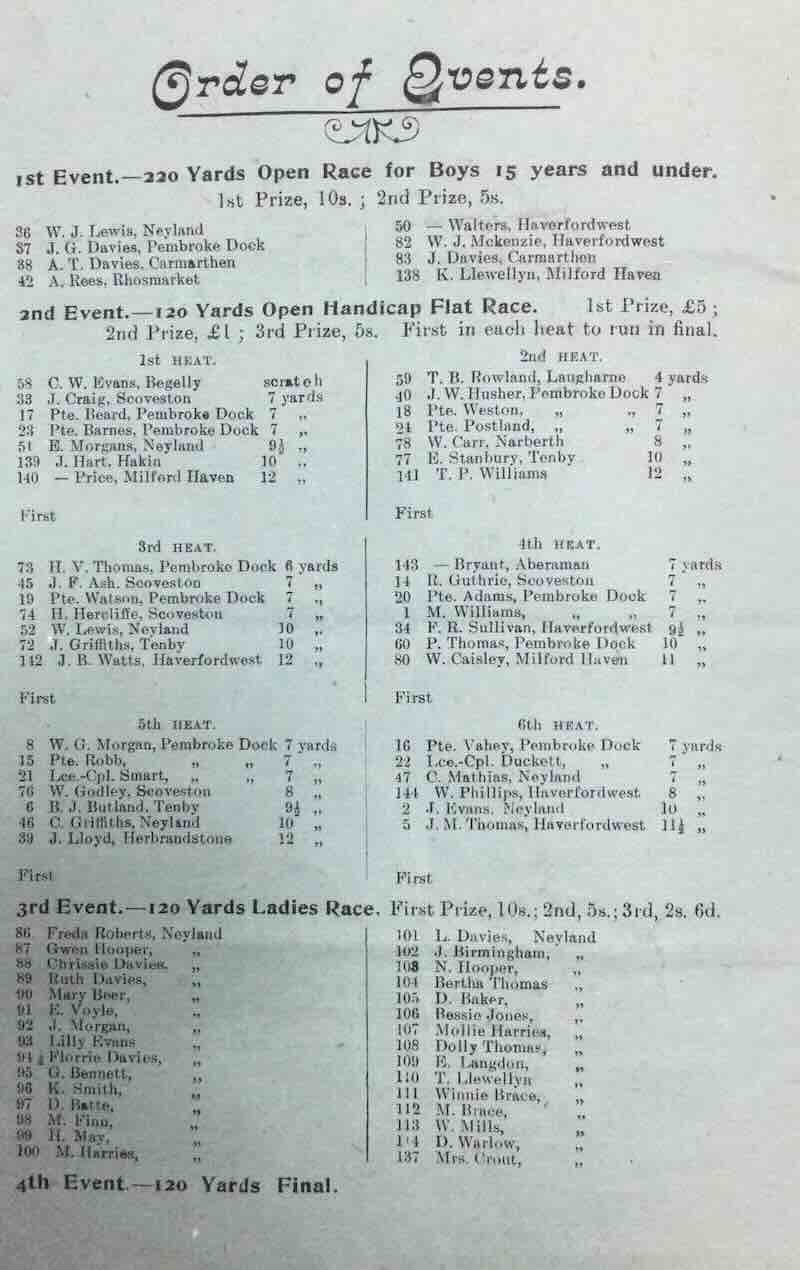
After the long pause of the Great War, Neyland’s annual sports returned in 1919 with even greater vigour. The Programme for Saturday, 5th July 1919 shows a meticulously planned event, still true to its 1890s roots but grander in scale.
President: Wm. Hill, Esq.
Chairman: W. O. Harries, Esq.
Vice-Presidents: Sir Evan D. Jones, M.P., Vere Rumsey Esq., F. W. Hitchings Esq., G. M. Voyle Esq., and others, a reflection of how civic and gentry figures now supported the sports as a local institution.
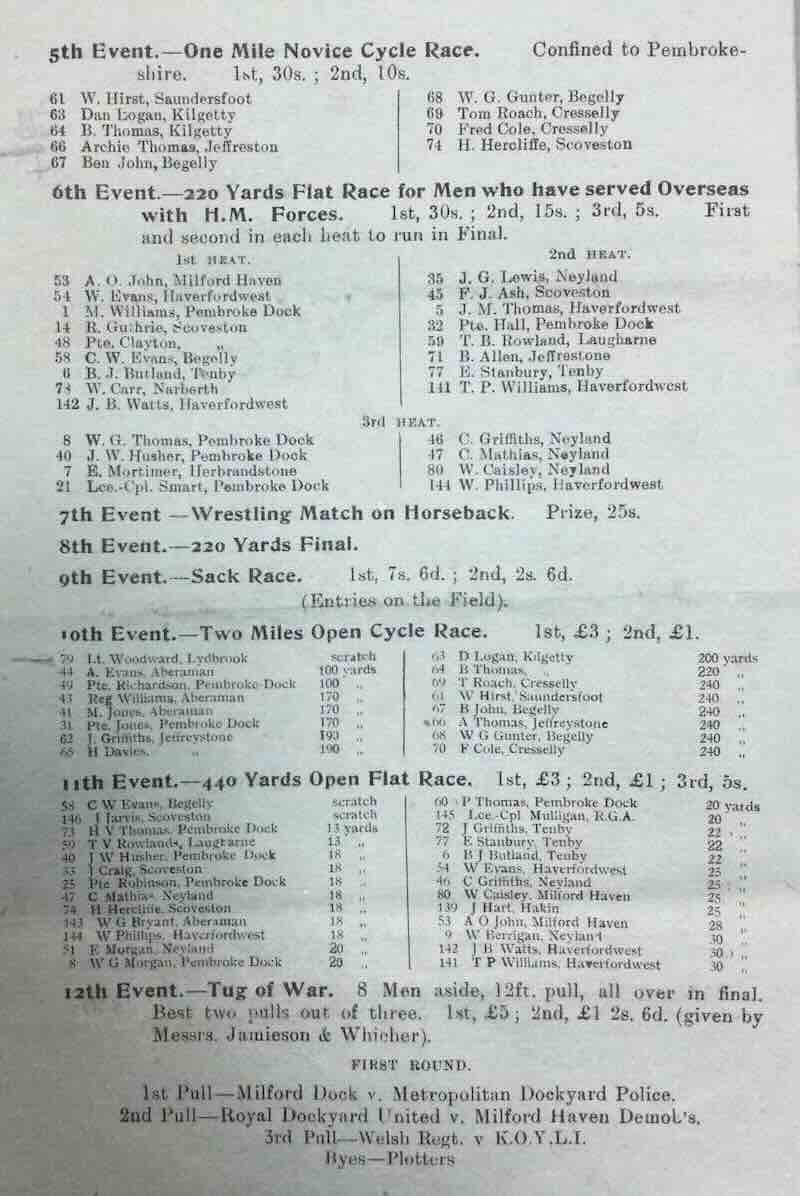
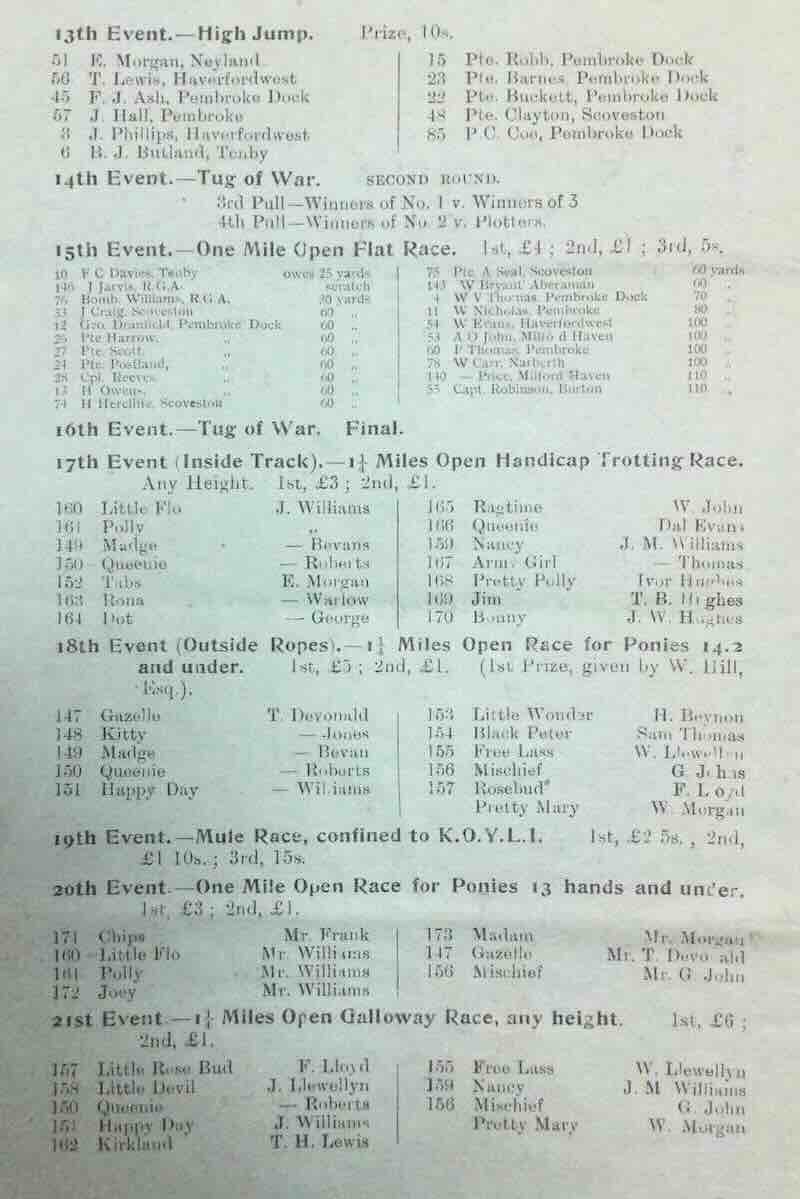
The day began at 2.30 p.m., with the Pembroke Dock Band providing music from 3 to 9 p.m. Events ranged from the 220-yard race for boys under 15, ladies’ 120-yard sprint, and mile bicycle and pony races, to the ever-popular tug of war, sack race, and military races for men who had served overseas.
Tea was served on the field, 1 s. for adults, 8 d. for children, and dancing on the green followed from 6.30 to 9 p.m. Late boats ferried revellers home across the Cleddau.
The printed order of events lists more than a hundred entrants, including:
- C. W. Evans (Begelly), E. Morgan (Neyland), W. H. Phillips (Haverfordwest) in foot races
- Freda Roberts (Neyland) and Gwen Hooper among the ladies’ sprinters
- W. O. Harries, now chairman, still competing and judging, a link between the Victorian pioneers and the new generation
Legacy
These reports and programmes reveal more than sport; they chart Neyland’s confidence as a community. In the decades following Brunel’s arrival, the town became a beacon of progress, a place where dockworkers, railwaymen, clerks, and tradesmen gathered not just for work but for shared celebration and fair play.
The Neyland Athletic Sports became an emblem of that civic pride, a day when the town’s people came together on equal footing, cheered by music and good company, beneath the summer sky of the Cleddau.
Even today, the echoes of the starter’s pistol, the umpire’s call, the referee’s whistle, and the laughter from the field seem to linger across Neyland’s Sports Field. They speak of a town that once ran, rode, and rejoiced its way into history, a community whose love of sport became part of its character. Though the bicycles and ponies have long gone, the spirit remains. On that same stretch of level ground where those men of Neyland built our town, new generations now play sports, cricket, football, and rugby, carrying forward a tradition first set in motion more than a century ago.
Sporting Names from Neyland in the reports
Here is a full extraction of names specifically associated with Neyland from all the newspaper reports and programmes in this article (1893 – 1919).
From the South Wales Daily News (15 June 1893 – 1st Annual Sports) - Neyland names mentioned:
- Mr George Pont – judge and starter (pony races)
- Mr T. W. Rowland – treasurer
- Mr J. R. George – hon. secretary
- Mr F. Hitchings – hon. secretary
- J. James, Neyland – race winner (boys’ race)
From the South Wales Daily News (19 July 1894 – 2nd Annual Sports) - Officials and competitors from Neyland:
- Mr W. O. Harries – cyclist and local competitor
- Gilbert Roberts – Neyland, winner hurdles
- W. J. Lewis – Neyland, runner in boys’ race
- C. G. Lewis – Neyland, competitor in foot races
- C. Griffiths – Neyland, competitor in later heats
- C. Mathias – Neyland, competitor in men’s races
- Lewis Bryant – Neyland, betting reference (evens against)
- W. H. Harries – Neyland, judge / starter / competitor
- J. Evans – Neyland, runner in later heat
- Lewis (Neyland) – listed in betting notes
From the 1919 Programme – “Neyland Annual Athletic Sports, Bicycle & Pony Races” (5 July 1919)
Officials and Committee Members from Neyland
- Wm. Hill Esq. – President
- W. O. Harries Esq. – Chairman (and long-standing competitor)
- Vere Rumsey Esq. – Vice-President
- F. W. Hitchings Esq. – Vice-President
- G. M. Voyle Esq., J. P. Sackville Owen Esq. – Vice-Presidents
- W. N. James Esq., J. A. Harries Esq., F. W. Merriman Esq. – Committee
- V. Llewellyn, H. Llewellyn, J. C. Valters, J. Saunders, T. Morgan, A. Richardson, J. C. Christian, W. Merry, W. Lewis, E. Morgan, Hy. Davies, S. Davies, H. Phillips, E. Siddall, J. Jenkins – Committee members (all Neyland-area)
- J. Harding – Hon. Secretary
- G. S. Harries, W. N. James, E. Morgan, H. Llewellyn, T. Brace, J. Young, W. Hooper – Judges/Starters/Handicappers (Neyland)
Competitors listed with Neyland as their town
- C. W. Evans
- E. Morgan, Neyland
- W. J. Lewis, Neyland
- C. Griffiths, Neyland
- C. Mathias, Neyland
- J. Evans, Neyland
- Freda Roberts, Neyland
- Gwen Hooper, Neyland
- Chrissie Davies, Neyland
- Mary Beer, Neyland
- Liz Voyle, Neyland
- Lily Evans, Neyland
- Florrie Davies, Neyland
- W. May, Neyland
- L. Davies, Neyland
- E. Morgan – pony owner (Pretty Polly)
- C. Griffiths – Neyland rider in cycle and flat events
From the Detailed 1919 Order of Events Sheets - Neyland competitors repeatedly appearing:
- C. W. Evans
- E. Morgans
- W. Lewis
- C. Griffiths
- C. Mathias
- J. Evans
- Freda Roberts
- Gwen Hooper
- Ruth Davies
- Mary Beer
- Liz Voyle
- Lily Evans
- Florrie Davies
- W. May
- L. Davies
Visitors from Far and Wide: Neyland’s Magnetism in the Age of the Athletic Sports (1893–1919)
From the very first Neyland Annual Athletic Sports, Bicycle & Pony Races in 1893, the town drew competitors from across Pembrokeshire and well beyond. What began as a local celebration of strength and speed quickly turned into a regional attraction, a festival that mixed railway ease with estuary spectacle.
How Far They Travelled
The names tell the story of distance.
Runners and riders came from:
- Tenby – competitors like H. Nicholls, H. V. Thomas, and B. J. Butland made the long cross-county journey of roughly 25 miles east, a full day’s trip by pony or train.
- Haverfordwest – W. H. Evans, T. P. Williams, J. M. Thomas, and W. Phillips travelled the 10-mile rail line down the Cleddau to Neyland’s quayside fields.
- Pembroke Dock – a short ferry or road hop of 3 miles across the Haven, home of the naval dockyard, which sent strong contingents of sailors and soldiers.
- Milford Haven – only 2 miles by water, but symbolically close rivals; their men competed fiercely in cycle and tug-of-war events.
- Aberaeron and Aberystwyth (Aberaman, Aberdare in later programmes) – some riders and cyclists bore addresses from the South Wales Valleys, more than 70 miles east, showing the reach of Neyland’s reputation.
- Carmarthen and Laugharne – A. T. Davies and T. B. Rowland came from 30 miles away, representing the central shires.
To a modern eye these seem modest distances, but in the 1890s a bicycle or steam train made them notable journeys. For many, it was the first glimpse of Brunel’s great western terminus.
Summary
Between 1893 and 1919, over 40 named Neyland residents appear as competitors, officials, or patrons of the Annual Athletic Sports.
- The Harries, Hitchings, James, Rumsey, and Evans families recur across generations, marking them as central figures in Neyland’s athletic and civic life.
- Women appear prominently in the 1919 Ladies’ Races, Freda Roberts, Gwen Hooper, Lily Evans, and others, showing how community sport broadened after the war.
- Continuity is striking: George Pont (1893) and W. O. Harries (1894–1919) bridge the Victorian founding era with the post-war revival.
The reach of these events turned Neyland into a yearly gathering point for the whole county. It wasn’t simply about sport; it was about pride of place. Farmers from Narberth met dockyard engineers from Pembroke Dock; soldiers from Tenby raced miners from Saundersfoot; bandmasters from Haverfordwest played side by side with local brass players.
Each summer, the sports renewed that sense of connection, proof that Neyland, once built for trains and ships, had become a place where people themselves converged.
What began as the Neyland Sports and Athletics Club has evolved, and today its legacy continues as part of the Neyland Hub Community Centre, still a place where the town comes together in the same spirit of energy and community first kindled more than a century ago.