By Carol Elliott
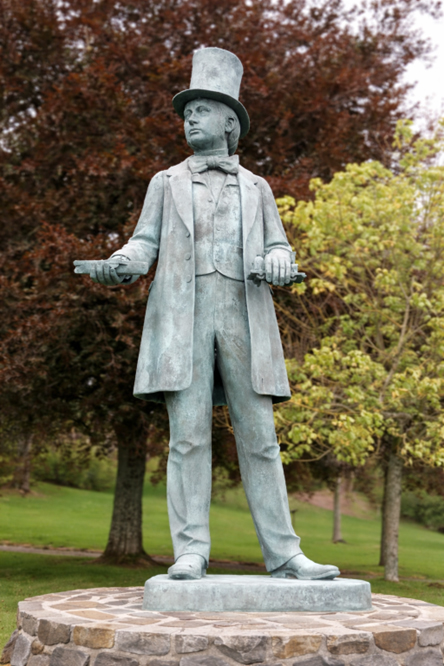
Who was Isambard Kingdom Brunel and what does he mean to Neyland?
When we speak of Neyland’s history, we often begin in 1856 with the arrival of the railway. It arrived in Neyland on April 15, 1856. Many say this was the date that Neyland was born. It was the 'Birth of Neyland Town'.
So who was this man? Isambard Kingdom Brunel was the engineer who brought the railway to Neyland, making it the western terminus of the Great Western Railway. Yet Neyland, in Brunel’s mind, was never meant to be simply the end of the line, as is written in so many history books. It was to be a gateway: a place where rail and ocean met. A point of departure to the wider world, to America and beyond.
Brunel had bold and ambitious dreams for Neyland. He saw it as part of an integrated transport system, linking London directly with America. Those dreams, however, were only partially realised, but they changed the course of this small hamlet called 'Neyland', forever.
To understand Neyland, we must first understand the man.
Brunel’s early life and family
Isambard Kingdom Brunel was born on 9 April 1806 in Portsmouth, the son of the distinguished French engineer Marc Isambard Brunel and Sophia Kingdom, an Englishwoman. From the outset, he was fascinated by engineering.
His father was engaged in advanced mechanical work at Portsmouth Dockyard, and the young Brunel was introduced early to technical thinking and practical invention working alongside his father. His education was intense: he was taught mathematics and engineering principles from a young age, and by the age of eight had already mastered Euclidean geometry.[1]
At fourteen, he was sent to France to study at the Lycée Henri IV in Paris, and later at the University of Caen, where he excelled in mathematics and science.[2]
The Thames Tunnel and early engineering formation
On returning to England, Brunel joined his father on the construction of the Thames Tunnel, the first tunnel ever driven beneath a navigable river.
Marc Isambard Brunel, as chief engineer, devised the revolutionary tunnelling shield, a cast-iron frame that protected workers from collapse while excavating beneath the riverbed. His son, Isambard Kingdom Brunel, served as resident engineer, working hands-on at the tunnel face alongside the men.[4]
On 12 January 1828, the tunnel suffered its most catastrophic flooding when water burst into the workings at around 6:30 in the morning. Brunel was at the front at the time and narrowly escaped death, making for an emergency exit that had to be broken open from the other side. Six men were killed in the disaster.[5]
Brunel himself was badly injured, suffering serious damage to his knee as well as internal injuries. He was forced to withdraw from the project to recuperate, effectively ending his direct involvement. Following this catastrophe, work on the tunnel was abandoned for several years until further funding was secured.[6]
This experience proved formative. It not only gave Brunel practical engineering experience at the highest level, but also shaped his approach to risk, scale, and innovation in all that followed.
The Great Western Railway and a new transport system
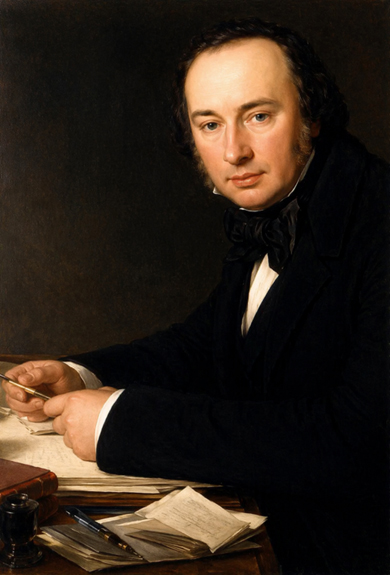
In 1833, aged just 27, Brunel was appointed chief engineer of the Great Western Railway.[7]
The railway, initially linking London with Bristol, was conceived of by Brunel as part of a wider, integrated transport network. He designed not only the route itself, but its entire infrastructure, bridges, tunnels, viaducts, and stations.
Among his most notable works was the Box Tunnel, one of the longest railway tunnels of its time.[8]
He also introduced the broad-gauge railway, designed to provide greater stability and speed. Though controversial and ultimately replaced, it demonstrated Brunel’s willingness to challenge accepted practice in pursuit of improvement.[9]
It was this railway that reached Neyland in 1856, placing the town at the western edge of Brunel’s grand design.[10]
Brunel’s vision for Neyland
Neyland was not simply an end terminus in Brunel’s thinking. It was a strategic point within a much larger system. He envisioned that it would be a direct shipping route from London to America: rail to Neyland, then steamship across the Atlantic.
In this vision, Neyland became a gateway, a place where Britain connected with the wider world. Though his full dream was never realised as intended, the arrival of the railway alone transformed the town’s development and identity and Neyland became a great railway town.
Bridges and the union of engineering and beauty
Brunel’s genius extended beyond railways. His design for the Clifton Suspension Bridge, approved in 1836, remains one of the most celebrated bridges in the world.[11]. It was designed by Brunel but completed after his death. It stands as a lasting example of his ability to unite structural innovation with architectural elegance.
Innovation at sea
Brunel also revolutionised maritime engineering. His first ship, the SS Great Britain, launched in 1843, was the first iron-hulled, screw-propelled ocean-going vessel, marking a turning point in ship design.[12]
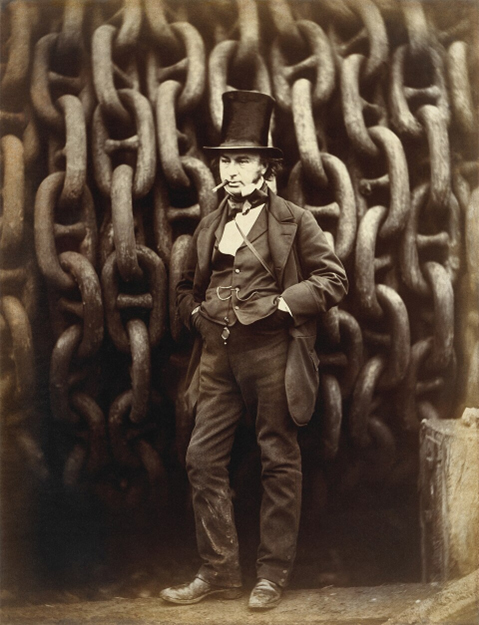
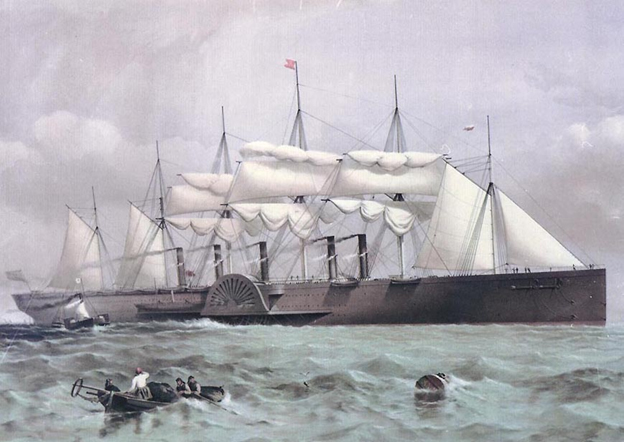
He later designed the SS Great Eastern, the largest ship of its time, an extraordinary feat of engineering that demonstrated his willingness to push beyond the limits of contemporary technology.[13] He called the SS Great Eastern his 'Babe' and envisaged that this ship would have its home port in Neyland. The SS Great Eastern did visit Neyland in 1860 and in 1862, and indeed one of our streets is named after this ship: 'Great Eastern Terrace'.
Character, struggle, and determination
Brunel’s career was defined by boldness and perseverance. A visionary of the Industrial Revolution, he worked far ahead of his time, pursuing ideas that others dismissed as impractical, yet which would later shape the modern world.
Yet his work came at a cost: he faced repeated engineering challenges, financial pressures, and declining health. Despite this, he continued to work with relentless energy.[14]
Death and legacy
Shortly after the launch of the SS Great Eastern, his 'Babe', Brunel suffered a stroke. He died on 15 September 1859, aged 53.[15]
Many of his greatest works were completed after his death. His influence, however, endured. He transformed railway engineering, bridge design, shipbuilding, and the concept of integrated transport systems. Much of what he built remains in use today.
Brunel and Neyland
For Neyland, Brunel’s importance lies not only in what he built, but in what he imagined.
He brought the railway here, but more than that, he brought a vision of Neyland as a gateway to the Atlantic world. Though his grand design was never fully realised, its impact reshaped the town. Neyland, in Brunel’s eyes, was never the end of the line.
It was the beginning.
Footnotes and Sources
[1] Rolt, L. T. C., Isambard Kingdom Brunel: A Biography (London: Longmans, 1957), pp. 9–12.
[2] Buchanan, R. A., Brunel: The Life and Times of Isambard Kingdom Brunel (London: Hambledon, 2006), pp. 18–20.
[3] Ibid., pp. 21–25.
[4] Bagust, Harold, The Greater Genius? A Biography of Marc Isambard Brunel (Stroud: Sutton, 2002), pp. 168–175.
[5] Rolt, Brunel, pp. 36–41; Brunel Museum, “Thames Tunnel History,” London.
[6] Buchanan, Brunel, pp. 32–35; Transport for London Archives, Thames Tunnel records.
[7] Simmons, Jack, The Railway in England and Wales 1830–1914 (Leicester: Leicester University Press, 1978), pp. 54–56.
[8] Rolt, Brunel, pp. 92–98.
[9] Simmons, Railway in England and Wales, pp. 102–105.
[10] MacDermot, E. T., History of the Great Western Railway, Vol. I (London: GWR, 1927), pp. 284–290.
[11] Cossons, Neil, The BP Book of Industrial Archaeology (Newton Abbot: David & Charles, 1975), pp. 112–115.
[12] Corlett, Ewan, The Iron Ship: The Story of Brunel’s SS Great Britain (London: Conway Maritime Press, 1975), pp. 23–30.
[13] Rolt, Brunel, pp. 280–300.
[14] Buchanan, Brunel, pp. 210–215.
[15] Rolt, Brunel, pp. 310–315.