By Carol Elliott
This article is based on a contemporary report published in The Pembroke County Guardian and Cardigan Reporter on 20 November 1908, which provides a detailed account of the opening of the Neyland fish market and ice factory and captures the atmosphere of the town on that remarkable day.[1]
On Monday, 20 November 1908, Neyland witnessed one of the most important and joyful days in its history. After years of uncertainty and decline following the loss of the Great Western Railway terminus and the transfer of the Irish packet steamers to Fishguard in 1906, the town gathered together to celebrate a new beginning.[2] The opening of the fish market and ice factory marked not simply the launch of an industry, but the rebirth of Neyland itself.
As reported in the newspaper, the occasion was nothing short of a town in celebration. It was described as “a red-letter day in the history of Neyland”, the moment when the town “started as a fishing port.” From early morning, crowds gathered in large numbers, and “a spirit of enthusiasm pervaded the town generally.” Houses were decorated throughout the town, bunting flew from buildings and the fishing trawlers alike, and “there was hardly a house which had not been decorated.” The harbour itself became part of the celebration, with ships dressed in flags and colours, creating what the paper described as a “festive appearance.”[1]
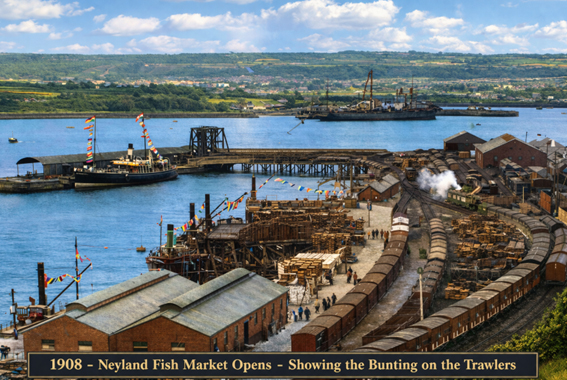
This was more than ceremony. It was a statement of intent. Neyland, which had suffered deeply after the railway focus shifted to Goodwick and Fishguard, was now determined to forge a new identity. The article acknowledged that loss directly, noting that since the transfer of the railway terminus, Neyland had shown “symptoms of incurability,” but now, with the fishing industry, “it has an industry of its own.”[1] The hope was clear. Neyland would rise again.
At the centre of this transformation stood Sir Charles Philipps of Picton Castle, described as the driving force behind the entire enterprise. It was he who had first proposed the idea of converting Neyland into a fishing port some two years earlier, and his leadership brought the scheme into reality. The newspaper recognised his role plainly, stating that he had been “the originator of the present enterprise,” one that would prove “a great boon to the district.”[1]
The new facilities themselves were impressive. An Ice Factory was opened at Barnlake Point. It was, opened by Lady Philipps, was described as “an imposing red brick structure,” capable of producing 35 tons of ice per day and storing around 500 tons. The machinery, built by Lindt Brothers of London, represented modern industrial investment brought directly to the Haven. Alongside it stood the new fish market, a purpose-built structure designed for efficiency, with covered handling areas, sorting space, and direct links to transport routes. This was not a small local venture. It was a serious and ambitious undertaking.[1]
The ceremonies began at the ice factory, where a large crowd gathered. Proceedings opened with prayer, after which Lady Philipps formally declared the factory open.
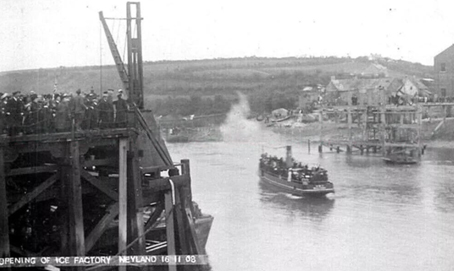
The event drew an impressive assembly of dignitaries. Among those present were Sir Charles Philipps, Lady Philipps, Mrs. Kingsford, Mr. and Mrs. Blake, Mr. J. Anthony of Tenby, Miss Hitchings of Pembroke Dock, Colonel Meyrick, Mr. Owen Griffiths, Mr. J. W. Penny, Mr. W. Williams, Captain Lloyd Philipps, Mr. W. P. Vaughan, Mr. J. Lawrence, Chairman of the Port Steam Trawling Company, along with clergy, council members, and representatives of the railway and local authorities. Their presence reflected the wider importance of the moment.[1]
A ceremonial plaque, engraved with the name of Lady Philipps and the date of the opening, was laid beside the ice factory to mark the occasion. Today, if you wander through the overgrowth at Barn Lake, near the site of the old factory, that same plaque can still be found today, quietly hidden among the undergrowth, a lasting reminder of that remarkable day.
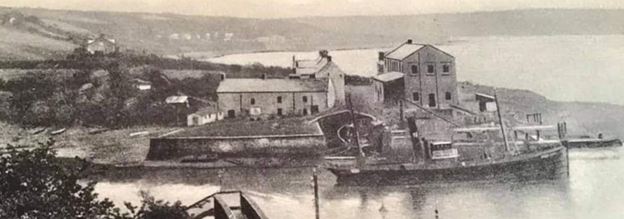
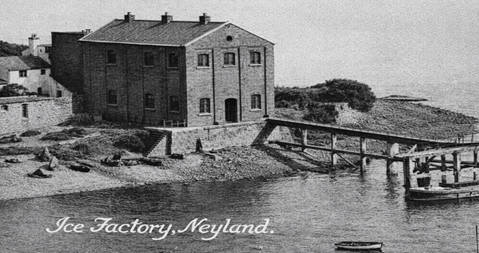
Following the opening of the ice factory, the company moved to the fish market, where further speeches were delivered. The tone was one of confidence and determination. It was made clear that Neyland was entering into direct, though friendly, competition with Milford Haven, long known as the ‘Grimsby of the West’. The article acknowledged this openly, noting that while Milford had held the title, Neyland now stood ready to challenge it, and that “any antagonism between Neyland and Milford is friendly.”[1]
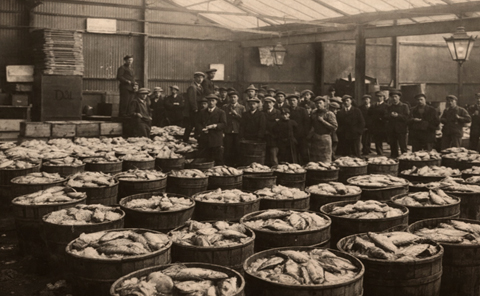
Lady Philipps spoke of the importance of the venture and expressed confidence in its success. Mrs. Kingsford also addressed the gathering, speaking warmly of the enterprise and the belief that it would benefit the town. Sir Charles Philipps, in his remarks, set out the broader vision. This was not simply about buildings or machinery, but about creating employment, securing trade, and establishing Neyland as a recognised centre of the fishing industry. The expectation was that fish landed at Neyland would supply both local demand and wider markets through efficient railway distribution.[1]
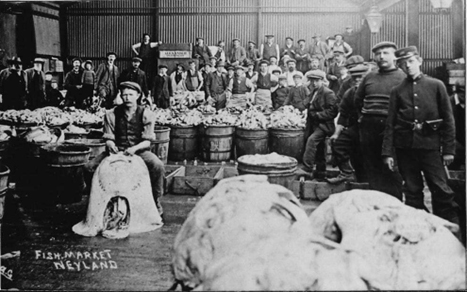
The celebrations did not end with the formal proceedings. The day was treated as a public holiday, allowing the whole community to take part. What followed was described as a carnival. There was music, dancing, and widespread public enjoyment. The town, which had endured years of economic uncertainty, embraced the moment with visible pride. The streets were filled with people, and the sense of occasion continued well into the evening.[1]
The newspaper account captures this sense of collective emotion. This was not simply the opening of new buildings. It was the restoration of confidence. Neyland, having lost its former role as the western gateway for Irish traffic, was now asserting a new identity rooted in industry and enterprise.
Looking forward, the expectations were high. With modern facilities, large-scale ice production, and established transport links, Neyland was positioned to develop into a significant fishing port for South Wales. The ability to preserve and distribute fish efficiently opened access to wider markets, and the investment signalled long-term intent.
In this light, the events of November 1908 stand as a defining moment. Faced with decline after the loss of the Irish packet service in 1906, Neyland did not retreat. Instead, it adapted, invested, and celebrated its future.
As recorded in The Pembroke County Guardian and Cardigan Reporter, this was not simply the opening of a fish market. It was the day Neyland reclaimed its place and its purpose.[1]
Footnotes
[1] The Pembroke County Guardian and Cardigan Reporter, 20 November 1908, p. 8. Contemporary report on the opening of the Neyland fish market and ice factory.
[2] Great Western Railway transfer of the Irish packet service from Neyland to Fishguard Harbour following the opening of Fishguard Harbour station, 1906. See also:
R. S. Thomas, The South Wales Railway and its Extensions, and contemporary railway reports on the development of Fishguard Harbour.