By Carol Elliott
Background: As early as the 17th century, mail was sent from Britain to the continent by ships known as packet boats. From 1660 they ran regularly from Harwich to Holland. This is because Holland was a major international trade partner for Britain. Other routes included Dover to Calais and Falmouth to Spain, Portugal and the West Indies. Both the ships and crew were contracted, not directly employed by Royal Mail. These times were often not safe to travel by sea. The packets and mail were attacked so often that there were official compensation rates for death or injury: £8 for a sailor’s arm or leg, £4 for an eye. [1]
Before railways linked towns and cities across Britain, sending a letter just on the British mainland, was nothing like it is today. There was no quick post, no overnight delivery, and no guarantee it would even arrive. A letter might pass through several hands, travel by horse over rough roads, and then wait days for a ship crossing. Bad weather could delay it for weeks. Storms could stop it completely. Sometimes, it was simply lost. And that was just within Britain.
Getting mail to Ireland was even harder. Every letter had to make a sea crossing, usually from one of a handful of coastal ports. Timing, tides, and weather all mattered. The journey depended as much on luck as planning.
This article tells the history of the 'Irish Packet Steamers'.
NOTE: An 'Irish Packet Steamer' was a ship used to carry mail between Britain and Ireland. The name comes from the 'packets' of letters and official documents kept onboard. These vessels were part of a fast, organised system linking train and sea, moving post, passengers, and goods on a fixed schedule. Often these ships were shortened to the name 'Packets'. They were built for speed, they were usually steam-powered, first with paddle wheels and later with propellers. For towns like Neyland, they were more than ships. They were a direct link between London and Ireland, and a vital part of everyday communication.
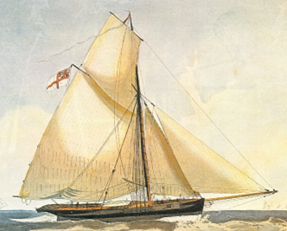
service before steam was used in 1824, they were used
alongside other sailing vessels like sloops and brigs
Long before the railway reached Neyland and the shores of the Cleddau in 1856, Pembrokeshire already occupied an important position within the communication network between Britain and Ireland and used the Irish Packet Steamers to get letters to and from Ireland. So the later development of Neyland as an 'Irish Pack Steamer Port' was not an isolated innovation but the continuation of an earlier system that had evolved over centuries. This Irish Packet Steamer system depended upon sea routes, natural harbours, and the gradual improvement of transport infrastructure, all shaped by the practical demands of moving mail, passengers, and goods across the Irish Sea.
The Irish packet service was not simply a transport link. It was a valuable and highly competitive commercial enterprise at the heart of communication between Britain and Ireland, and this trade was financially attractive. While the government contracts for carrying the mail provided a guaranteed income, the real profit lay in the additional traffic that travelled alongside it. Every sailing represented not just letters, but people, livestock, and commercial goods moving between two countries on a fixed and reliable schedule.[1] Control of a packet route brought more than income. It brought status and importance. A port handling the Irish mail became part of a national network linking London directly with Ireland.
From at least the seventeenth century, 'packet boats' were employed to carry official correspondence, government dispatches, and travellers between Britain and Ireland.[1] These vessels operated under contract and formed a crucial part of state and commercial communication. By the early nineteenth century, as trade expanded and administrative efficiency became increasingly important, efforts were made to regularise and improve these services.
A significant advance came in 1824 with the introduction of steam-powered packet vessels on the Milford Haven to Waterford route.[2] Steam propulsion transformed the nature of sea travel. Where sailing vessels had been dependent upon favourable winds, steam packets could maintain more regular schedules and reduce journey times. Crossings between Milford Haven and Waterford, a distance of approximately eighty-one nautical miles, could in favourable conditions be completed within eight to twelve hours.[3] This brought a new level of reliability to the Irish mail service and reinforced the strategic importance of Milford Haven as a western maritime gateway.
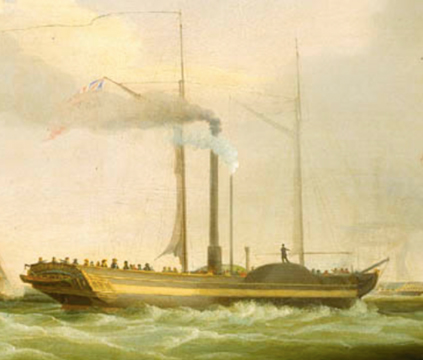
Built in 1821 as Lightning for the Post Office mail service between Holyhead and Howth, this wooden paddle steamer was part of the early steam packet network. After carrying King George IV to Ireland in 1821, she was renamed Royal Sovereign. In 1824, she was transferred to the Milford–Waterford route, bringing one of the first steam-powered mail services into the Haven.
Yet the effectiveness of the route was determined as much by its land connections as by its maritime crossing. Mail from London travelled by stagecoach across South Wales, passing through Carmarthen and Haverfordwest before reaching the Haven. Even under favourable conditions, this journey took between twenty-eight and thirty hours and required repeated changes of horses and drivers.[4] Delays caused by weather, road conditions, or logistical constraints were common. In comparison with the improving infrastructure of the Holyhead route, which would later benefit from railway development, the western approach to Milford remained slow and inefficient.
Recognising these limitations, efforts were made to improve facilities at the Pembrokeshire end of the route. Between 1829 and 1832, Hobbs Point at Pembroke Dock was developed into a dedicated packet station. Hobbs Point Pier was finished in 1832 as part of a government-sponsored scheme to develop the packet service between the Haven and southern Ireland. Mail coaches arrived daily at the 'Royal', a coaching inn close to Hobbs Point, having made the long journey from London via Gloucester. Sarah Williams, landlady of the Royal, served as Pembroke Dock’s Postmistress. The journey required frequent changes of horses and drivers, and it was reported that drivers from Pembroke Dock would travel only as far as St Clears before handing over to another driver and returning home on the next incoming coach.[5]
Hobbs Point was a significant piece of infrastructure. It allowed mail coaches to draw up directly alongside vessels, enabling the rapid transfer of mail bags, passengers, horses, and carriages. Later a hotel and stables were built at Hobbs Point to accommodate any overnight passengers and horses. For a period, Pembroke Dock became the principal southern Irish mail station for Britain, supported by the deep, sheltered waters of Milford Haven, one of the finest natural harbours in the country.
Despite these improvements, structural weaknesses in the service persisted. The vessels operating on the Milford route were often smaller and less powerful than those deployed on the rival Holyhead to Dublin route. Passenger numbers reflect this disparity. In the mid-1830s, more than 11,000 passengers annually used the Holyhead route, while only around 2,200 travelled via Milford.[6] This imbalance was not simply a matter of preference but the result of infrastructure, investment, and accessibility.
Operational difficulties were also frequent. Newspaper reports of the day and official observations tell us about delays, mechanical problems, and the limitations of the vessels themselves.[7] The Irish Sea remained an unpredictable environment, with storms, fog, and navigational hazards regularly affecting crossings. Even within Milford Haven, local conditions could present challenges. Variations in tides, the presence of mud banks near the shoreline, and the difficulty of bringing vessels close to fixed landing points meant that loading and unloading were not always straightforward. In some cases, goods and passengers required intermediate transfer, adding time and complexity to the process. These practical limitations reduced the overall efficiency of the route and undermined its competitiveness.
Nevertheless, the Milford Haven route retained clear advantages. The sea crossing to Waterford was shorter than that from Liverpool to Dublin, and in favourable conditions could be competitive in speed.[8] More importantly, Milford Haven itself offered exceptional shelter and capacity. It was a harbour capable of accommodating large numbers of vessels in safety. The difficulty lay not in the harbour but in the wider transport system, the road system that connected it to the rest of Britain. Pembrokeshire was a long way from London.
In 1837, responsibility for the Irish mail service was transferred to the Admiralty, and the Irish terminus was moved from Dunmore East to Waterford City.[9] This change formed a much broader attempt to improve coordination and operational efficiency. However, it did not alter the fundamental imbalance between the Milford and Holyhead routes. The road to Milford was still long and rough in places. Investment and political support in London increasingly favoured Holyhead, where there was better overland connections and it had more substantial vessels which created a more reliable and attractive service.
The decisive shift came in 1848, when the Post Office transferred its Irish mail contract to the Holyhead and Kingstown route.[10] The Milford to Waterford service was discontinued, bringing to an end more than two decades of sustained effort to establish a southern Irish mail station in Pembrokeshire. Pembrokeshire had lost its Irish Packet business.
Yet this was not the end of the story. The infrastructure at Pembroke Dock remained in place. The experience gained through decades of packet service was not lost. Above all, the natural advantages of Milford Haven remained unchanged. The harbour still offered deep water, shelter, and strategic positioning on the western approaches to Britain.
What had been lacking was not vision, but connectivity. Remember, there was no railway at this time.
Within a few years, that missing element would arrive. The railway would link the industrial centres of Britain directly to the shores of the Haven, transforming what had been a difficult and inefficient route into one of speed, integration, and national significance.
The arrival of the railway at Neyland in 1856 did not create the Irish packet trade. It realised it.
Neyland - A Vision for a Global Packet Port
The publication of Alfred Brett’s pamphlet in 1859 was crucial to understanding the rise of the Irish packet steamers at Neyland [11]. It is within this framework that the development of Neyland must be understood.
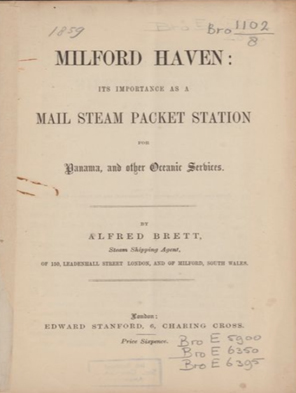
Just three years after the railway reached the shores of the Cleddau in 1856, Brett, a steam shipping agent with direct interests in Milford and the Haven, published 'Milford Haven: Its Importance as a Mail Steam Packet Station for Panama, and other Oceanic Services'. This was not a casual description of the harbour. It was a clear and deliberate argument for its future.
Brett was writing from within the industry. He recognised immediately what the arrival of the railway had changed. For the first time, Milford Haven, and in practical terms Neyland, was directly connected to London by rail. Mail, passengers, and goods could now move in a continuous journey from the capital to the quay. What had once been a remote but well-sheltered harbour had become strategically positioned within a national transport system.
This was the turning point. Before the railway, the Haven had potential. After it, that potential could be realised. Brett’s pamphlet sets out this argument with clarity, presenting Milford Haven as a deep, secure harbour capable of handling large steam vessels, but more importantly, as the western terminus of a railway that could feed directly into a maritime mail network.
Within its pages, Brett looked far beyond the Irish Sea. He argued that Milford Haven was ideally placed not only for Irish communication, but for wider oceanic services, including routes to the Caribbean and across the Isthmus of Panama to the Pacific. This was a vision of global communication, and the Haven was positioned as its starting point.
For Neyland, this context is essential. The later development of the Irish packet service was not an isolated success. It formed part of this wider moment of ambition, when the Haven was being actively promoted as a gateway for international mail and passenger traffic. The infrastructure developed at Neyland, its railway connection, quays, and packet facilities, all emerged from this same vision.
Brett’s work shows how quickly this transformation was recognised. Within a few short years of the railway’s arrival, the Haven had shifted from a place of local significance to one of national and potential international importance. The Irish packet steamers that later operated from Neyland were therefore not the beginning of the story, but one expression of a much larger idea already in motion.
It is within this framework that the rise of Neyland must be understood. The town did not simply grow because ships called there. It grew because it became part of a system that connected rail and sea, Britain and Ireland, and potentially, Britain and the wider world.
Footnotes
[1] J. C. Sainty, The English Packet Service, 1689–1850 (London: HMSO, 1957), pp. 1–12.
[2] Desmond Davies, Neyland: A Great Western Outpost (Didcot: Wild Swan Publications, 1996), p. 29.
[3] Ibid., p. 29; also contemporary packet service timings in Admiralty records.
[4] Roger S. Thomas, The South Wales Railway and its Irish Traffic (unpublished PhD thesis, University of Wales, 1971), pp. 12–15.
[5] Davies, Neyland, p. 29; also R. P. Brereton, engineering reports on Pembroke Dock improvements, c. 1830.
[6] Thomas, South Wales Railway, p. 14.
[7] Contemporary reports in Welsh and national newspapers, 1830s–1840s; see also Davies, Neyland, pp. 29–30.
[8] Davies, Neyland, p. 29.
[9] Thomas, South Wales Railway, pp. 15–16.
[10] Ibid., p. 17; Post Office records relating to the transfer of the Irish mail contract, 1848.
[11] Alfred Brett, Milford Haven: Its Importance as a Mail Steam Packet Station for Panama, and other Oceanic Services (London: Edward Stanford, 1859).