By Carol Elliott
This article draws upon the findings of the 2011 archaeological survey of St Tudwal’s Church undertaken by Caroe & Partners, together with detailed genealogical research into the Lords of Newton in Llanstadwell.
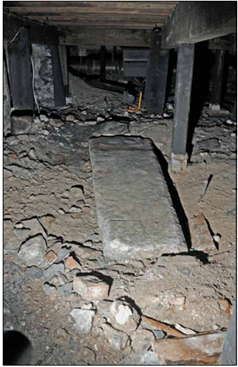
In 2011, during conservation works to the tower of St Tudwal’s Church, Llanstadwell, an important medieval monument was rediscovered beneath the church floor. Access was gained to the voids beneath the suspended floors of the nave, chancel, and north transept, allowing for the first time a detailed archaeological inspection of areas that had been sealed since the nineteenth century.[1] During this work, the remains of a badly worn tombstone effigy were found lying beneath the floor of the north transept.
This discovery forms part of a wider body of evidence which, when brought together, allows the early history of Llanstadwell and the long lost medieval manor of Newton to be understood with new clarity.
The concealment of the tomb dates from the major Victorian restoration of 1876. At that time, the internal floor levels were raised by approximately four feet and the walls of the church were heightened.[2] These works significantly altered the proportions of the building and, in doing so, sealed earlier medieval features beneath the new floor. Monuments that had once been visible were not removed but buried, preserving them in situ but removing them from view.
This tombstone effigy lay hidden as a result of this work.
The north transept in which it was found is itself a later medieval addition, constructed in the fourteenth century.[3] This phase of building is of particular significance. Across south Pembrokeshire and the wider west of England, the addition of transepts in the fourteenth century is frequently associated with the creation of private chapels for local elite families. These chapels often functioned as chantries, where masses were said for the souls of the founder and their descendants, and where members of the patron family were buried within the church.[4]
At Llanstadwell, the architectural evidence strongly supports this interpretation. Within the east wall of the north transept, below the floor level, is a plain arched recess constructed in simple rubble masonry. Although lacking decorative features, its form and dimensions clearly indicate that it was designed to house a tomb.[5] The Caroe report notes that its size is entirely suitable to accommodate the tombstone slab found beneath the floor and concludes that “it is possible that the two belonged together as the focus of a chantry chapel of c.1300–1325 for which the north transept was built”.[6]
This interpretation is further supported by the presence of a squint, or hagioscope, linking the north transept to the chancel. The report describes a “squint passage” providing a visual connection from the transept toward the altar.[7] Such features were deliberately constructed to allow those within a side chapel, this this case the north transept, to maintain sight of the high altar, particularly during the elevation of the Host at Mass. This ensured that even when worshipping in a private space, the patron family remained visually and spiritually connected to the central liturgical action of the church.
Taken together, the tomb recess and the squint demonstrate that the north transept was not a casual addition but a carefully designed chapel integrated into the religious life of the building.
Within Llanstadwell parish there was only one family of sufficient standing to commission such a structure, and they were namely the Lords of Newton. The architectural and archaeological evidence therefore strongly indicates that the transept was built as their private chapel and burial place.
Discovering the Tombstone
The tomb itself was rediscovered during the 2011 works when the floor of the north transept was opened. Beneath the surface, slightly to the south of the centre of the eastern half of the space, lay a slab of grey stone measuring approximately 1.77 metres in length and tapering toward one end.[8] Its upper surface was heavily weathered and damaged, but enough detail survived to identify it as a medieval effigy.
At its narrower end is an incised foliate terminal, from which rises the shaft of a cross. At the opposite end is the worn outline of a male head resting on a square cushion. The broad, wavy form of the hair suggests a lay figure rather than a cleric.
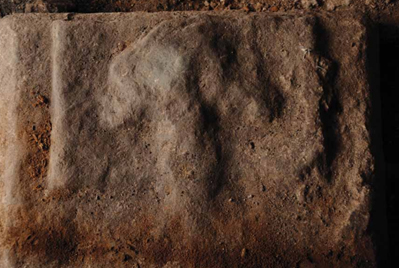
Faint traces of an arm bent at the elbow and drawn across the chest can also be detected, though much of the detail has been lost through centuries of wear.[9]
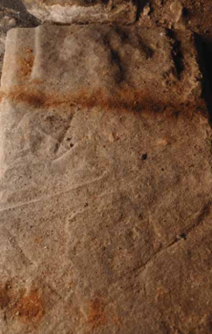
and drawn across the chest
The physical form of the slab is significant. The edges are chamfered, indicating that it was not originally set into the floor but intended to stand free within a recess.[10]
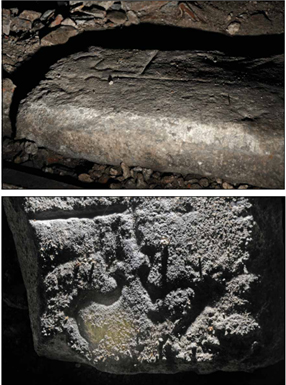
This confirms that it was once a visible and prominent monument, most likely placed within the arched recess in the north transept wall. Its position there would have been beside the altar of the chapel, reinforcing its importance within the space.
Richard Fenton in 1811
The rediscovery of the slab also confirms an earlier historical account. Writing in 1811, Richard Fenton recorded a tradition relating to a sculptured tombstone at Llanstadwell, linking the church, Newton manor, and the surrounding landscape:
“From hence the road descends to Hazelbeach, a small but convenient landing place on the Haven, much used for the shipment of culm and limestone; and not far from it stands Newton, an old mansion, once the residence of a family of some consequence in this part of the county.
The church of Llanstadwell, pleasantly situated on the margin of the Haven, is a plain structure, and contains little worthy of notice; yet I learn from the information of Mr. Child, of Newton, that in the churchyard there was a sculptured tombstone, bearing an effigy almost effaced, and almost overgrown with the turf, which was removed to make way for the interment of his uncle, Mr. Bowlas, the late proprietor of Newton; he having directed his body to be laid there, as if from tradition he had understood that this was formerly the burial place of the ancient lords of the place; for in a pedigree of that family there is mention made of one buried at Newton, meant, I presume, for Llanstadwell, that mansion and its dependencies making then the whole parish.”[11]
This passage is of exceptional importance. It records that even in the early nineteenth century, the effigy was already badly worn, consistent with its present condition. It also preserves a clear local tradition that the stone marked the burial place of the “ancient lords of the place”.
Within Llanstadwell parish, this can only refer to the Lords of Newton. This tradition is now directly supported by genealogical evidence. In the heraldic visitation material preserved in the early seventeenth-century pedigree tradition, Sir William Craddock, Lord of Newton, is explicitly recorded as “buried at Newton”, providing a rare and unambiguous statement of burial location within the family record.[41]
This confirms that members of the Newton lordship were interred within the parish and strongly supports Fenton’s account. When this genealogical evidence is considered alongside the archaeological identification of a high-status effigy within a purpose-built transept chapel of the early fourteenth century, it becomes highly probable that the monument represents one of these early Lords of Newton, and possibly Sir William Craddock himself.[14]
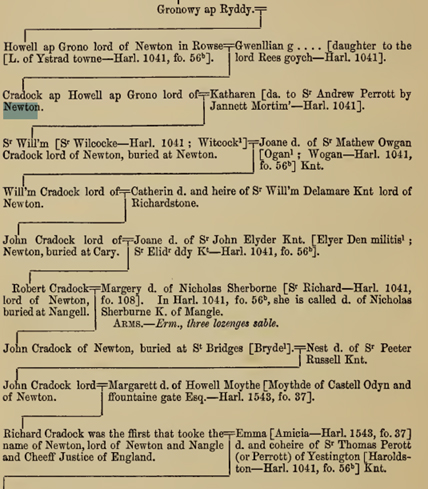
“Sr Wm Cradock lord of Newton, buried at Newton.”
The Caroe report considers it highly likely that the slab rediscovered beneath the transept floor is the same monument described by Fenton.[12] When these strands of evidence are combined, a clear sequence emerges. The effigy was originally placed within the north transept in the early fourteenth century as the burial of its patron. At some later date it was disturbed and removed to the churchyard, where it remained exposed and weathered. During the nineteenth century restoration, when the floor was raised, it was either deliberately reburied or simply covered over, remaining hidden until its rediscovery in 2011.
The significance of this monument becomes clearer when set alongside recent historical research. In tracing the lineage of Sir Richard Craddock, later known as Sir Richard Newton, born at Newton in 1370 and appointed Chief Justice of the Common Pleas in 1439, the genealogical evidence consistently pointed back to the medieval lords of Newton in Llanstadwell parish.[13] Welsh genealogical manuscripts and heraldic visitations preserve this descent, linking the later Newton family to earlier figures such as Howell ap Gronw and the Craddock line.
Seen individually, each element is important. The rediscovery of the tomb beneath the church floor, the identification of the medieval manor of Newton, and the reconstruction of the family lineage each contribute to our understanding. Taken together, they transform it.
The effigy provides a physical monument dating to around 1300 to 1325. The architecture of the transept shows that it formed part of a purpose-built chapel. Fenton preserves the tradition that it marked the burial of the ancient lords of the place. The genealogical evidence demonstrates that such a lordly family existed in the parish at precisely this period.
Because of this combined research, it is now possible to see the effigy not as an isolated fragment, but as part of a coherent historical narrative.
The archaeological evidence places the monument within a purpose-built chantry chapel of the early fourteenth century, while the architectural setting identifies it as the burial of a patron of status. The historical tradition recorded by Fenton associates the stone with the “ancient lords of the place”, and this is now directly supported by genealogical evidence. In the heraldic visitation material preserved in Harleian MS 1041, Sir William Craddock, Lord of Newton, is explicitly recorded as “buried at Newton”.[11] Taken together, this evidence strongly indicates that the effigy commemorates one of the early Lords of Newton, and it is entirely plausible that it represents Sir William Craddock himself, or a near contemporary within that line, whose descendants would include Sir Richard Craddock, later Newton, Chief Justice of the Common Pleas.
The rediscovery of the tomb, together with the identification of the medieval manor of Newton and the reconstruction of its lineage, has made this connection possible. What lay hidden beneath the church floor for more than a century can now be understood within the full context of Llanstadwell’s history. Through the combination of archaeology, architecture, and genealogical research, a monument once reduced to a worn and almost forgotten stone can now be recognised as part of the burial tradition of the Newton lordship, restoring to the parish a direct and tangible link to its medieval past.
References
[1] Caroe & Partners Architects, Llanstadwell, St Tudwal: Archaeological Survey of the Standing Fabric (2011), Introduction.
[2] Royal Commission on the Ancient and Historical Monuments of Wales, Inventory of the Ancient Monuments in Wales and Monmouthshire: Pembrokeshire (London, 1925), p.178.
[3] Caroe & Partners (2011), structural phases identifying the north transept as fourteenth century.
[4] Lloyd, Orbach and Scourfield, The Buildings of Wales: Pembrokeshire (New Haven and London, 2004), p.42; Scourfield, Pembrokeshire Churches (Logaston Press, 2002), p.598.
[5] Caroe & Partners (2011), description of tomb recess in north transept.
[6] Ibid., interpretation of slab and recess as chantry chapel c.1300–1325.
[7] Ibid., reference to “squint passage” linking transept to chancel.
[8] Ibid., description of slab beneath north transept floor.
[9] Ibid., details of effigy carving.
[10] Ibid., note on chamfered edges indicating freestanding placement.
[11] Richard Fenton, A Historical Tour through Pembrokeshire (London, 1811), p.152.
[12] Caroe & Partners (2011), discussion linking slab to Fenton’s account.
[13] Calendar of Patent Rolls, Henry VI; Edward Foss, The Judges of England, vol. 5 (London, 1848); Lewys Dwnn, Heraldic Visitations of Wales (Llanidloes, 1846).
[14] The Visitation of Gloucestershire, with pedigrees preserved in Harleian MS 1041, fol. 56b (early seventeenth century), recording “Sr Wm Cradock lord of Newton, buried at Newton.”