By Carol Elliott
Patron and Benefactor William Mordaunt, Esq. of Scoveston,
VIVAT REX · ET FLOREAT GREX
Of ancient blood derived from the Mordaunts of Norfolk, and by marriage with Anne Butler
becoming lord of Scoveston in Pembrokeshire, William Mordant, Esq., stands remembered
less for his suits and mortgages than for his pious benefaction to St Tudwal’s, where in 1684
he caused the bells to be cast and inscribed with his name, that both his loyalty to the
Crown and his care for the parish flock might sound forth in bronze for generations to come.
William Mordant of Scoveston, Esq. was of the noble line of Mordaunt of Turvey, Barons of
the Realm, and cadet of the house long seated at Massingham in Norfolk. There came into
Pembrokeshire one William Mordant, Esq., whose fortune was to wed Anne Butler, the sole
daughter and heiress of that ancient Pembrokeshire stock whose patrimony lay at
Johnston, Hayston, and Scoveston. By this match, solemnised 22 July 1656, the ancient
seat of Scoveston passed to the Mordants, and William assumed the style of lord thereof.
That he was a man active in affairs of property is amply borne out by the records of his
transactions in the local archives. Thus, we find him:
• 16 February 1658, he entered a bond of obligation at Scoveston.
• 14 May 1662 styled “of Hilton,” selling lands to John Fort of Scavington.
• 16 October 1662, he was nominated by the Earl of Carbery to the Commission of the Peace, though he declined the oath, unwilling to fetter conscience.
• 24 October 1679, he issued a bill for £13.6s.0d, a debt that would resurface in later litigation.
• 23 May 1689, he appears in the will of the Reverend William of Freystrop.
• 1689–90, he is a defendant in a case concerning £40 due upon a bond.
• 1 October 1694, he is mortgaging a large part of his estate.
• 28–29 September 1696, he is embroiled in an award over Saundersland in Steynton parish, and again granted a mortgage of his estate.
• 1697, he seized cattle at Rock in Llanstadwell, the lawful distress of a landlord.
• 1698–99, again we see him before the courts.
• 1 October 1700, he secured an assignment of mortgage.
• before 19 May 1722, his death occurred, for on that date his widow Anne appears in deeds as such.
Such entries reveal him a man much engaged in the commerce of land, debt, and security,
the usual economy of the country gentleman of that age, whose estates were rich in acres
but poor in coin.
Yet his greatest memorial is not to be found in the dusty schedules of Chancery and
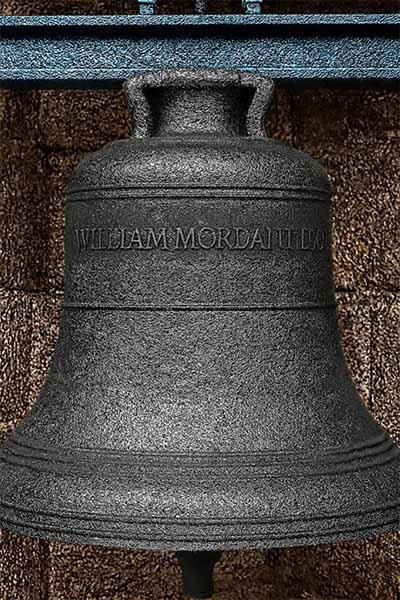
archives, but in the tower of St Tudwal’s Church in Llanstadwell. In the year 1684, as patron
and benefactor, he provided for the casting of a peal of bells, upon which his name was
struck in perpetuity:
“WILLIAM MORDANT ESQ : RICHARD SWAYNE VICAR : TP : IC : 1684 : WC : TC”
The inscription on the two bells names not only himself, but also Richard Swayne, the vicar
then incumbent, and the two churchwardens of the parish. The mysterious marks “WC”
and “TC” are the initials of the Covey brothers, William and Thomas, itinerant bellfounders
of the later seventeenth century. These men carried their craft from shire to shire, and are
known elsewhere in Wales, notably at Llanfihangel-y-Creuddyn, where their names and
mottoes appear in identical fashion.
Another legend upon one of the bells proclaims:
“1684 · VIVAT REX ET FLOREAT GREX.”
That is: “Long live the King, and may the flock flourish.” In this loyal proclamation, we see
the temper of the age: the Restoration gentry affirming allegiance to Charles II upon his
throne, while praying also for the prosperity of their parishioners, the “flock” under the
pastoral care of the vicar.
The Bells of St Tudwal's Church
The manner in which these bells were cast is worth noting. The Covey brothers, William and
Thomas, were itinerant bellfounders working in Wales during the late seventeenth century.
Their initials, “WC” for William Covey and “TC” for Thomas Covey, appear alongside the
names of patrons and vicars on several church bells of this period, including those at
Llanstadwell and elsewhere in Pembrokeshire and Cardiganshire. They were known for
casting bells “in situ”, that is, not in a permanent foundry, but on the very site where the
bells were to be hung. This practice avoided the enormous cost and risk of transporting
heavy bells over poor roads and rough ground.
The method was both ingenious and traditional. First, a pit was dug in the churchyard
beside the tower. Over it the founders built a furnace of clay and brick, where the bell-
metal, an alloy of four parts copper to one part tin, would be melted. Into the pit they
prepared a mould of loam and wax, forming a temporary “false bell” in wax around which
the loam casing was shaped.
At this stage the inscriptions were created: the founders pressed letter-stamps into the wax
surface, so that the names of the benefactor (William Mordant Esq.), the vicar (Richard
Swayne), the wardens, the loyal motto (VIVAT REX ET FLOREAT GREX), and their own initials (WC and TC) were all set in bold relief. When the mould was complete, a clay cope was
placed over it and the whole assembly heated, melting the wax away and leaving a hollow
cavity bearing the lettering in negative.
Into this cavity the founders poured the molten bell-metal, glowing at over 1,000°C, filling
every channel and letter. When cooled and broken out of its mould, the new bell emerged
with the inscriptions and ornaments standing proud in bronze, fixed for eternity.
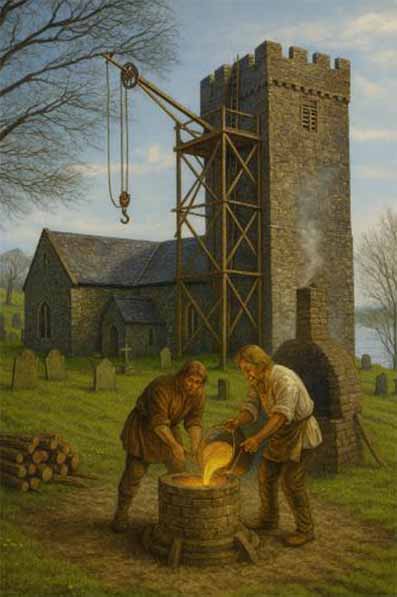
Finally, the bell had to be raised to the belfry. This was never attempted through the tight
spiral stair, but by means of scaffolding and tackle erected against the tower. The bell was
hoisted laboriously, inch by inch, until it could be brought through the belfry opening and
set upon its timber frame, where it has remained ever since, a permanent voice for church
and parish.
William Mordant lived at Scoveston in the Parish of Llanstadwell in the 1600s. He was a
country squire of ancient blood, enriched by marriage with a Pembrokeshire seat. Though
he declined the oath of a magistrate, he did not decline his duty as a Christian patron.
As benefactor of the bells of St Tudwal’s in 1684 in the Parish of Llanstadwell, he revealed
himself a man of piety and conviction, loyal to both king and parish. His life, though marked
by the usual burdens of debt and estate, is ennobled by his steadfast conscience and
enduring gift: the bells that still carry his name each time they ring out across the Cleddau.
Copyright © 2025 Contributor: Carol Elliott, Llanstadwell