By Nicola Morgan
Preface
The day that my mum and I happened upon Hephzibah Chapel during our week’s holiday on Neyland Marina during the summer of 2002 proved to be both the end of one story, and also the beginning of another. The chapel itself seemed to be locked up, but I could hear a considerable buzzing noise coming from the rear of the building so I followed my nose and found the lovely Jimmy Button, busy strimming away at the waist-high grass, weeds and brambles in the old graveyard.
“Who are you looking for?” he asked.
“Howells, Cummings and Biddlecombe.” I replied.
“Ah! I think I’ve just cleared them!”
And so he had. There, standing proudly among the chaos of undergrowth around them were three distinct gravestones standing side by side. In the middle was that of William and Mary Howell, to the left was that of Edmund and Elizabeth Biddlecombe, and to the right stood that of James and Martha Cummings.
I went straight back to fetch mum from the car (waiting while she changed into her ‘graveyard shoes’ which she always kept in the boot when out with me!) and we walked back to where her great grandparents and her great, great grandparents lay.
What a moment for us both.
For my mum it was an emotional moment which perfectly marked the affection that she (and more especially her father Herbert Cummings) had felt for the family in Pembrokeshire she had known throughout her life. Even though our small branch of the Cummings family had established itself firmly in Cardiff, our ties to Neyland and to Cosheston had always remained unbreakable. And so we had an opportunity at last to pay our respects to some of our Pembrokeshire forebears, and put some flowers on their graves. I remember wondering what they would have made of our visit, some 150 years after their deaths.
Sadly my mum passed away the following year, but that week in Neyland was very special for us both, and for me it sparked another burst of energetic genealogical research which has brought me here, to the Neyland Heritage Project.
Author: Nicci Morgan
This article forms part of an ongoing series researching the Howells family
of Great Honeyborough and their role in the development of Llanstadwell and Neyland.
The Howells Family of Great Honeyborough
Part 1: William Howell(s) (1800–1865)
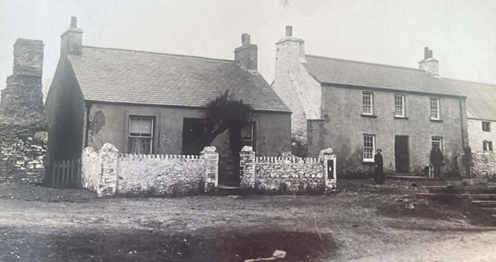
How William Howell(s) came to meet his future wife Mary Evans remains unknown. The available evidence suggests that they were born some distance apart, William in Narberth and Mary in Nolton, approximately eighteen miles away. No surviving records describe their meeting, but it is reasonable to suppose that they may have encountered one another at a regional market such as Haverfordwest, or after independently moving into the Llanstadwell area in search of employment during the 1820s.
What is certain is that, from relatively modest beginnings, William and Mary established a substantial family whose later generations would become closely connected with the development of Great Honeyborough and its surrounding communities.
According to the 1861 census, William Howell was born around 1800 in Narberth. Despite extensive searches of the Anglican parish registers for Narberth, no baptism has yet been identified that can be securely attributed to him. It has not been possible to establish a definite connection with William Howell, a butcher of Sheep Street, Narberth, recorded aged 72 in 1861, although a familial relationship such as cousin or nephew remains plausible. This line of enquiry requires further research [1].
Mary Howell, née Evans, presents a clearer documentary record. She was baptised at Nolton on 5 March 1793, the daughter of Thomas Evans and Mary Griffiths. Her parents had married in the same parish on 26 December 1784, and Mary appears to have been their third child, following John, baptised 22 November 1785, and Thomas, baptised 19 June 1787 [2].
William Howell and Mary Evans were married by banns at Llanstadwell Parish Church on 20 June 1826. Both are recorded in the parish register as being of full age and of the parish, suggesting that they had already established residence locally prior to their marriage. Notably, both were able to sign their names, indicating a degree of literacy. The witnesses were John Bowen, Sarah Bowen and Jane Evans [3].
Following their marriage, the couple settled in Llanstadwell, almost certainly at Great Honeyborough, from an early stage. They had five children, all baptised in Llanstadwell Parish Church: Thomas (1827), Elizabeth Evans (1828), Jane (1830), Martha (1833) and Eliza (1835) [4].
By the time of the 1841 census, the family were living at Great Honeyborough. William, aged 40, is recorded as a blacksmith, with Mary aged 45, and two children, Thomas aged 14 and Martha aged 7, residing in the household. Their immediate neighbours included Elizabeth James and her family, established farmers in the Honeyborough Green area. This suggests that the Howells family were living in close proximity to the agricultural centre of the settlement, likely on or near Honeyborough Green itself. William’s occupation as a blacksmith would have been of central importance within such a rural community, and contemporary evidence indicates the presence of at least one smithy in the area at that time [5].
Three of the daughters are absent from the 1841 household. Elizabeth, Jane, and Eliza appear to have been boarding with a schoolmistress, Jane Roberts, in Pembroke Dock. Whether this arrangement was for educational purposes or domestic employment is unclear, and no further detail is provided in the census record [6].
By 1851, William Howell had significantly advanced his position. The census records him as a farmer of 90 acres, employing two servants, Josiah Griffiths and William Vaughan, both resident within the household. Also present were daughters Elizabeth, now aged 22 and working as a dressmaker, Martha aged 17, and Eliza aged 16. By this date, Thomas and Jane had left the family home [7].
Electoral registers for the period 1859 to 1863 show William Howell qualifying to vote by virtue of land occupation at an annual value of 50 shillings in Great Honeyborough, indicating a recognised status as a property holder within the parish [8].
The 1861 census provides the fullest account of the household. William, aged 61, is described as a farmer of 60 acres, while Mary, aged 68, remains with him. Two unmarried daughters, Martha and Eliza, both dressmakers, are still living at home. Also present is a young servant, William Poyntz, aged 14, specifically described as a cowherd. This detail is particularly significant in identifying the operation as a working dairy farm, almost certainly centred on the property now known as The Old Dairy on Honeyborough Green [9].
The presence of the Poyntz family nearby further reinforces the agricultural context of the household, suggesting a network of local labour supporting the farm.
A notable addition to the neighbourhood in 1861 is James Cummings, a 24-year-old railway porter born in Gloucester. His occupation indicates employment at the recently established railway terminus at Neyland, opened in 1856. Later that same year, he married Martha Howell, thereby linking the family directly to the emerging railway community [10].
Mary Howell died on 30 September 1862 at the age of 69. Her death was registered by Levi Reynolds, who was present at the time. The cause of death is recorded as “natural decay”, a term commonly used in the nineteenth century to denote death from natural causes rather than accident or violence [11].
William Howell survived his wife by less than three years, dying on 3 August 1865 aged 65 from cardiac pneumonia. His death was registered by his son-in-law James Cummings. His will, made on the day of his death and proved on 2 August 1866, reveals a man of some property and standing within the community [12].
He left personal effects valued at £300, a substantial sum at the time, to be divided equally among his children. More significantly, he bequeathed three cottages in Great Honeyborough. The upper cottage was left to Eliza Hall, the middle cottage to Jane Howell, and the lower cottage to Martha Cummings. These properties are most likely identifiable with the present-day cottages at 3, 5 and 7 Honeyborough Green, although precise attribution remains uncertain [13].
It is notable that his son Thomas and eldest daughter Elizabeth did not receive property. This may indicate that both were already financially established, Thomas as a shipwright at Cosheston and Elizabeth through her marriage to Edmund Biddlecombe, also a shipwright [14].
William and Mary Howell are buried at Hephzibah Chapel, Little Honeyborough. Their shared gravestone, recorded in 2002, stands alongside those of two of their daughters. The inscription reads:
Mary Howell died 30 September 1862 aged 69 wife
William Howell died 3 August 1865 aged 65 husband
With the deaths of William and Mary, the first generation of the Howells family at Great Honeyborough comes to a close. The subsequent histories of their children Thomas, Elizabeth, Jane, Martha and Eliza will be explored in the next part of this series.
Sources
[1] 1861 Census of England and Wales, Narberth; parish register searches, Narberth (NLW / parish collections)
[2] Nolton Parish Registers, baptisms and marriages, 1784–1793
[3] Llanstadwell Parish Register, marriage entry, 20 June 1826
[4] Llanstadwell Parish Registers, baptisms 1827–1835
[5] 1841 Census, Great Honeyborough, Llanstadwell Parish
[6] 1841 Census, Pembroke Dock, household of Jane Roberts
[7] 1851 Census, Llanstadwell Parish
[8] Electoral Registers, 1859–1863, Llanstadwell
[9] 1861 Census, Honeyborough, Llanstadwell Parish
[10] 1861 Census; railway context, Neyland terminus (opened 1856)
[11] General Register Office Death Index and Certificate, Mary Howell, 1862
[12] General Register Office Death Index, William Howell, 1865; Probate Calendar, 1866
[13] Will of William Howell, proved 1866
[14] Occupational records and census returns, Cosheston and Pembroke St Mary
Author: Nicci Morgan